. 2009 Mar;77(3):1112-20.
doi: 10.1128/IAI.01280-08. Epub 2008 Dec 29.

Phosphoethanolamine substitution of lipid A and resistance of Neisseria gonorrhoeae to cationic antimicrobial peptides and complement-mediated killing by normal human serum

Affiliations

Phosphoethanolamine substitution of lipid A and resistance of Neisseria gonorrhoeae to cationic antimicrobial peptides and complement-mediated killing by normal human serum

Lisa A Lewis et al. Infect Immun. 2009 Mar.

Abstract

The capacity of Neisseria gonorrhoeae to cause disseminated gonococcal infection requires that such strains resist the bactericidal action of normal human serum. The bactericidal action of normal human serum against N. gonorrhoeae is mediated by the classical complement pathway through an antibody-dependent mechanism. The mechanism(s) by which certain strains of gonococci resist normal human serum is not fully understood, but alterations in lipooligosaccharide structure can affect such resistance. During an investigation of the biological significance of phosphoethanolamine extensions from lipooligosaccharide, we found that phosphoethanolamine substitutions from the heptose II group of the lipooligosaccharide beta-chain did not impact levels of gonococcal (strain FA19) resistance to normal human serum or polymyxin B. However, loss of phosphoethanolamine substitution from the lipid A component of lipooligosaccharide, due to insertional inactivation of lptA, resulted in increased gonococcal susceptibility to polymyxin B, as reported previously for Neisseria meningitidis. In contrast to previous reports with N. meningitidis, loss of phosphoethanolamine attached to lipid A rendered strain FA19 susceptible to complement killing. Serum killing of the lptA mutant occurred through the classical complement pathway. Both serum and polymyxin B resistance as well as phosphoethanolamine decoration of lipid A were restored in the lptA-null mutant by complementation with wild-type lptA. Our results support a role for lipid A phosphoethanolamine substitutions in resistance of this strict human pathogen to innate host defenses.


Figures
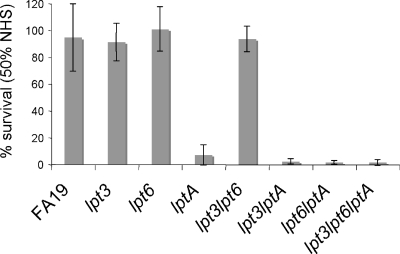
FIG. 1.
FIG. 1.
NHS susceptibility of 4′-PEA-deficient gonococcal strains. Serum bactericidal assays were performed using the wt strain FA19 and FA19 mutant strains that lack PEA substitutions (the lpt3 strain lacks 3-PEA from HepII, the lpt6 strain lacks 6-PEA from HepII, and the lptA strain lacks PEA attached to lipid A) using 50% (vol/vol) NHS. Values represent the average percent survival calculated from three or more independent experiments.
FIG. 2.
FIG. 2.
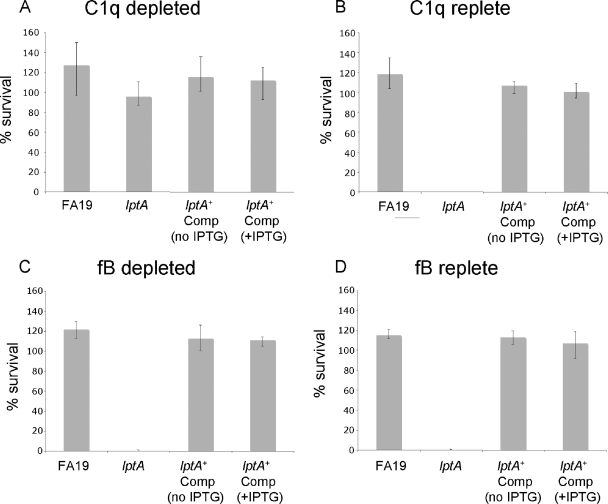
The CCP (but not the ACP) is required for serum killing of the lptA::spc mutant. Serum bactericidal assays were performed using FA19, its lptA mutant (lptA::spc; labeled lptA), and the complemented lptA mutant (lptA::spc lptA+; labeled lptA+ Comp) using 20% (vol/vol) C1q-depleted (C1q) NHS without CCP and MBL-deficient (A) or factor B-depleted (fB) NHS that was ACP deficient (C). In control assays CCP activity was restored to C1q serum by the addition of purified C1q (final concentration of 100 μg/ml) (B), and ACP activity was restored to fB sera by the addition of fB (final concentration of 200 μg/ml) (D). Values represent the average percent survival calculated from three or more independently performed experiments. Where indicated, the assay was performed in the presence or absence of 1 mM IPTG.
FIG. 3.
FIG. 3.
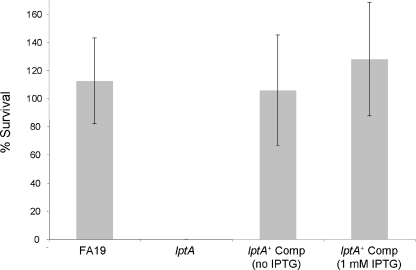
Complementation of the lptA::spc mutant restores NHS resistance. Serum bactericidal assays were performed using FA19, its lptA mutant (lptA::spc; labeled lptA), and the complemented lptA mutant (lptA::spc lptA+; labeled lptA+ Comp) using 50% (vol/vol) NHS. Values represent the average percent survival calculated from three or more independent experiments. Where indicated, the assay was performed in the presence or absence of 1 mM IPTG.
FIG. 4.
FIG. 4.
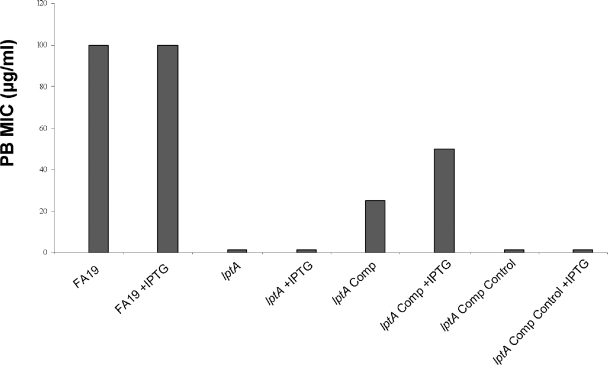
PB susceptibility (PB MIC) of gonococcal strains expressing lptA. PB susceptibility was determined by the method of Tzeng et al. (49) using wt strain FA19, its lptA::spc mutant (labeled lptA), the lptA+ complemented derivative (labeled lptA Comp), and the complemented control (labeled Comp Control), which lacks the ectopically expressed lptA gene but contains the NICS sequence from pGCC4 (see Materials and Methods). The assay was performed in the presence or absence of 1 mM IPTG, and the results are representative of two independent experiments.
FIG. 5.
FIG. 5.
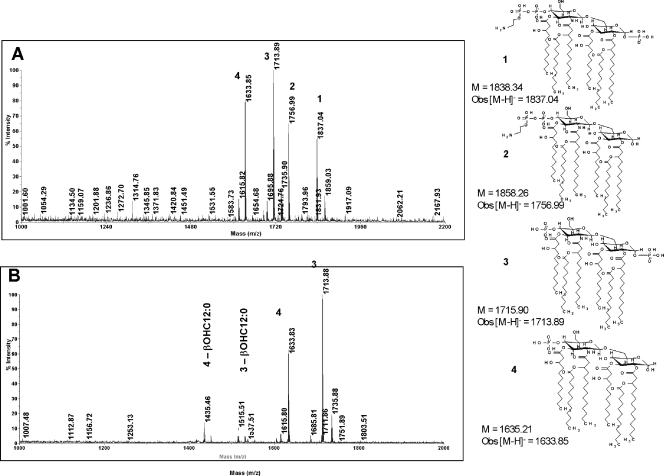
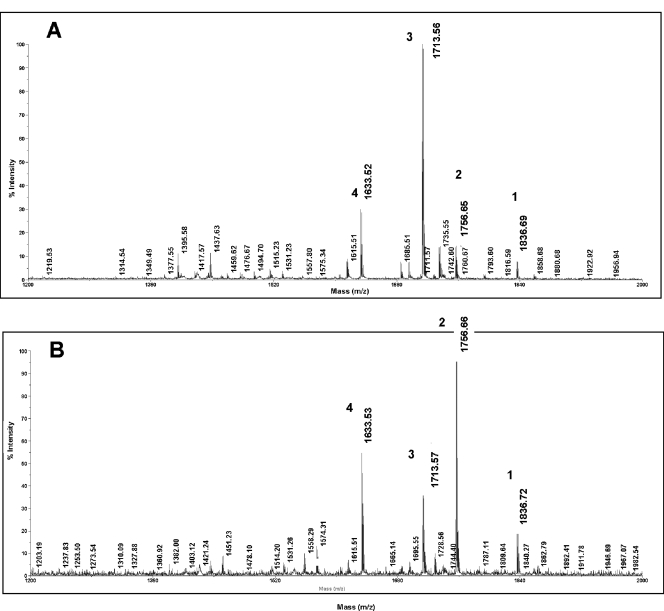
MALDI-TOF MS spectra for gonococcal lipid A. Shown are the data for the lipid A from parent strain FA19 (A) and transformant strain FA19 lptA::spc (B). The lipid A structures that are consistent with the [M-H] ions observed in the MALDI-TOF MS spectra are also shown in this figure. The calculated molecular weights for the structures (M) are given along with the observed [M-H] ion for the lipid A from FA19 (wt); the single-digit numbers above ion peaks refer to structures shown to the right of panels A and B. Obs, observed.
FIG. 6.
FIG. 6.
Complementation of lptA::spc restores 4-PEA substitution of lipid A. Lipid A was purified from complemented strain FA19 lptA::spc lptA+ grown in the absence (A) or presence (B) of 1 mM IPTG. Shown are the MALDI-TOF MS spectra for the lipid A species. Note that for the lipid A prepared from gonococci grown in the presence of IPTG, the levels of the two major PEA-containing species, with [M-H] ions of m/z 1,836.72 and 1,756.66, are elevated compared to the species in the same strain grown in the absence of IPTG. The single-digit numbers above ion peaks refer to structures shown in Fig. 5B.

References

    1. Apicella, M. A., M. Shero, G. A. Jarvis, J. M. Griffiss, R. E. Mandrell, and H. Schneider. 1987. Phenotypic variation in epitope expression of the Neisseria gonorrhoeae lipooligosaccharide. Infect. Immun. 551755-1761. - PMC - PubMed
    1. Banerjee, A., R. Wang, S. N. Uljon, P. A. Rice, E. C. Gotschlich, and D. C. Stein. 1998. Identification of the gene (lgtG) encoding the lipooligosaccharide beta chain synthesizing glucosyl transferase from Neisseria gonorrhoeae. Proc. Natl. Acad. Sci. USA 9510872-10877. - PMC - PubMed
    1. Burch, C. L., R. J. Danaher, and D. C. Stein. 1997. Antigenic variation in Neisseria gonorrhoeae: production of multiple lipooligosaccharides. J. Bacteriol. 179982-986. - PMC - PubMed
    1. Cannon, J. G., T. J. Lee, L. F. Guymon, and P. F. Sparling. 1981. Genetics of serum resistance in Neisseria gonorrhoeae: the sac-1 genetic locus. Infect. Immun. 32547-552. - PMC - PubMed
    1. Caroff, M., A. Tacken, and L. Szabo. 1988. Detergent-accelerated hydrolysis of bacterial endotoxins and determination of the anomeric configuration of the glycosyl phosphate present in the “isolated lipid A” fragment of the Bordetella pertussis endotoxin. Carbohydr. Res. 175273-282. - PubMed

Publication types

MeSH terms

LinkOut - more resources