


Association analyses of the interaction between the ADSS and ATM genes with schizophrenia in a Chinese population
- PMID: 19115993
- PMCID: PMC2654671
- DOI: 10.1186/1471-2350-9-119
Association analyses of the interaction between the ADSS and ATM genes with schizophrenia in a Chinese population
Abstract
Background: The blood-derived RNA levels of the adenylosuccinate synthase (ADSS) and ataxia telangiectasia mutated (ATM) genes were found to be down- and up-regulated, respectively, in schizophrenics compared with controls, and ADSS and ATM were among eight biomarker genes to discriminate schizophrenics from normal controls. ADSS catalyzes the first committed step of AMP synthesis, while ATM kinase serves as a key signal transducer in the DNA double-strand breaks response pathway. It remains unclear whether these changes result from mutations or polymorphisms in the two genes.
Methods: Six SNPs in the ADSS gene and three SNPs in the ATM gene in a Chinese population of 488 schizophrenics and 516 controls were genotyped to examine their association with schizophrenia (SZ). Genotyping was performed using the Sequenom platform.
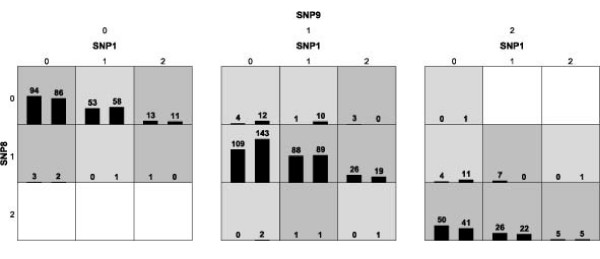
Results: There was no significant difference in the genotype, allele, or haplotype distributions of the nine SNPs between cases and controls. Using the Multifactor Dimensionality Reduction (MDR) method, we found that the interactions among rs3102460 in the ADSS gene and rs227061 and rs664143 in the ATM gene revealed a significant association with SZ. This model held a maximum testing accuracy of 60.4% and a maximum cross-validation consistency of 10 out of 10.
Conclusion: These findings suggest that the combined effects of the polymorphisms in the ADSS and ATM genes may confer susceptibility to the development of SZ in a Chinese population.
Figures
References
-
- Nishimura Y, Martin CL, Vazquez-Lopez A, Spence SJ, Alvarez-Retuerto AI, Sigman M, Steindler C, Pellegrini S, Schanen NC, Warren ST, Geschwind DH. Genome-wide expression profiling of lymphoblastoid cell lines distinguishes different forms of autism and reveals shared pathways. Hum Mol Genet. 2007;16:1682–1698. doi: 10.1093/hmg/ddm116. - DOI - PubMed
-
- Tsuang MT, Nossova N, Yager T, Tsuang MM, Guo SC, Shyu KG, Glatt SJ, Liew CC. Assessing the validity of blood-based gene expression profiles for the classification of schizophrenia and bipolar disorder: a preliminary report. Am J Med Genet B Neuropsychiatr Genet. 2005;133B:1–5. doi: 10.1002/ajmg.b.30161. - DOI - PubMed
MeSH terms
Substances
LinkOut - more resources
Full Text Sources
Medical
Research Materials
Miscellaneous
