


Vitamins C and E and beta carotene supplementation and cancer risk: a randomized controlled trial
- PMID: 19116389
- PMCID: PMC2615459
- DOI: 10.1093/jnci/djn438
Vitamins C and E and beta carotene supplementation and cancer risk: a randomized controlled trial
Abstract
Background: Observational studies suggested that a diet high in fruits and vegetables, both of which are rich with antioxidants, may prevent cancer development. However, findings from randomized trials of the association between antioxidant use and cancer risk have been mostly negative.
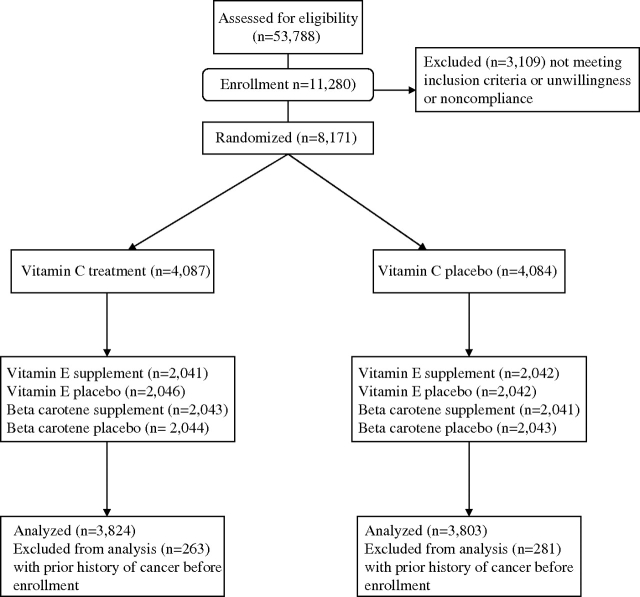
Methods: From 8171 women who were randomly assigned in the Women's Antioxidant Cardiovascular Study, a double-blind, placebo-controlled 2 x 2 x 2 factorial trial of vitamin C (500 mg of ascorbic acid daily), natural-source vitamin E (600 IU of alpha-tocopherol every other day), and beta carotene (50 mg every other day), 7627 women who were free of cancer before random assignment were selected for this study. Diagnoses and deaths from cancer at a specific site were confirmed by use of hospital reports and the National Death Index. Cox proportional hazards regression models were used to assess hazard ratios (represented as relative risks [RRs]) of common cancers associated with use of antioxidants, either individually or in combination. Subgroup analyses were conducted to determine if duration of use modified the association of supplement use with cancer risk. All statistical tests were two-sided.
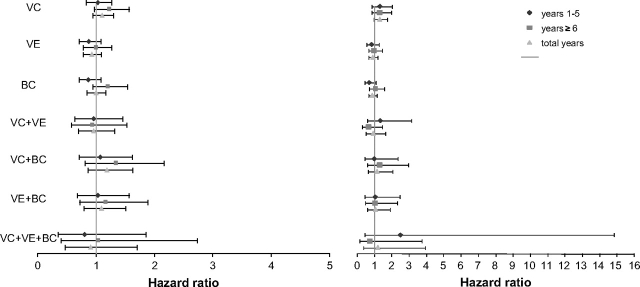
Results: During an average 9.4 years of treatment, 624 women developed incident invasive cancer and 176 women died from cancer. There were no statistically significant effects of use of any antioxidant on total cancer incidence. Compared with the placebo group, the RRs were 1.11 (95% confidence interval [CI] = 0.95 to 1.30) in the vitamin C group, 0.93 (95% CI = 0.79 to 1.09) in the vitamin E group, and 1.00 (95% CI = 0.85 to 1.17) in the beta carotene group. Similarly, no effects of these antioxidants were observed on cancer mortality. Compared with the placebo group, the RRs were 1.28 (95% CI = 0.95 to 1.73) in the vitamin C group, 0.87 (95% CI = 0.65 to 1.17) in the vitamin E group, and 0.84 (95% CI = 0.62 to 1.13) in the beta carotene group. Duration and combined use of the three antioxidants also had no effect on cancer incidence and cancer death.
Conclusions: Supplementation with vitamin C, vitamin E, or beta carotene offers no overall benefits in the primary prevention of total cancer incidence or cancer mortality.
Figures
Comment in
-
Vitamin supplements and cancer prevention: where do randomized controlled trials stand?J Natl Cancer Inst. 2009 Jan 7;101(1):2-4. doi: 10.1093/jnci/djn453. Epub 2008 Dec 30. J Natl Cancer Inst. 2009. PMID: 19116387 No abstract available.
References
-
- Weisburger JH. Nutritional approach to cancer prevention with emphasis on vitamins, antioxidants, and carotenoids. Am J Clin Nutr. 1991;53(suppl 1):226S–237S. - PubMed
-
- van Poppel G. Epidemiological evidence for beta-carotene in prevention of cancer and cardiovascular disease. Eur J Clin Nutr. 1996;50(suppl 3):S57–S61. - PubMed
-
- La Vecchia C, Altieri A, Tavani A. Vegetables, fruit, antioxidants and cancer: a review of Italian studies. Eur J Nutr. 2001;40(6):261–267. - PubMed
-
- Genkinger JM, Platz EA, Hoffman SC, Comstock GW, Helzlsouer KJ. Fruit, vegetable, and antioxidant intake and all-cause, cancer, and cardiovascular disease mortality in a community-dwelling population in Washington County, Maryland. Am J Epidemiol. 2004;160(12):1223–1233. - PubMed
-
- Lunet N, Valbuena C, Vieira AL, et al. Fruit and vegetable consumption and gastric cancer by location and histological type: case-control and meta-analysis. Eur J Cancer Prev. 2007;16(4):312–327. - PubMed
