Review
. 2009 Feb;7(2):129-43.
doi: 10.1038/nrmicro1949. Epub 2008 Dec 31.

Reconstruction of biochemical networks in microorganisms

Affiliations
Review

Reconstruction of biochemical networks in microorganisms

Adam M Feist et al. Nat Rev Microbiol. 2009 Feb.

Abstract

Systems analysis of metabolic and growth functions in microbial organisms is rapidly developing and maturing. Such studies are enabled by reconstruction, at the genomic scale, of the biochemical reaction networks that underlie cellular processes. The network reconstruction process is organism specific and is based on an annotated genome sequence, high-throughput network-wide data sets and bibliomic data on the detailed properties of individual network components. Here we describe the process that is currently used to achieve comprehensive network reconstructions and discuss how these reconstructions are curated and validated. This review should aid the growing number of researchers who are carrying out reconstructions for particular target organisms.


Figures
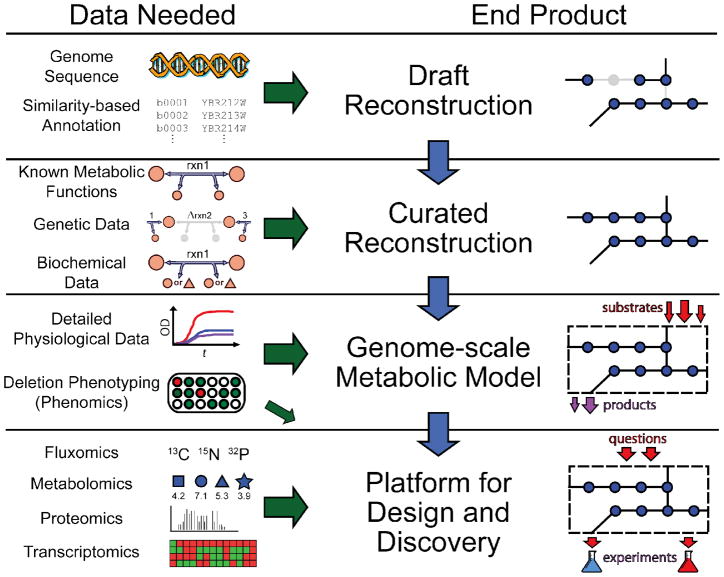
Figure 1
Figure 1. The phases and data utilized for generating a metabolic reconstruction
Genome-scale metabolic reconstruction can be summarized in four major phases, each of the latter phases building off the previous. Also characteristic of the reconstruction process is the iterative refinement of reconstruction content that is driven by experimental data and occurs in the three latter phases. For each phase, specific data types are necessary and these range from high-throughput data types (e.g., phenomics, metabolimics, etc.), to detailed studies characterizing individual components (e.g., biochemical data for a particular reaction). For example, the genome annotation can provide a parts list of a cell, whereas genetic data can provide information about the contribution of each gene product towards a phenotype (e.g., when removed or mutated). The product generated from each reconstruction phase can be utilized and applied to examine a growing number of questions with the final product having the broadest applications.
Figure 2
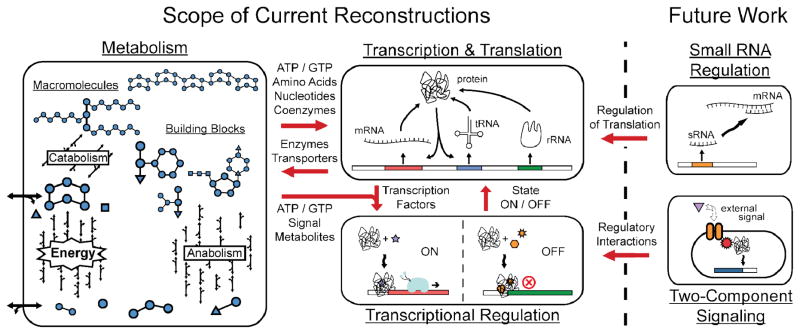
Figure 2. Network integration: the interface between different types of reconstructions
The ultimate goal of network reconstruction is to fully represent every component of the cell and define the interactions between them. Reconstruction of metabolism, transcriptional regulation, and transcription and translation networks is currently possible (as outlined in the text), with the most emphasis, to date, on metabolic reconstruction. Incorporation of small RNAs and two-component signaling interactions are future areas of reconstruction where reconstruction technologies and development are needed. For integration of networks, the interplay between each of the processes needs to be defined to fully connect each of the major cellular functions.

References

    1. Palsson BO. Two-dimensional annotation of genomes. Nat Biotechnol. 2004;22:1218–9. - PubMed
    1. Reed JL, Famili I, Thiele I, Palsson BO. Towards multidimensional genome annotation. Nat Rev Genet. 2006;7:130–41. - PubMed
    1. Price ND, Reed JL, Palsson BO. Genome-scale models of microbial cells: evaluating the consequences of constraints. Nat Rev Microbiol. 2004;2:886–897. - PubMed
    1. Becker SA, et al. Quantitative prediction of cellular metabolism with constraint-based models: The COBRA Toolbox. Nat Protocols. 2007;2:727–738. - PubMed
    1. Feist AM, Palsson BO. The growing scope of applications of genome-scale metabolic reconstructions using Escherichia coli. Nat Biotech. 2008;26:659–667. - PMC - PubMed

Publication types