Review
. 2008:99:1-32.
doi: 10.1016/S0065-2776(08)00601-9.

Cis-regulatory elements and epigenetic changes control genomic rearrangements of the IgH locus

Affiliations
Review

Cis-regulatory elements and epigenetic changes control genomic rearrangements of the IgH locus

Thomas Perlot et al. Adv Immunol. 2008.

Abstract

Immunoglobulin variable region exons are assembled from discontinuous variable (V), diversity (D), and joining (J) segments by the process of V(D)J recombination. V(D)J rearrangements of the immunoglobulin heavy chain (IgH) locus are tightly controlled in a tissue-specific, ordered and allele-specific manner by regulating accessibility of V, D, and J segments to the recombination activating gene proteins which are the specific components of the V(D)J recombinase. In this review we discuss recent advances and established models brought forward to explain the mechanisms underlying accessibility control of V(D)J recombination, including research on germline transcripts, spatial organization, and chromatin modifications of the immunoglobulin heavy chain (IgH) locus. Furthermore, we review the functions of well-described and potential new cis-regulatory elements with regard to processes such as V(D)J recombination, allelic exclusion, and IgH class switch recombination.


Figures
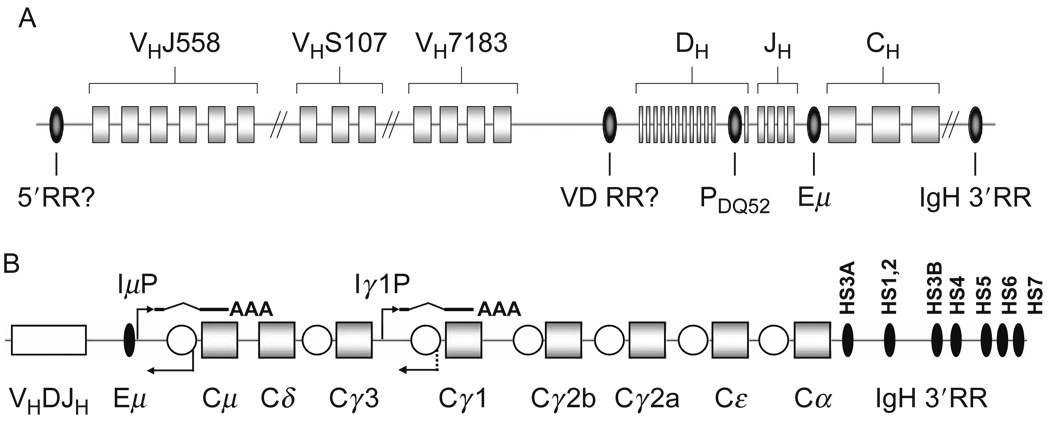
FIGURE 1.1
FIGURE 1.1
Schematic depiction of the murine IgH locus. (A) VH, DH, JH gene segments and CH exons are shown as rectangles, known and potential regulatory elements as ovals. The VH families VHJ558, VHS107, and VH7183 are depicted as examples for distal, intermediate, and proximal VH families, respectively. The cis-regulatory elements PDQ52 (promoter of DQ52), Eμ (intronic enhancer), and IgH 3′RR (IgH 3′ regulatory region) are depicted. The potential regulatory elements 5′RR (5′ regulatory region) and VD RR (VH–DH intergenic regulatory region) are depicted with a question mark. Drawing not to scale. (B) The 3′ part of the IgH locus. An assembled VHDJH exon is shown as a white rectangle, CH genes as squares, Eμ and individual DNaseI hypersensitive sites within the IgH 3′RR are depicted as black ovals, switch regions as white circles. I promoters are located upstream of every switch region (Chaudhuri et al., 2007; Lennon and Perry, 1985; Lutzker and Alt, 1988), only μ and γ1 I promoters (IμP, Iγ1P) are depicted. Transcripts from I promoters get spliced and polyadenylated. Switch regions also get transcribed in the antisense orientation (Apel et al., 1992; Julius et al., 1988, Morrison et al., 1998; Perlot et al., 2008). Concomitant transcription from IμP and, for example, Iγ1P can target AID to μ and γ1 switch regions and thereby initiate CSR to Cγ1.
FIGURE 1.2
FIGURE 1.2
Transcripts within the IgH locus. VH, DH, JH gene segments and CH exons are shown as rectangles, enhancer and promoter elements as ovals. 12 bp and 23 bp RSSs are depicted as black and white triangles, respectively. Drawings not to scale. (A) The IgH locus in germline configuration is transcribed from the promoter of DQ52 (PDQ52) to produce the μ0 transcript (Alessandrini and Desiderio, 1991), and from within the Eμ enhancer to generate the Iμ transcript (Lennon and Perry, 1985; Su and Kadesch, 1990), both of which are getting spliced and polyadenylated (Kottmann et al., 1994, Su and Kadesch, 1990). DH and JH elements are transcribed in the antisense orientation (Bolland et al., 2007; Chakraborty et al., 2007), suggested start sites (dashed arrows) are located around PDQ52 (Chakraborty et al., 2007) and Eμ (Bolland et al., 2007). Sites of transcriptional termination of DH–JH antisense germline transcripts are unknown. (B) Unrearranged VH segments are transcribed in the sense orientation from the individual VH promoters (VHP) (Yancopoulos and Alt, 1985). The intron between the leader (L) and the VH exon (VH) is spliced out, and the VH sense germline transcript gets polyadenylated (Yancopoulos and Alt, 1985). The VH segments and VH intergenic regions can also get transcribed in the antisense orientation (Bolland et al., 2004). Start and termination sites of VH antisense germline transcripts are unknown. Therefore, individual antisense transcripts could comprise one VH segment and its adjacent regions or multiple VH segments including intergenic regions, shown as short and long solid arrows, respectively. (C) Upon D to JH recombination, the assembled DJH exon gets transcribed from the DH promoter (PDH) and spliced to the Cμ exons to generate the Dμ transcript (Alessandrini and Desiderio, 1991; Reth and Alt, 1984), which in one reading frame encodes for a short μHC molecule (Reth and Alt, 1984). DH antisense germline transcription is present throughout the remaining unrearranged DH segments (Chakraborty et al., 2007). Suggested origin of DH antisense germline transcripts is the region around the promoter of the recombined DH segment (depicted as PDH) (Chakraborty et al., 2007), transcriptional termination sites are unknown. (D) Upon VH to DJH recombination, the promoter of the rearranged VH segment (depicted as VHP) drives expression of mRNA encoding for the μHC. In addition to Iμ sense transcription, the Sμ switch region is also transcribed in the antisense orientation (Perlot et al., 2008) from promoters residing within Sμ (Apel et al., 1992; Morrison et al., 1998), the transcriptional termination site of the Sμ antisense transcript is unknown. The assembled VHDJH exon and the adjacent JH region are transcribed in the antisense orientation potentially from start sites within the JH cluster (dashed arrow) (Perlot et al., 2008), the transcriptional termination site of the VHDJH antisense transcript is unknown. Upstream unrearranged VH segments are transcriptionally silenced upon assembly of a functional VHDJH exon (Bolland et al., 2004; Yancopoulos and Alt, 1985).

References

    1. Afshar R, Pierce S, Bolland DJ, Corcoran A, Oltz EM. Regulation of IgH gene assembly: Role of the intronic enhancer and 5′ Δθ52 region in targeting DHJH recombination. J. Immunol. 2006;176(4):2439–2447. - PubMed
    1. Alessandrini A, Desiderio SV. Coordination of immunoglobulin DJH transcription and D-to-JH rearrangement by promoter-enhancer approximation. Mol. Cell. Biol. 1991;11(4):2096–2107. - PMC - PubMed
    1. Alt FW, Enea V, Bothwell AL, Baltimore D. Activity of multiple light chain genes in murine myeloma cells producing a single, functional light chain. Cell. 1980;21(1):1–12. - PubMed
    1. Alt FW, Rosenberg N, Casanova RJ, Thomas E, Baltimore D. Immunoglobulin heavy-chain expression and class switching in a murine leukaemia cell line. Nature. 1982;296(5855):325–331. - PubMed
    1. Alt FW, Yancopoulos GD, Blackwell TK, Wood C, Thomas E, Boss M, Coffman R, Rosenberg N, Tonegawa S, Baltimore D. Ordered rearrangement of immunoglobulin heavy chain variable region segments. EMBO J. 1984;3(6):1209–1219. - PMC - PubMed

Publication types

MeSH terms

LinkOut - more resources
