


Rates and determinants of uptake and use of an internet physical activity and weight management program in office and manufacturing work sites in England: cohort study
- PMID: 19117828
- PMCID: PMC2629365
- DOI: 10.2196/jmir.1108
Rates and determinants of uptake and use of an internet physical activity and weight management program in office and manufacturing work sites in England: cohort study
Abstract
Background: Internet-based physical activity (PA) and weight management programs have the potential to improve employees' health in large occupational health settings. To be successful, the program must engage a wide range of employees, especially those at risk of weight gain or ill health.
Objective: The aim of the study was to assess the use and nonuse (user attrition) of a Web-based and monitoring device-based PA and weight management program in a range of employees and to determine if engagement with the program was related to the employees' baseline characteristics or measured outcomes.
Methods: Longitudinal observational study of a cohort of employees having access to the MiLife Web-based automated behavior change system. Employees were recruited from manufacturing and office sites in the North West and the South of England. Baseline health data were collected, and participants were given devices to monitor their weight and PA via data upload to the website. Website use, PA, and weight data were collected throughout the 12-week program.
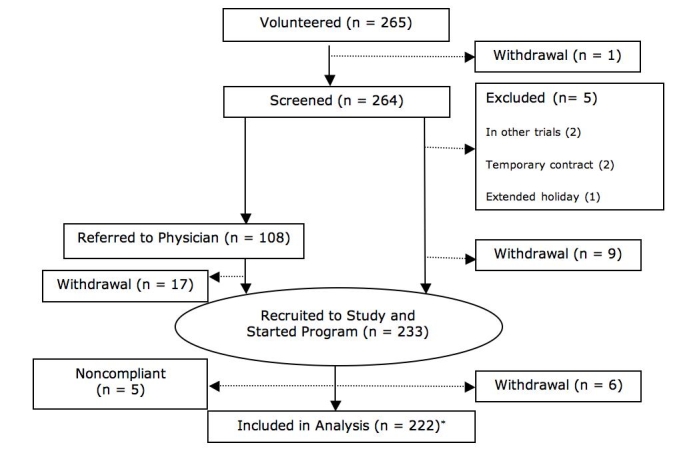
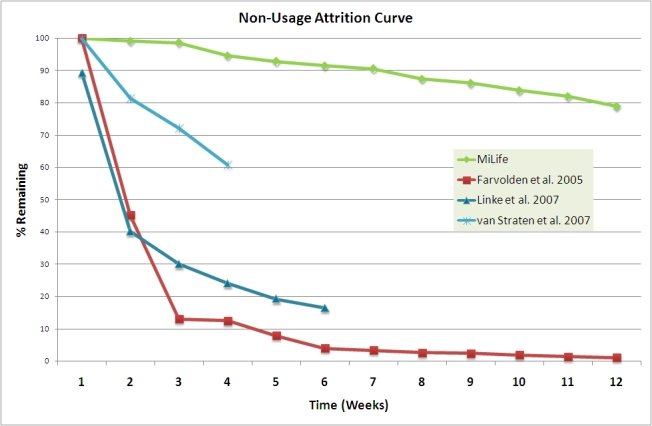
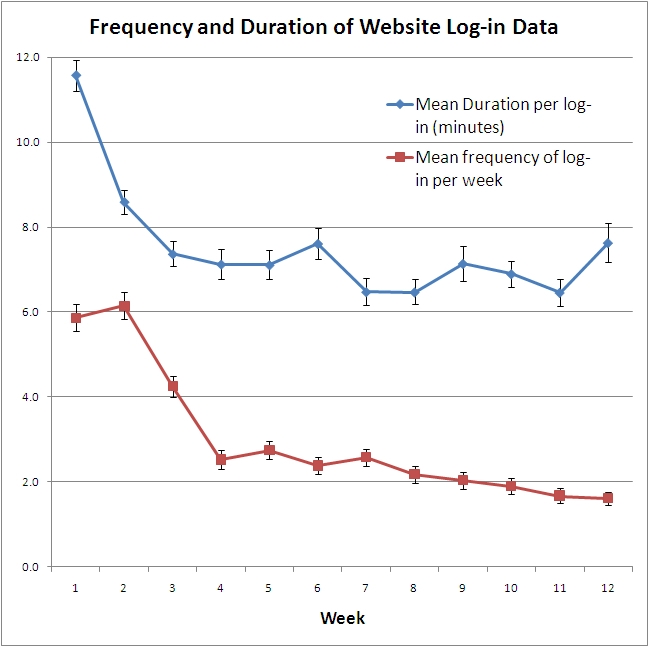
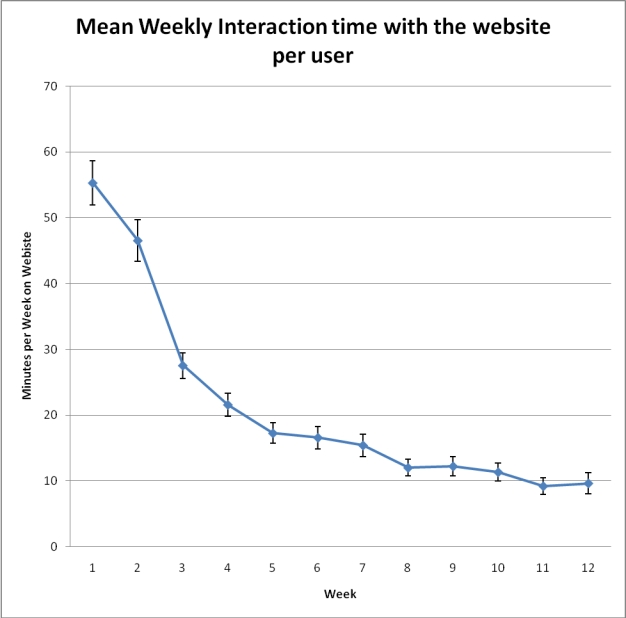
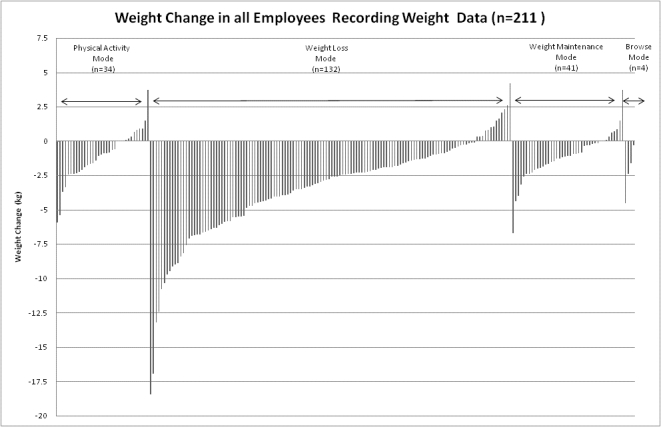
Results: Overall, 12% of employees at the four sites (265/2302) agreed to participate in the program, with 130 men (49%) and 135 women (51%), and of these, 233 went on to start the program. During the program, the dropout rate was 5% (11/233). Of the remaining 222 Web program users, 173 (78%) were using the program at the end of the 12 weeks, with 69% (153/222) continuing after this period. Engagement with the program varied by site but was not significantly different between the office and factory sites. During the first 2 weeks, participants used the website, on average, 6 times per week, suggesting an initial learning period after which the frequency of website log-in was typically 2 visits per week and 7 minutes per visit. Employees who uploaded weight data had a significant reduction in weight (-2.6 kg, SD 3.2, P< .001). The reduction in weight was largest for employees using the program's weight loss mode (-3.4 kg, SD 3.5). Mean PA level recorded throughout the program was 173 minutes (SE 12.8) of moderate/high intensity PA per week. Website interaction time was higher and attrition rates were lower (OR 1.38, P= .03) in those individuals with the greatest weight loss.
Conclusions: This Web-based PA and weight management program showed high levels of engagement across a wide range of employees, including overweight or obese workers, shift workers, and those who do not work with computers. Weight loss was observed at both office and manufacturing sites. The use of monitoring devices to capture and send data to the automated Web-based coaching program may have influenced the high levels of engagement observed in this study. When combined with objective monitoring devices for PA and weight, both use of the website and outcomes can be tracked, allowing the online coaching program to become more personalized to the individual.
Conflict of interest statement
MiLife Coaching Ltd is a subsidiary company of Unilever.
Figures
References
-
- National Audit Office, authors. Tackling Obesity in England. Report by The Comptroller and Auditor General. HC 220 Session 2000-2001. Norwich, UK: The Stationery Office; 2001. Feb.
-
- House of Commons Health Committee, authors. 2004 May 27. Obesity. House of Commons Health Committee Third Report of Session 2003–04 Volume I; HC 23-I.
-
- Hurling R, Fairley BW, Dias MB. Internet-based PA interventions: are more interactive designs better? Psychol Health. 2006;21(6):757–772. doi: 10.1080/14768320600603257. - DOI
-
- Hurling Robert, Catt Michael, Boni Marco De, Fairley Bruce William, Hurst Tina, Murray Peter, Richardson Alannah, Sodhi Jaspreet Singh. Using internet and mobile phone technology to deliver an automated physical activity program: randomized controlled trial. J Med Internet Res. 2007;9(2):e7. doi: 10.2196/jmir.9.2.e7. http://www.jmir.org/2007/2/e7/v9i2e7 - DOI - PMC - PubMed
