. 2008 Dec 31;28(53):14443-9.
doi: 10.1523/JNEUROSCI.4698-08.2008.

Spred1 is required for synaptic plasticity and hippocampus-dependent learning

Affiliations

Spred1 is required for synaptic plasticity and hippocampus-dependent learning

Ellen Denayer et al. J Neurosci. .

Abstract

Germline mutations in SPRED1, a negative regulator of Ras, have been described in a neurofibromatosis type 1 (NF1)-like syndrome (NFLS) that included learning difficulties in some affected individuals. NFLS belongs to the group of phenotypically overlapping neuro-cardio-facial-cutaneous syndromes that are all caused by germ line mutations in genes of the Ras/mitogen-activated protein kinase extracellular signal-regulated kinase (ERK) pathway and that present with some degree of learning difficulties or mental retardation. We investigated hippocampus-dependent learning and memory as well as synaptic plasticity in Spred1(-/-) mice, an animal model of this newly discovered human syndrome. Spred1(-/-) mice show decreased learning and memory performance in the Morris water maze and visual-discrimination T-maze, but normal basic neuromotor and sensory abilities. Electrophysiological recordings on brain slices from these animals identified defects in short- and long-term synaptic hippocampal plasticity, including a disequilibrium between long-term potentiation (LTP) and long-term depression in CA1 region. Biochemical analysis, 4 h after LTP induction, demonstrated increased ERK-phosphorylation in Spred1(-/-) slices compared with those of wild-type littermates. This indicates that deficits in hippocampus-dependent learning and synaptic plasticity induced by SPRED1 deficiency are related to hyperactivation of the Ras/ERK pathway.


Figures

Figure 1.
Figure 1.
Impaired Morris water maze performance in Spred1−/− (KO, n = 14) mice compared with wild-type (WT, n = 21) and Spred1+/− (HZ, n = 21) littermates. a, There is no significant effect of genotype on mean path length during the first week of acquisition training (p = 0.4), whereas Spred1−/− mice are unable to reach the same performance as the two other genotype groups during the second week (p < 0.001). b, c, More specific spatial performance measures indicate that (b) Spred1−/− mice display significantly longer distance to target from day 2 onwards (genotype × trial block interaction, p = 0.003), and (c) there is significantly more persistent thigmotaxic swimming in Spred1−/− mice compared with the other groups during the first (p = 0.016) and second acquisition week (p = 0.002). Also, spatial memory performance is impaired in Spred1−/− mice during the probe trials. d, The first probe trial already indicates that Spred1−/− animals spent less time searching the target quadrant than Spred1+/− or WT mice (p < 0.05). WT and Spred1+/− mice showed a significant preference for the target quadrant, whereas in Spred1−/− mice, there was no difference between time in the target quadrant and any of the other quadrants. This is also obvious from representative heat plots that are shown above the bar charts (dwell frequency is indicated by coloration from red through blue; circle indicates platform position). target, adj, opp indicate target, adjacent, and opposite quadrants, respectively. e, Results of the second probe trial demonstrate that WT and Spred1+/− further increased their preference for the target quadrant, whereas Spred1−/− mice failed to develop such a preference even after prolonged training (p < 0.001 for time spent in target quadrant).*p < 0.05 (pairwise comparison with WT values).
Figure 2.
Figure 2.
Differences between Spred1−/− (KO, n = 18), Spred1+/− (HZ, n = 21), and WT (n = 20) mice in visual discrimination learning and transitive task performance in the T maze. a, During initial black-white discrimination training, Spred1−/− mice showed less correct responses than their WT and Spred1+/− littermates, and fell behind their performance from trial block 10 onwards (p = 0.005). b, Acquisition training for AB and BC stimulus discrimination shows only borderline differences between the genotypes (stimuli A, B, and C are depicted at the bottom of the graph). c, Performance on mixed trials revealed highly significant differences between the genotypes (p < 0.001) with Spred1+/− animals displaying an intermediate level of performance. d, During the final test trials, Spred1−/− and Spred1+/− mice were significantly less accurate in AB and BC discrimination compared with their WT littermates (p < 0.001). Spred1−/− mice also performed significantly worse than the two other groups of mice on the untrained transitive pair AC (p < 0.001). *p < 0.001 (pairwise comparison with WT values).
Figure 3.
Figure 3.
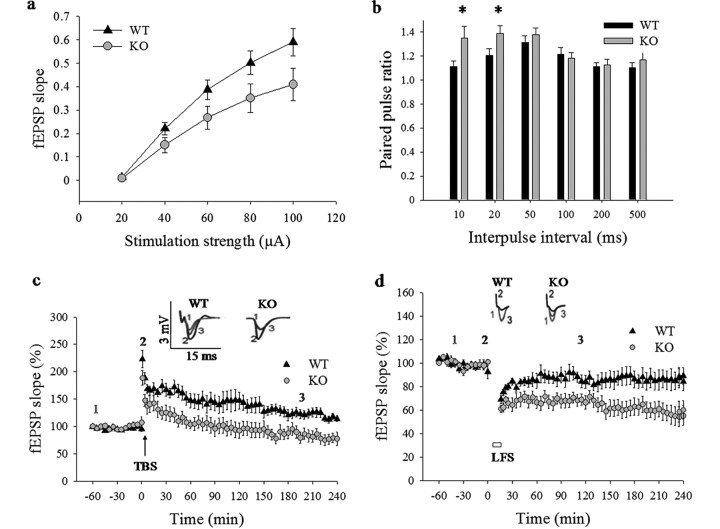
Differences in basic excitability and synaptic plasticity recorded on hippocampal slices from Spred1−/− (KO) mice and their WT littermates. a, Input–output curves indicate progressively lower fEPSP slope at stronger stimulation in Spred1−/− (n = 24) than WT (n = 31) slices (p = 0.049). b, PPF values (calculated as the ratio of the second on the first fEPSP slope) showed increased facilitation in Spred1−/− mice at 10 and 20 ms interpulse intervals (n = 12 for each genotype, p < 0.05, Mann–Whitney U test). c, Spred1−/− mice showed a consistent impairment of LTP in CA1 area after TBS, with responses returning to baseline values after 55 min (12 slices, 6 animals for each genotype, p < 0.05, Wilcoxon matched-pairs signed rank test). Insets, Representative analog traces, numbers indicate trace-time point. d, LTD is enhanced in Spred1−/− slices compared with those of WT mice (n = 12 slices, 6 animals for each genotype, p < 0.05, repeated-measures ANOVA). Open box under curves indicates duration of LFS. *p < 0.05 (pairwise comparison with WT values).
Figure 4.
Figure 4.
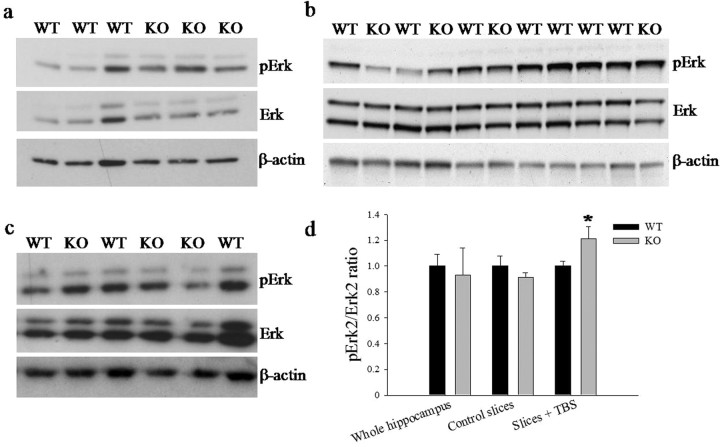
Differences in Erk activation between Spred1−/− (KO) and WT mice. a, Western blots display enhanced Erk2 phosphorylation in Spred1−/− (n = 5) versus WT (n = 8) in TBS-stimulated hippocampal slices (p = 0.030, ANOVA). Three representative samples of each genotype are shown. β-Actin is shown as a loading control. b, c, This enhanced pErk2/Erk2 ratio could not be found in whole hippocampi in basal conditions in two independent experiments (p = 0.741, n = 7 for WT, n = 4 for Spred1−/−; p = 0.888, n = 4 for WT, n = 5 for Spred1−/−) (c) nor in unstimulated control slices (p = 0.339, n = 6 for WT, n = 6 for Spred1−/−). Three representative samples of each genotype are shown. d, Bar-graphs indicate mean pErk2/Erk2 ratio which shows significantly higher ratios in the Spred1−/− slices (*p = 0.030, ANOVA) after TBS, but not in whole hippocampi or unstimulated slices.

References

    1. AtkinsCM, Selcher JC, Petraitis JJ, Trzaskos JM, Sweatt JD (1998) The ERK cascade is required for mammalian associative learning. Nat Neurosci 1:602–609. - PubMed
    1. Bentires-AljM, Kontaridis MI, Neel BG (2006) Stops along the RAS pathway in human genetic disease. Nat Med 12:283–285. - PubMed
    1. BremsH, Chmara M, Sahbatou M, Denayer E, Taniguchi K, Kato R, Somers R, Messiaen L, De Schepper S, Fryns JP, Cools J, Marynen P, Thomas G, Yoshimura A, Legius E (2007) Germline loss-of-function mutations in SPRED1 cause a neurofibromatosis 1-like phenotype. Nat Genet 39:1120–1126. - PubMed
    1. CasciT, Vinós J, Freeman M (1999) Sprouty, an intracellular inhibitor of Ras signaling. Cell 96:655–665. - PubMed
    1. CostaRM, Yang T, Huynh DP, Pulst SM, Viskochil DH, Silva AJ, Brannan CI (2001) Learning deficits, but normal development and tumor predisposition, in mice lacking exon 23a of Nf1. Nat Genet 27:399–405. - PubMed

Publication types

MeSH terms

Substances