. 2009 Feb 12;52(3):688-99.
doi: 10.1021/jm8011855.

Single-step high-yield radiosynthesis and evaluation of a sensitive 18F-labeled ligand for imaging brain peripheral benzodiazepine receptors with PET

Affiliations

Single-step high-yield radiosynthesis and evaluation of a sensitive 18F-labeled ligand for imaging brain peripheral benzodiazepine receptors with PET

Emmanuelle Briard et al. J Med Chem. .

Abstract

Elevated levels of peripheral benzodiazepine receptors (PBR) are associated with activated microglia in their response to inflammation. Hence, PBR imaging in vivo is valuable for investigating brain inflammatory conditions. Sensitive, easily prepared, and readily available radioligands for imaging with positron emission tomography (PET) are desirable for this purpose. We describe a new 18F-labeled PBR radioligand, namely [18F]N-fluoroacetyl-N-(2,5-dimethoxybenzyl)-2-phenoxyaniline ([18F]9). [18F]9 was produced easily through a single and highly efficient step, the reaction of [18F]fluoride ion with the corresponding bromo precursor, 8. Ligand 9 exhibited high affinity for PBR in vitro. PET showed that [18F]9 was avidly taken into monkey brain and gave a high ratio of PBR-specific to nonspecific binding. [18F]9 was devoid of defluorination in rat and monkey and gave predominantly polar radiometabolite(s). In rat, a low level radiometabolite of intermediate lipophilicity was identified as [18F]2-fluoro-N-(2-phenoxyphenyl)acetamide ([18F]11). [18F]9 is a promising radioligand for future imaging of PBR in living human brain.


Figures
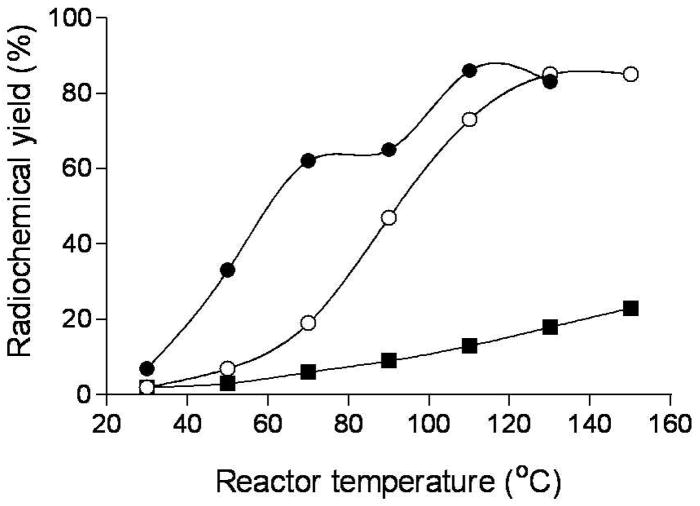
Figure 1
Figure 1
Temperature dependence of decay-corrected radiochemical yields of [18F]9 prepared in anhydrous MeCN (●) or MeCN containing 0.3% v/v H2O (○), and of [18F]11 prepared in anhydrous MeCN within a microfluidic device using two 2 m-coiled micro-reactors (■).
Figure 2
Figure 2
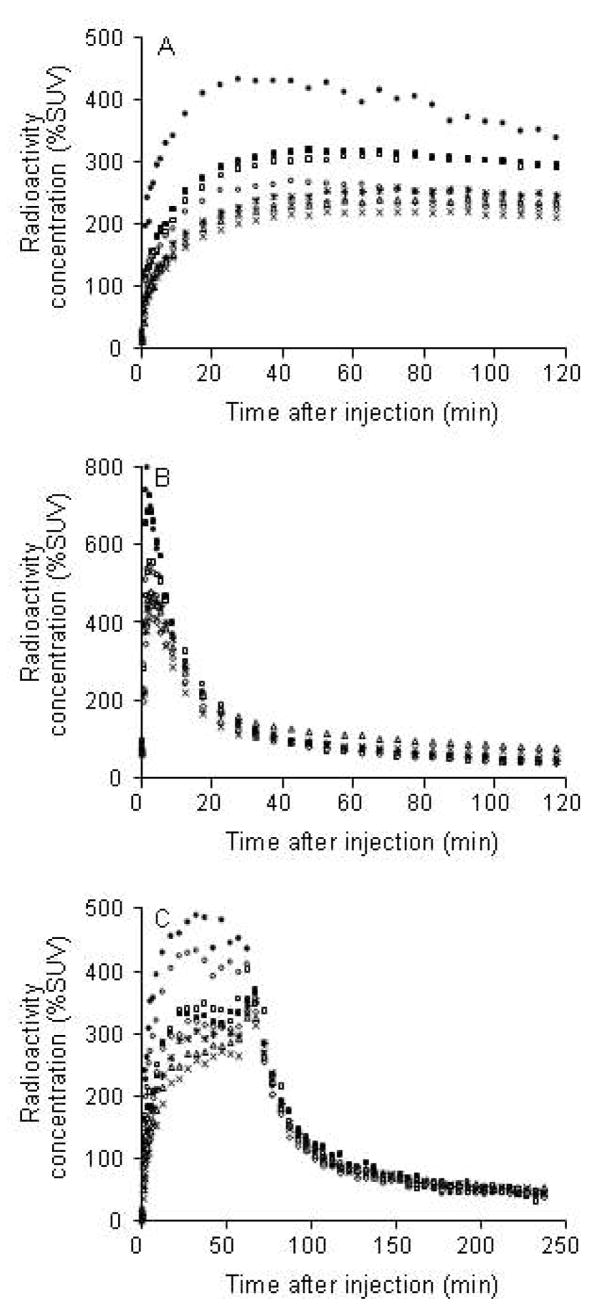
Rhesus monkey brain time-activity curves after (A) intravenous injection of [18F]9 (5.80 mCi with 3.91 μg of 9) alone (Panel A), intravenous injection of 1 (3 mg/kg) in the same monkey at 24 min before [18F]9 (5.09 mCi, with 4.58 μg of 9) (Panel B), and intravenous injection in a different monkey of [18F]9 (1.28 mCi, with 1.75 μg of 9) followed at 60 min later with 1 (3 mg/kg) (Panel C). Key: fourth ventricle of choroid plexus (●), striatum (■), thalamus (□), cerebellum (○), frontal cortex (×), temporal cortex (△), parietal cortex (*), and occipital cortex (◇).
Figure 3
Figure 3
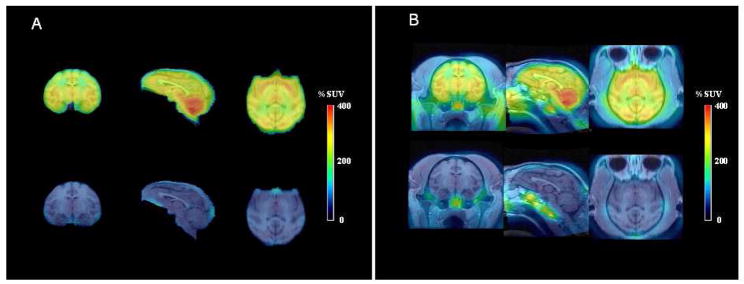
Panel A: in left to right order, average coronal, sagittal and horizontal PET images of monkey brain, acquired between 60 and 120 min after intravenous injection of NCA [18F]9 (5.8 mCi) alone (upper row), and in the same monkey after pre-block of PBR with 1 (3 mg/kg, i.v.) given 24 min before NCA [18F]9 (5.09 mCi) (lower row). In panel B the same PET data have been superimposed on the corresponding MR images.
Figure 4
Figure 4
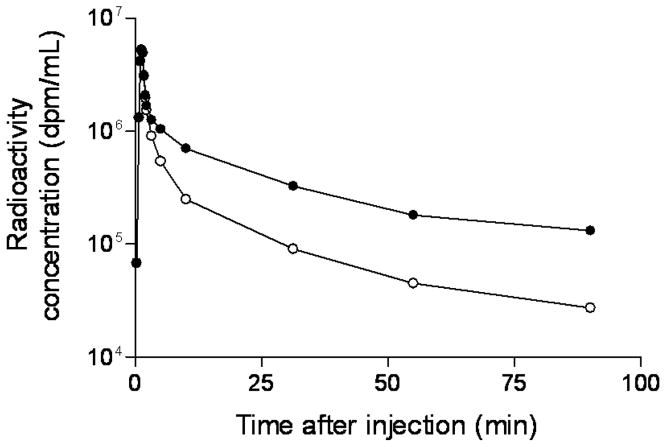
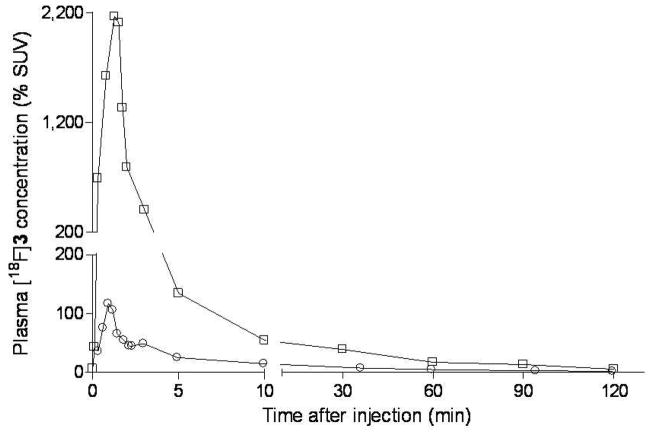
Time course of plasma concentration of total radioactivity (%SUV) (●) and unchanged [18F]9 (○) after intravenous injection of NCA [18F]9 into rhesus monkey.
Figure 5
Figure 5
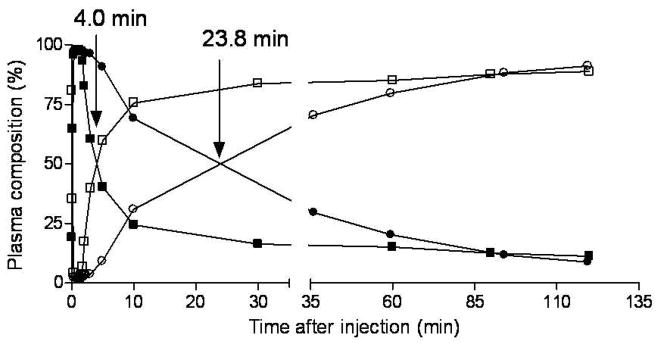
Time course of compositions of plasma radioactivity after injection of [18F]9 into the same rhesus monkey under baseline and PBR pre-block conditions. (○) unchanged [18F]9 in baseline experiment; (●) radiometabolites in baseline experiment; (■) unchanged [18F]9 in pre-block experiment; (□) radiometabolites in pre-block experiment. Arrows indicate the times at which [18F]9 and its radiometabolite were equally present in these experiments.
Figure 6
Figure 6
Time course of plasma concentration of [18F]9 (%SUV) after intravenous injection of [18F]9 in the baseline (○) and pre-block experiment in the same monkey (□).
Scheme 1
Scheme 1
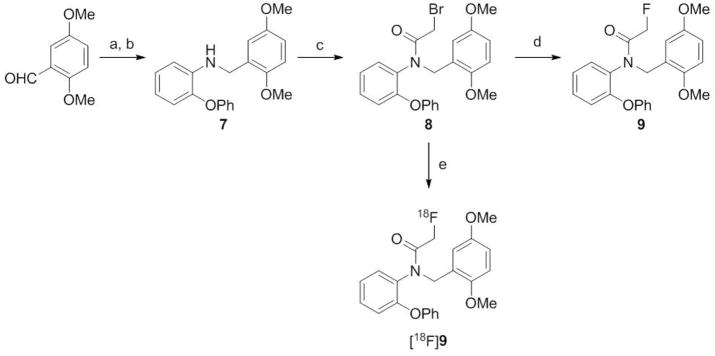
Synthesis of 9 and [18F]9. Reaction conditions and yields. a) 2-phenoxyaniline, MeOH, rt, 24 h; b) NaBH4, rt, 1 h; 75% for steps a plus b overall; c) bromoacetyl bromide, CH2Cl2, Et3N, 0 °C, 1 h; 73% d) KF, di(ethylene glycol), 150 °C, 4 h; 95%; e) [18F]fluoride ion, MeCN-trace water, 18-crown-6, KHCO3, 110 °C, 10 min; RCY 97%, or [18F]fluoride ion; MeCN, K 2.2.2, K2CO3, 100 °C, 20 min; isolated and formulated RCY, 12.2%.
Scheme 2
Scheme 2
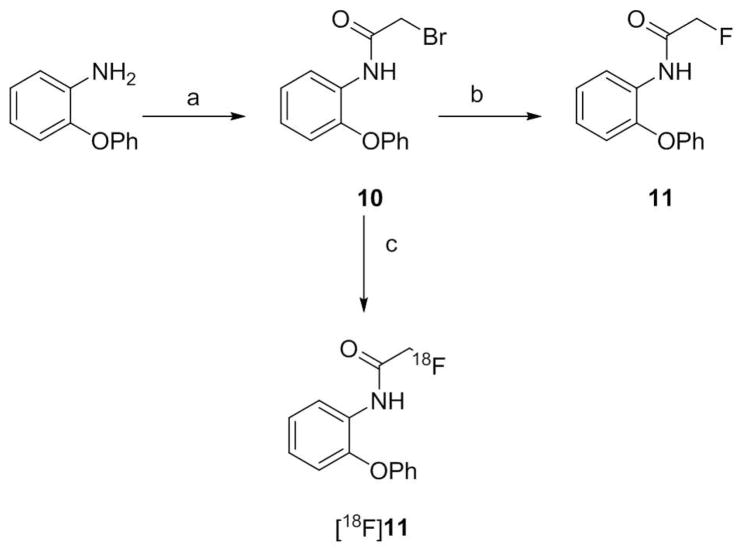
Synthesis of 11 and [18F]11. Reaction conditions and yields. a) bromoacetic anhydride, AcOH, Et3N, rt, 2 h; 80% b) KF, ethylene glycol, 150 °C, 2 h; 65%; c) [18F]fluoride ion, MeCN, K 2.2.2, K2CO3; 160 °C, RCY 26–30%.
Scheme 3
Scheme 3
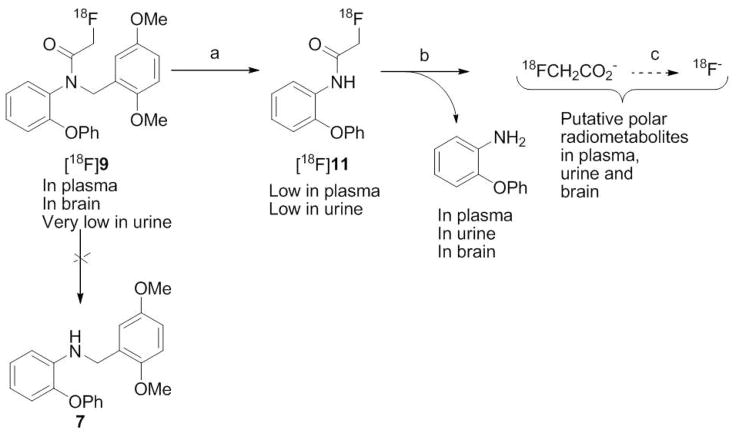
Summary of metabolism of [18F]9 in rat in vivo.
Chart 1
Chart 1
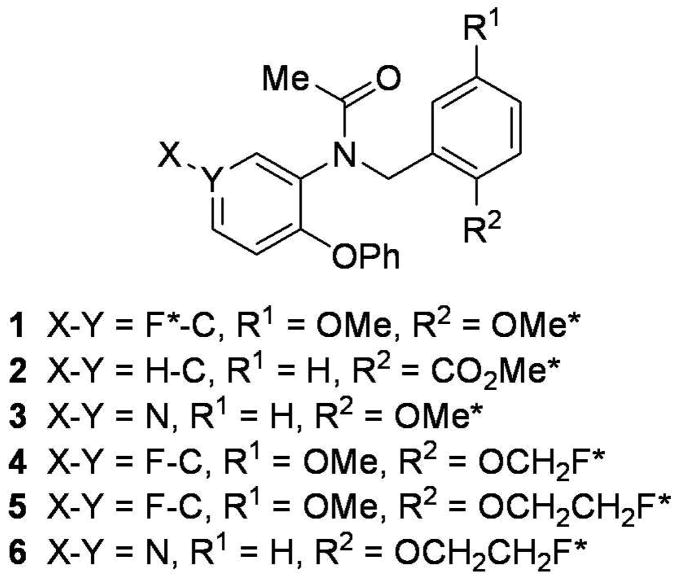
Ligands and PET radioligands based on the aryloxyanilide 1. An asterisk indicates a site in which the ligand has been labeled with either carbon-11 or fluorine-18. 254×190mm (96 × 96 DPI)

References

    1. McEnery MW, Snowman AM, Trifletti RR, Snyder SH. Isolation of the mitochondrial benzodiazepine receptor: association with the voltage dependent anion channel and the adenine nucleotide carrier. Proc Natl Acad Sci US A. 1992;89:3170–3174. - PMC - PubMed
    1. Schoemaker H, Bliss M, Yamamura HI. Specific high-affinity saturable binding of [3H]Ro5-4864 to benzodiazepine binding sites in the rat cerebral cortex. Eur J Pharmacol. 1981;71:173–175. - PubMed
    1. Braestrup C, Albrechtsen R, Squires RF. High densities of benzodiazepine receptors in human cortical areas. Nature. 1977;269:702–704. - PubMed
    1. Anholt RR, De Souza EB, Oster-Granite ML, Snyder SH. Peripheral-type benzodiazepine receptors: autoradiographic localization in whole body sections of neonatal rats. J Pharmacol Exp Ther. 1985;233:517–526. - PubMed
    1. Parola AL, Yamamura HI, Laird HE., II Peripheral-type benzodiazepine receptors. Life Sciences. 1993;52:1329–1342. - PubMed

Publication types

Substances

LinkOut - more resources