


DAP10- and DAP12-associated receptors in innate immunity
- PMID: 19120482
- PMCID: PMC2794881
- DOI: 10.1111/j.1600-065X.2008.00720.x
DAP10- and DAP12-associated receptors in innate immunity
Abstract
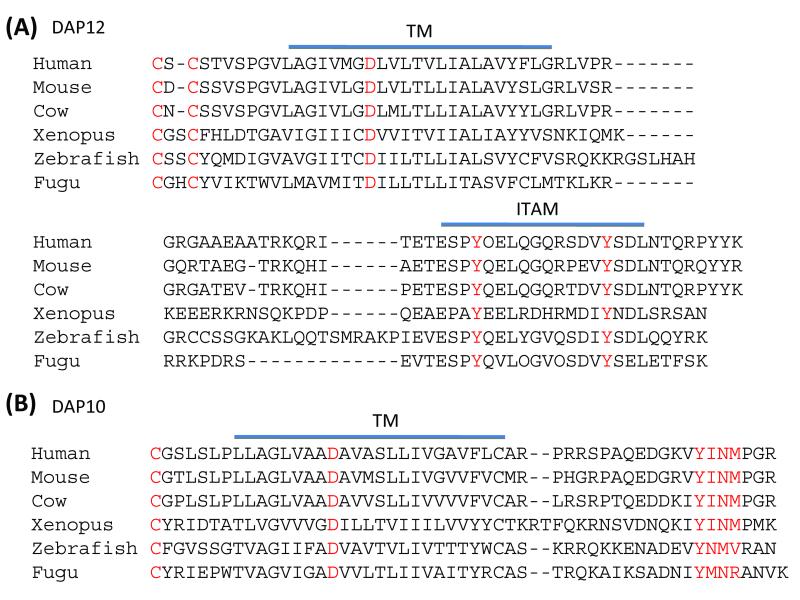
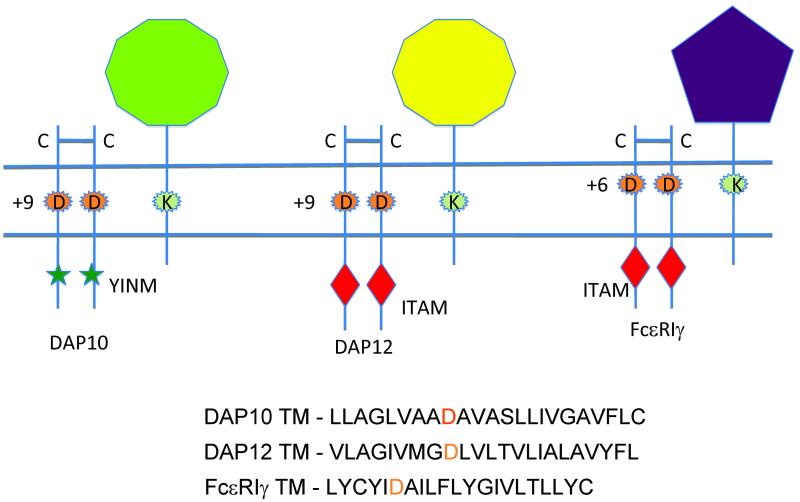
The DAP10 and DAP12 signaling subunits are highly conserved in evolution and associate with a large family of receptors in hematopoietic cells, including dendritic cells, plasmacytoid dendritic cells, neutrophils, basophils, eosinophils, mast cells, monocytes, macrophages, natural killer cells, and some B and T cells. Some receptors are able to associate with either DAP10 or DAP12, which contribute unique intracellular signaling functions. Studies of humans and mice deficient in these signaling subunits have provided surprising insights into the physiological functions of DAP10 and DAP12, demonstrating that they can either activate or inhibit immune responses. DAP10- and DAP12-associated receptors have been shown to recognize both host-encoded ligands and ligands encoded by microbial pathogens, indicating that they play an important role in innate immune responses.
Figures
References
-
- Blank U, Ra C, White K, Metzger H, Kinet J-P. Complete structure and expression in transfected cells of high affinity IgE receptor. Nature. 1989;337:187–189. - PubMed
-
- Lanier LL, Corliss BC, Wu J, Leong C, Phillips JH. Immunoreceptor DAP12 bearing a tyrosine-based activation motif is involved in activating NK cells. Nature. 1998;391:703–707. - PubMed
-
- Weissman AM, Samelson LE, Klausner RD. A new subunit of the human T-cell antigen receptor complex. Nature. 1986;324:480–482. - PubMed
Publication types
MeSH terms
Substances
Grants and funding
LinkOut - more resources
Full Text Sources
Other Literature Sources
