Review
. 2009 Jan;227(1):264-82.
doi: 10.1111/j.1600-065X.2008.00721.x.

Systems biology of innate immunity

Affiliations
Review

Systems biology of innate immunity

Daniel E Zak et al. Immunol Rev. 2009 Jan.

Abstract

Systems biology is the comprehensive and quantitative analysis of the interactions between all of the components of biological systems over time. Systems biology involves an iterative cycle, in which emerging biological problems drive the development of new technologies and computational tools. These technologies and tools then open new frontiers that revolutionize biology. Innate immunity is well suited for systems analysis, because the relevant cells can be isolated in various functional states and their interactions can be reconstituted in a biologically meaningful manner. Application of the tools of systems biology to the innate immune system will enable comprehensive analysis of the complex interactions that maintain the difficult balance between host defense and inflammatory disease. In this review, we discuss innate immunity in the context of the systems biology concepts, emergence, robustness, and modularity, and we describe emerging technologies we are applying in our systems-level analyses. These technologies include genomics, proteomics, computational analysis, forward genetics screens, and analyses that link human genetic polymorphisms to disease resistance.


Figures

Fig. 1
Fig. 1. The iterative cycle of systems biology
Biology dictates what new technology and computational tools must be developed to answer specific questions. Newly developed technologies and tools in turn open new frontiers, revolutionizing biology and generating new fields of inquiry.
Fig. 2
Fig. 2. Emergent properties
Biological functions, like the arch, emerge from context-specific interactions of the constituent elements. Emergent functional properties cannot be understood by analyzing the constituents in isolation (adapted from an image posted anonymously at http://cache.gizmodo.com/gadgets/images/monitor_arch.jpg).
Fig. 3
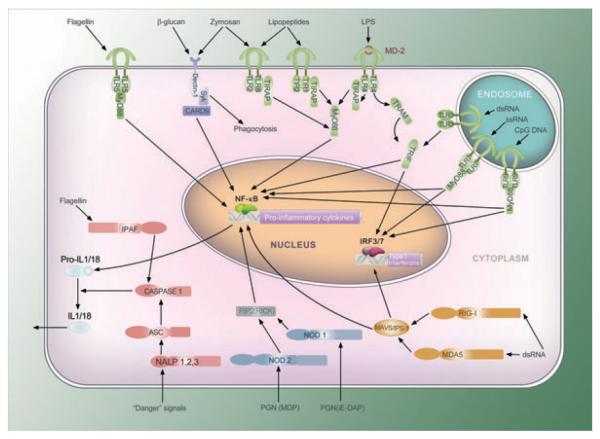
Fig. 3. Currently known TLR, NLR, and RLR receptors, their cognate adapters, and primary agonists
Membrane-bound TLRs and their adapters are shown in green. Cytoplasmic NLRs are shown in blue (for NOD1 and NOD2) and red (for the inflammasome NLRs and adapters). Cytoplasmic RLRs are shown in yellow. The phagocytic PRR Dectin-1 is shown in purple (figure adapted from 1).
Fig. 4
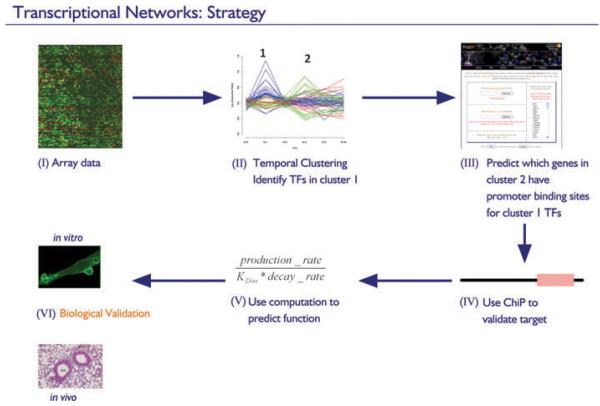
Fig. 4. Strategy for unraveling transcriptional networks
(I) Microarrays are used to profile temporal gene expression responses in stimulated macrophages. (II) Clustering reveals groups of genes with different expression kinetics. (III) Candidate regulatory links between genes are made by searching for enrichment of regulatory elements of transcription factors expressed in early groups (no. 1) in the promoters of genes expressed in later groups (no. 2). (IV) Regulatory predictions are validated by chromatin immunoprecipitation. (V) Mathematical modeling is used to predict the functional nature of validated interactions (activation, repression, etc.). (VI) Functional predictions are tested in vitro and in vivo.
Fig. 5
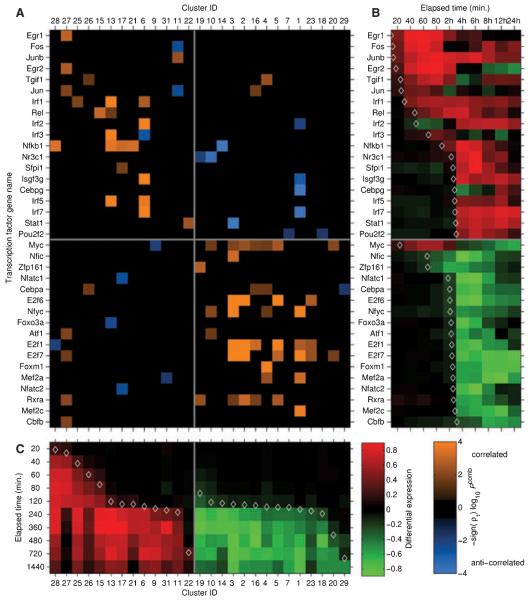
Fig. 5. Hypothesis-generating transcriptional regulatory network controlling the macrophage response to TLR activation
The computational analyses used to generate this predicted regulatory network are described in the main text. (A) Matrix defining potential interactions between transcription factors (TFs) and clusters of co-expressed genes. Each column represents a cluster of co-expressed genes, while each row represents a TF potentially controlling gene expression in the network. Clusters and TFs are ordered according to the kinetics of their responses to LPS stimulation. An orange solid rectangle indicates that the TF is potentially an activator for the genes in the cluster, while a blue solid rectangle indicates that the TFis potentially a repressor for the genes in the cluster. (B) Heat-map depicting gene expression profiles for TFs in the network in response to LPS stimulation. Red indicates upregulation, while green indicates downregulation. (C) Heat-map depicting median expression profile of genes in each co-regulated cluster in response to LPS stimulation. Red indicates upregulation, while green indicates downregulation (figure reproduced from 98).

References

    1. Ishii KJ, et al. Host innate immune receptors and beyond: making sense of microbial infections. Cell Host Microbe. 2008;3:352–363. - PubMed
    1. Underhill DM, Ozinsky A. Phagocytosis of microbes: complexity in action. Annu Rev Immunol. 2002;20:825–852. - PubMed
    1. Herskovits AA, Auerbuch V, Portnoy DA. Bacterial ligands generated in a phagosome are targets of the cytosolic innate immune system. PLoS Pathog. 2007;3:e51. - PMC - PubMed
    1. Aderem AA, Scott WA, Cohn ZA. A selective defect in arachidonic acid release from macrophage membranes in high potassium media. J Cell Biol. 1984;99:1235–1241. - PMC - PubMed
    1. Aderem AA, et al. Ligated complement receptors do not activate the arachidonic acid cascade in resident peritoneal macrophages. J Exp Med. 1985;161:617–622. - PMC - PubMed

MeSH terms

Substances