


ARHI: A new target of galactose toxicity in Classic Galactosemia
- PMID: 19122833
- PMCID: PMC2613282
- DOI: 10.1016/j.bihy.2008.06.011
ARHI: A new target of galactose toxicity in Classic Galactosemia
Abstract
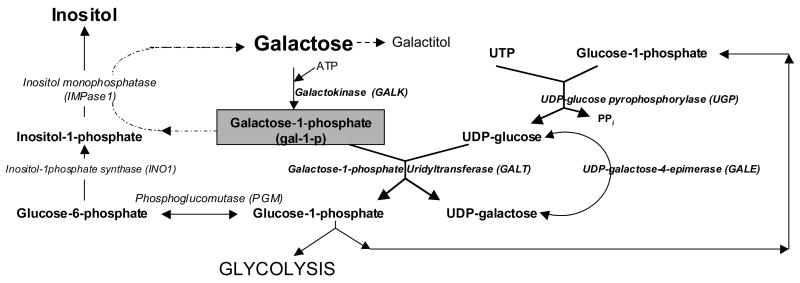
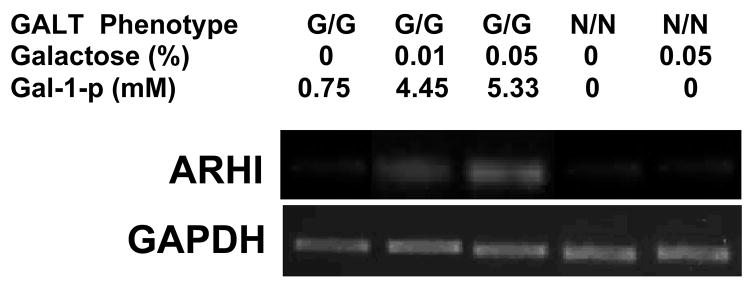
In humans, deficiency of galactose-1-phosphate uridyltransferase (GALT) activity can lead to a potentially lethal disease called Classic Galactosemia. Although a galactose-restricted diet can prevent the acute lethality associated with the disorder, chronic complications persist in many well-treated patients. Approximately 85% of young women with Classic Galactosemia experience hypergonadotropic hypogonadism and premature ovarian failure (POF). Others suffer from mental retardation, growth restriction, speech dyspraxia, and ataxia. Despite decades of intense biochemical characterization, little is known about the molecular etiology, as well as the chronology of the pathological events leading to the poor outcomes. Several hypotheses have been proposed, most of which involved the accumulation of the intermediates and/or the deficit of the products, of the blocked GALT pathway. However, none of these hypotheses satisfactorily explained the absence of patient phenotypes in the GALT-knockout mice. Here we proposed that the gene encoded the human tumor suppressor gene aplysia rashomolog I (ARHI) is a target of toxicity in Classic Galactosemia, and because ARHI gene is lost in rodents in through evolution, it thus accounts for the lack of clinical phenotypes in the GALT-knockout mice.
Figures
References
-
- Leloir LF. The enzymatic transformation of uridine diphosphate glucose into a galactose derivative. Arch Biochem. 1951;33(2):186–90. - PubMed
-
- Duggleby RG, et al. Sequence differences between human muscle and liver cDNAs for UDPglucose pyrophosphorylase and kinetic properties of the recombinant enzymes expressed in Escherichia coli. Eur J Biochem. 1996;235(1–2):173–9. - PubMed
-
- Salo WL, et al. The specificity of UDP-glucose 4-epimerase from the yeast Saccharomyces fragilis. Biochim Biophys Acta. 1968;151(2):484–92. - PubMed
-
- Parthasarathy R, Parthasarathy L, Vadnal R. Brain inositol monophosphatase identified as a galactose 1-phosphatase. Brain Res. 1997;778(1):99–106. - PubMed
-
- Isselbacher KJ, et al. Congenital galactosemia, a single enzymatic block in galactose metabolism. Science. 1956;123(3198):635–6. - PubMed
Grants and funding
LinkOut - more resources
Full Text Sources