


Review
doi: 10.1161/CIRCULATIONAHA.108.805887.
Neurogenic orthostatic hypotension: a pathophysiological approach
Affiliations
- PMID: 19124673
- PMCID: PMC4182314
- DOI: 10.1161/CIRCULATIONAHA.108.805887
Item in Clipboard
Review
Neurogenic orthostatic hypotension: a pathophysiological approach
Circulation.
.
No abstract available
Figures

Algorithm for clinical evaluation of OH. The algorithm asks if OH is persistent and consistent; if it is neurogenic; and if it is associated with postganglionic, sympathetic, noradrenergic denervation. BP indicates blood pressure; CNS, central nervous system; LBD, Lewy body dementia; and NE, norepinephrine.

Heart rate and blood pressure responses in the 4 phases of the Valsalva maneuver in (left) a control subject and (right) a patient with NOH. NOH is characterized by a progressive decline in blood pressure in phase II (arrow), slow recovery of blood pressure in phases III and IV (gray polygon), and absence of overshoot in pressure above baseline in phase IV (thick black line).

Cardiac positron emission tomographic scans after intravenous injection of 6-[18F]fluorodopamine (6-[18F]FDA) or the perfusion imaging agent [13N]-ammonia ([13N]NH3) in a patient with MSA and a patient with PD9NOH. Note absence of detectable 6-[18F]fluorodopamine–derived radioactivity in the left ventricular myocardium, despite normal perfusion as indicated by [13N]-ammonia–derived radioactivity, in the patient with PD9+NOH.
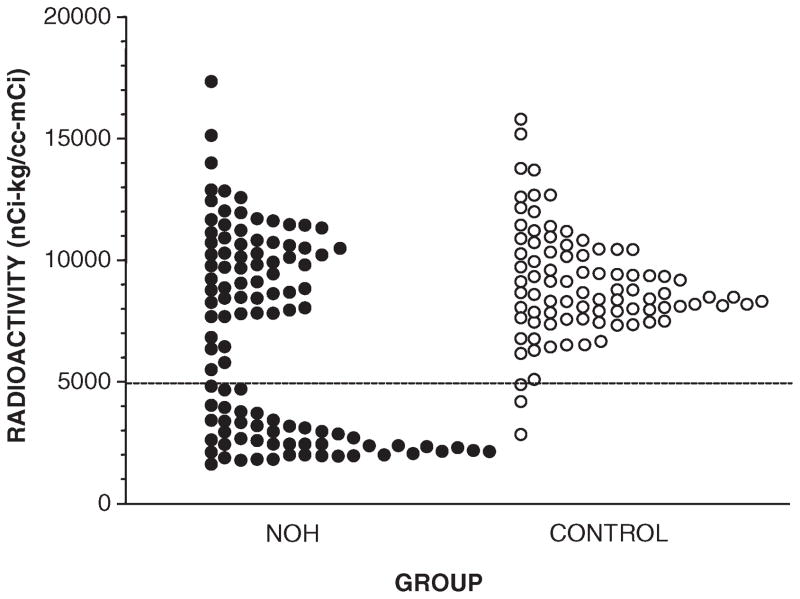
Individual values for interventricular septal myocardial concentrations of 6-[18F]fluorodopamine–derived radioactivity in patients with NOH or control subjects. Dashed line shows 2 SDs below the normal mean. Note bimodal distribution of 6-[18F]fluorodopamine–derived radioactivity in NOH patients, with approximately half having low radioactivity and half normal radioactivity.

Individual values for interventricular septal myocardial concentrations of 6-[18F]fluorodopamine–derived radioactivity in patients with NOH and central neurodegeneration who had either a definite or an equivocal diagnosis. Note bimodal distributions of radioactivity regardless of surety of diagnosis.
References
-
- Kaufmann H. Consensus statement on the definition of orthostatic hypotension, pure autonomic failure and multiple system atrophy. Clin Auton Res. 1996;6:125–126. - PubMed
-
- Shibao C, Grijalva CG, Raj SR, Biaggioni I, Griffin MR. Orthostatic hypotension-related hospitalizations in the United States. Am J Med. 2007;120:975–980. - PubMed
-
- Rose KM, Eigenbrodt ML, Biga RL, Couper DJ, Light KC, Sharrett AR, Heiss G. Orthostatic hypotension predicts mortality in middle-aged adults: the Atherosclerosis Risk In Communities (ARIC) Study. Circulation. 2006;114:630– 636. - PubMed
-
- Applegate WB, Davis BR, Black HR, Smith WM, Miller ST, Burlando AJ. Prevalence of postural hypotension at baseline in the Systolic Hypertension in the Elderly Program (SHEP) cohort. J Am Geriatr Soc. 1991;39:1057–1064. - PubMed
-
- Goldstein DS, Pechnik S, Holmes C, Eldadah B, Sharabi Y. Association between supine hypertension and orthostatic hypotension in autonomic failure. Hypertension. 2003;42:136–142. - PubMed
Publication types
MeSH terms
Substances
Grants and funding
LinkOut - more resources
Full Text Sources
Other Literature Sources
Medical
