Real-time electronic diary reports of cue exposure and mood in the hours before cocaine and heroin craving and use
- PMID: 19124692
- PMCID: PMC2943840
- DOI: 10.1001/archgenpsychiatry.2008.509
Real-time electronic diary reports of cue exposure and mood in the hours before cocaine and heroin craving and use
Abstract
Context: In ecological momentary assessment (EMA), participants electronically report their activities and moods in their daily environments in real time, enabling a truly prospective approach to the study of acute precipitants of behavioral events. Ecological momentary assessment has greatly enhanced the study of tobacco addiction, but its use has rarely been attempted in individuals with cocaine or heroin addiction.
Objective: To prospectively monitor the acute daily life precipitants of craving for and use of cocaine and heroin.
Design: Cohort study.
Participants: A volunteer sample of 114 cocaine- and heroin-abusing outpatients who were being treated with methadone provided EMA data on handheld electronic devices for 14 918 person-days (mean, 130.9; range, 6-189 days per participant). Of these outpatients, a total of 102 (63 men, 39 women) provided acute precraving and/or preuse data and were thus included in the present analyses.
Main outcome measures: Changes in reports of mood and exposure to 12 putative drug-use triggers at random intervals during the 5 hours preceding each self-reported episode of drug craving or use, analyzed via repeated-measures logistic regression (generalized linear mixed models).
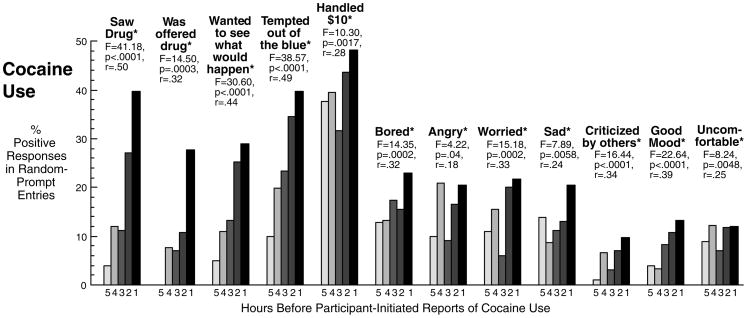
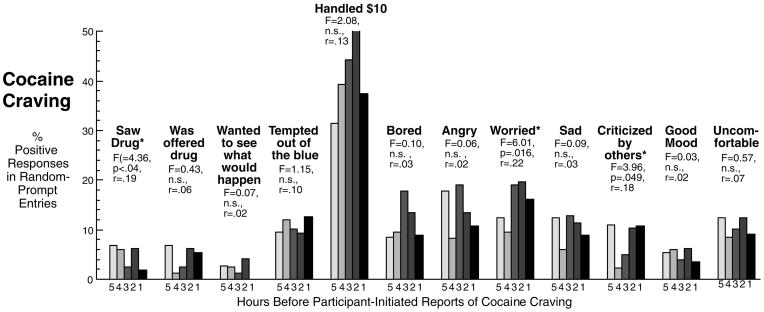
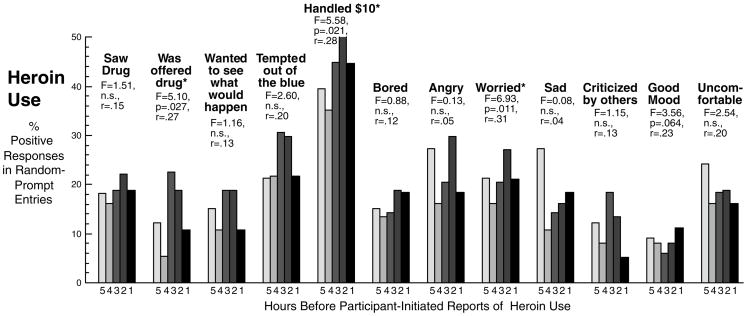
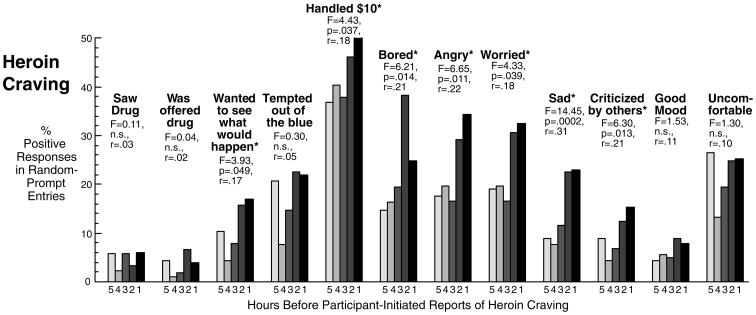
Results: During the 5 hours preceding cocaine use or heroin craving, most of the 12 putative triggers showed linear increases. Cocaine use was most robustly associated with increases in participants reporting that they "saw [the] drug" (P < .001), were "tempted to use out of the blue" (P < .001), "wanted to see what would happen if I used" (P < .001), and were in a good mood (P < .001). Heroin craving was most robustly associated with increases in reports of feeling sad (P < .001) or angry (P = .01). Cocaine craving and heroin use showed few reliable associations with any of the putative triggers assessed.
Conclusions: These findings confirm that polydrug-abusing individuals can provide behavioral data in their daily environments using handheld electronic devices and that those data can reveal orderly patterns, including prospectively detectable harbingers of craving and use, which may differ across drugs.
Conflict of interest statement
None of the authors has any conflicts of interests to disclose.
Figures
References
-
- Shiffman S, Paty J, Gnys M, Kassel J, Hickcox M. First lapses to smoking: within-subjects analysis of real-time reports. Journal of Consulting and Clinical Psychology. 1996 Apr;64(2):366–379. - PubMed
-
- Barrett L, Barrett D. An introduction to computerized experience-sampling. Social Science Computing Review. 2001;19:175–185.
-
- Stone A, Shiffman S. Ecological momentary assessment (EMA) in behavioral medicine. Annals of Behavioral Medicine. 1994;16:199–202.
-
- Shiffman S, Gwaltney CJ, Balabanis MH, et al. Immediate antecedents of cigarette smoking: an analysis from ecological momentary assessment. Journal of Abnormal Psychology. 2002 Nov;111(4):531–545. - PubMed
-
- Shiffman S, Waters AJ. Negative affect and smoking lapses: a prospective analysis. Journal of Consulting and Clinical Psychology. 2004 Apr;72(2):192–201. - PubMed
Publication types
MeSH terms
Substances
Grants and funding
LinkOut - more resources
Full Text Sources
Other Literature Sources
Medical
Research Materials