The effect of insecticide synergists on the response of scabies mites to pyrethroid acaricides
- PMID: 19125173
- PMCID: PMC2603020
- DOI: 10.1371/journal.pntd.0000354
The effect of insecticide synergists on the response of scabies mites to pyrethroid acaricides
Abstract
Background: Permethrin is the active component of topical creams widely used to treat human scabies. Recent evidence has demonstrated that scabies mites are becoming increasingly tolerant to topical permethrin and oral ivermectin. An effective approach to manage pesticide resistance is the addition of synergists to counteract metabolic resistance. Synergists are also useful for laboratory investigation of resistance mechanisms through their ability to inhibit specific metabolic pathways.
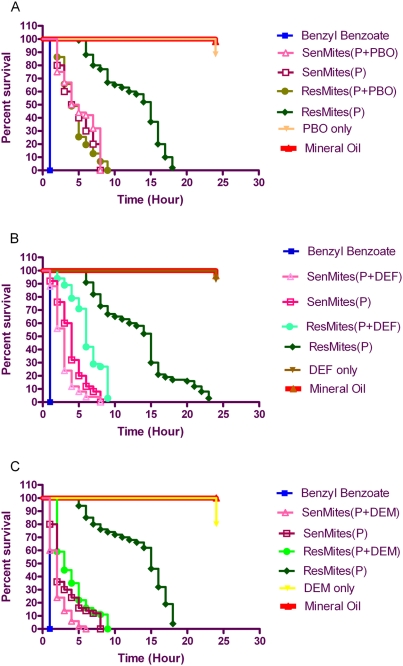
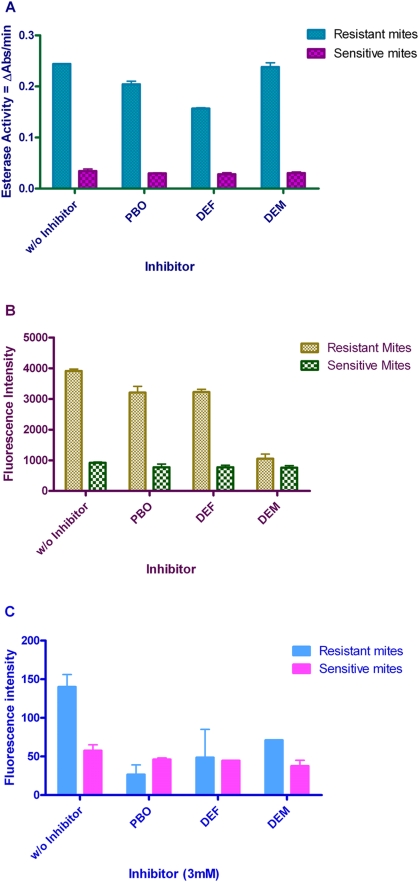
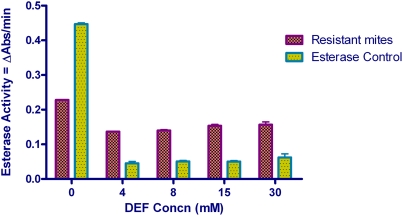
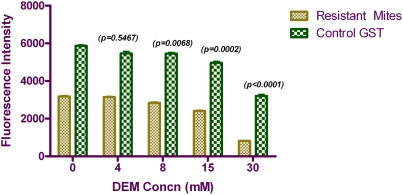
Methodology/principal findings: To determine the role of metabolic degradation as a mechanism for acaricide resistance in scabies mites, PBO (piperonyl butoxide), DEF (S,S,S-tributyl phosphorotrithioate) and DEM (diethyl maleate) were first tested for synergistic activity with permethrin in a bioassay of mite killing. Then, to investigate the relative role of specific metabolic pathways inhibited by these synergists, enzyme assays were developed to measure esterase, glutathione S-transferase (GST) and cytochrome P450 monooxygenase (cytochrome P450) activity in mite extracts. A statistically significant difference in median survival time of permethrin-resistant Sarcoptes scabiei variety canis was noted when any of the three synergists were used in combination with permethrin compared to median survival time of mites exposed to permethrin alone (p<0.0001). Incubation of mite homogenates with DEF showed inhibition of esterase activity (37%); inhibition of GST activity (73%) with DEM and inhibition of cytochrome P450 monooxygenase activity (81%) with PBO. A 7-fold increase in esterase activity, a 4-fold increase in GST activity and a 2-fold increase in cytochrome P450 monooxygenase activity were observed in resistant mites compared to sensitive mites.
Conclusions: These findings indicate the potential utility of synergists in reversing resistance to pyrethroid-based acaricides and suggest a significant role of metabolic mechanisms in mediating pyrethroid resistance in scabies mites.
Conflict of interest statement
The authors have declared that no competing interests exist.
Figures
References
-
- Mounsey KE, Holt DC, McCarthy J, Currie BJ, Walton SF. Scabies: molecular perspectives and therapeutic implications in the face of emerging drug resistance. Future Microbiol. 2008;3(1):57–66. - PubMed
-
- Carapetis JR, Connors C, Yarmirr D, Krause V, Currie BJ. Success of a scabies control program in an Australian aboriginal community. Pediatric Infect Dis J. 1997;16(5):494–499. - PubMed
-
- Davies TGE, Field LM, Usherwood PNR, Williamson MS. DDT, pyrethrins, pyrethroids and insect sodium channels. IUBMB Life. 2007;59(3):151–162. - PubMed
-
- Anspaugh DD, Rose RL, Koehler PG, Hodgson E, Roe M. Multiple mechanisms of pyrethroid resistance in the German cockroach, Blattella germanica (L.). Pest Biochem Physiol. 1994;50:138–148.
-
- Jamroz RC, Guerrero FD, Pruett JH, Oehler DD, Miller RJ. Molecular and biochemical survey of acaricide resistance mechanisms in larvae from Mexican strains of the southern cattle tick, Boophilus microplus. . J Insect Physiol. 2000;46:685–695. - PubMed
Publication types
MeSH terms
Substances
Grants and funding
LinkOut - more resources
Full Text Sources
Research Materials