Adipokines, inflammation, and visceral adiposity across the menopausal transition: a prospective study
- PMID: 19126626
- PMCID: PMC2682462
- DOI: 10.1210/jc.2008-0701
Adipokines, inflammation, and visceral adiposity across the menopausal transition: a prospective study
Abstract
Context: Postmenopausal women have greater visceral adiposity compared with premenopausal women. Adipokines are associated with increased adiposity, insulin resistance, and atherosclerosis.
Objective: The objective of the study was to assess changes in adipokines and inflammatory markers through the menopausal transition and correlate them with changes in visceral adiposity.
Design and setting: This was a prospective cohort study of women through the menopausal transition conducted at the University of Washington.
Participants: Sixty-nine healthy women were followed up longitudinally from premenopausal (aged 45-55 yr) to postmenopausal status (aged 49-60 yr).
Outcome: On premenopausal and postmenopausal visits, fasting blood was drawn for adiponectin, leptin, serum amyloid A (SAA), C-reactive protein (CRP), monocyte-chemotactic protein-1, tissue plasminogen activator antigen (tPA), IL-6, and TNF-alpha. Body composition measures were assessed by body mass index, whole-body dual x-ray absorptiometry scan, and computed tomography scan of the abdomen at the lumbar 4-5 level.
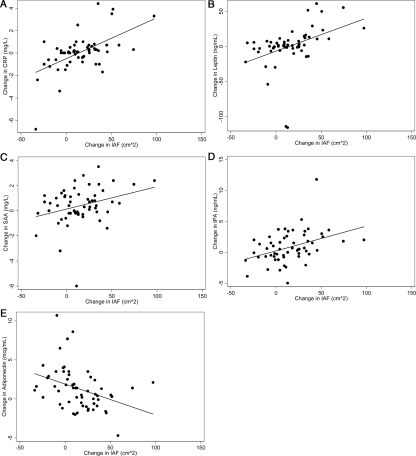
Results: Women had a statistically significant increase in SAA, tPA, monocyte-chemotactic protein-1, and adiponectin between the two measurement occasions (P = 0.04, P = 0.02, P = 0.001, and P < 0.001, respectively). The increase in intraabdominal fat was correlated positively with the change in SAA (r = 0.31, P = 0.02), CRP (r = 0.56, P < 0.001), tPA (r = 0.40, P = 0.002), and leptin (r = 0.41, P = 0.002) and negatively correlated with the change in adiponectin (r = -0.37, P = 0.005). After adjustment for change in sc abdominal fat, the correlation between change in CRP, tPA, leptin, and adiponectin remained significantly associated with change in intraabdominal fat.
Conclusions: Women going through the menopausal transition have deleterious changes in inflammatory markers and adipokines that correlate with increased visceral adiposity.
Figures
References
-
- Kanaley JA, Sames C, Swisher L, Swick AG, Ploutz-Snyder LL, Steppan CM, Sagendorf KS, Feiglin D, Jaynes EB, Meyer RA, Weinstock RS 2001 Abdominal fat distribution in pre- and postmenopausal women: the impact of physical activity, age, and menopausal status. Metabolism 50:976–982 - PubMed
-
- Tchernof A, Desmeules A, Richard C, Laberge P, Daris M, Mailloux J, Rheaume C, Dupont P 2004 Ovarian hormone status and abdominal visceral adipose tissue metabolism. J Clin Endocrinol Metab 89:3425–3430 - PubMed
-
- Gohlke-Barwolf C 2000 Coronary artery disease—is menopause a risk factor? Basic Res Cardiol 95(Suppl 1):I77–183 - PubMed
-
- Tilg H, Moschen AR 2006 Adipocytokines: mediators linking adipose tissue, inflammation and immunity. Nat Rev Immunol 6:772–783 - PubMed
-
- Berg AH, Scherer PE 2005 Adipose tissue, inflammation, and cardiovascular disease. Circ Res 96:939–949 - PubMed
Publication types
MeSH terms
Substances
Grants and funding
- R01 HL064322/HL/NHLBI NIH HHS/United States
- P01 HL030086/HL/NHLBI NIH HHS/United States
- DK35816/DK/NIDDK NIH HHS/United States
- M01-RR-00037/RR/NCRR NIH HHS/United States
- HL64322/HL/NHLBI NIH HHS/United States
- R01 NR004141/NR/NINR NIH HHS/United States
- M01 RR000037/RR/NCRR NIH HHS/United States
- HL30086/HL/NHLBI NIH HHS/United States
- K23RR16067/RR/NCRR NIH HHS/United States
- P30 DK035816/DK/NIDDK NIH HHS/United States
- NR04141/NR/NINR NIH HHS/United States
- P30 DK-17047/DK/NIDDK NIH HHS/United States
- K23 RR016067/RR/NCRR NIH HHS/United States
- P30 DK017047/DK/NIDDK NIH HHS/United States
LinkOut - more resources
Full Text Sources
Medical
Research Materials
Miscellaneous