


The accuracy of self-reported history of seizures in Danish, Norwegian and U.S. twins
- PMID: 19128944
- PMCID: PMC2674277
- DOI: 10.1016/j.eplepsyres.2008.11.014
The accuracy of self-reported history of seizures in Danish, Norwegian and U.S. twins
Abstract
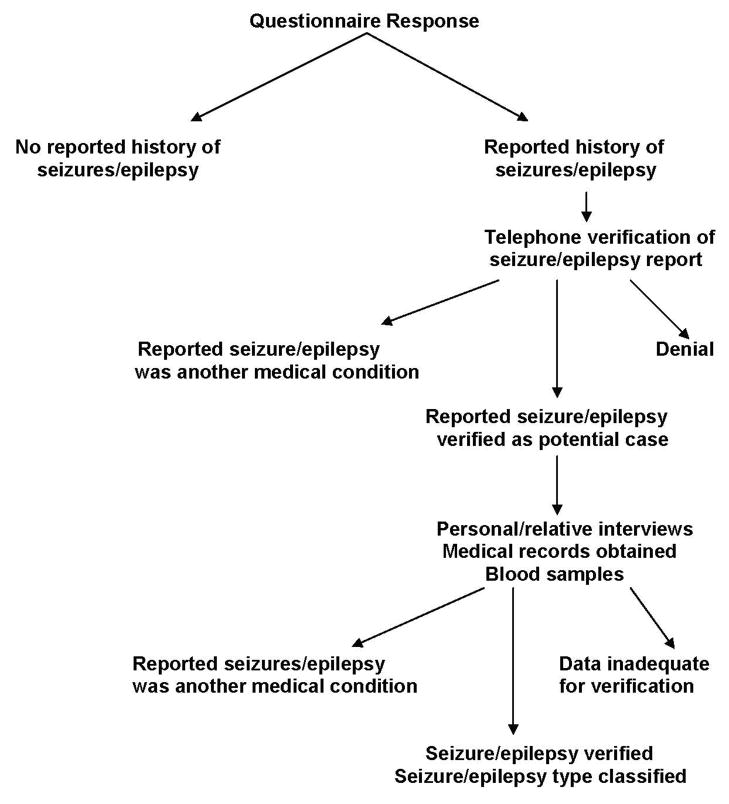
Questionnaire surveys provide an efficient means of identifying potential seizure cases in large population-based cohorts. Concerns exist, however, with regard to the reliability of self-reported information both with respect to the validity of the results obtained and with regard to the usefulness of this approach in identifying true cases. Information on history of seizures obtained by questionnaire from members of 47,626 twin pairs included in the Mid-Atlantic (MATR), Danish (DTR) and Norwegian (NTR) Twin Registries was verified using medical records and detailed clinical and family interviews. The accuracy of these reports was assessed. Self-reported epilepsy was verified in 81.9% of twins overall (86.1% (DTR), 75.6% (NTR) and 80.7% (MATR)). However, when both pair members reported a history of epilepsy in the affected pair member, epilepsy was verified in >90% of cases. Among MATR twins with a verified history of epilepsy, 21.5% reported other seizures but not epilepsy and 18.5% of verified Norwegian epilepsy cases reported no history of epilepsy themselves and were identified only through their co-twin. The results of this study indicate that the accuracy of self-reported epilepsy and febrile seizures among those who provided information on health history was high across all populations. However, the relatively large percentage of twins with a verified diagnosis who did not acknowledge epilepsy suggests that the frequency of epilepsy may be under-estimated in self-reported samples.
Figures
References
-
- Jacoby A. Epilepsy and the quality of everyday life. Findings from a study of people with well-controlled epilepsy. Soc Sci Med. 1992;36:657–666. - PubMed
-
- Jacoby A. Felt versus enacted stigma: a concept revisited. Soc Sci Med. 1994;38:269–274. - PubMed
-
- Ottman R, Hauser WA, Susser M. Validity of family history data on seizure disorders. Epilepsia. 1993;34:469–475. - PubMed
-
- Santilli N, Dreifuss FE. Pediatric management problems. Epilepsy. Pediatr Nurs. 1979;5:62. - PubMed
-
- Scambler G. Patient perceptions of epilepsy and of doctors who manage epilepsy. Seizure. 1994;3:287–293. - PubMed
Publication types
MeSH terms
Grants and funding
LinkOut - more resources
Full Text Sources
Medical
