. 2009 Mar 22;276(1659):1101-7.
doi: 10.1098/rspb.2008.1554.

A bizarre Cretaceous theropod dinosaur from Patagonia and the evolution of Gondwanan dromaeosaurids

Affiliations

A bizarre Cretaceous theropod dinosaur from Patagonia and the evolution of Gondwanan dromaeosaurids

Fernando E Novas et al. Proc Biol Sci. .

Abstract

Fossils of a predatory dinosaur provide novel information about the evolution of unenlagiines, a poorly known group of dromaeosaurid theropods from Gondwana. The new dinosaur is the largest dromaeosaurid yet discovered in the Southern Hemisphere and depicts bizarre cranial and postcranial features. Its long and low snout bears numerous, small-sized conical teeth, a condition resembling spinosaurid theropods. Its short forearms depart from the characteristically long-armed condition of all dromaeosaurids and their close avian relatives. The new discovery amplifies the range of morphological disparity among unenlagiines, demonstrating that by the end of the Cretaceous this clade included large, short-armed forms alongside crow-sized, long-armed, possibly flying representatives. The new dinosaur is the youngest record of dromaeosaurids from Gondwana and represents a previously unrecognized lineage of large predators in Late Cretaceous dinosaur faunas mainly dominated by abelisaurid theropods.


Figures
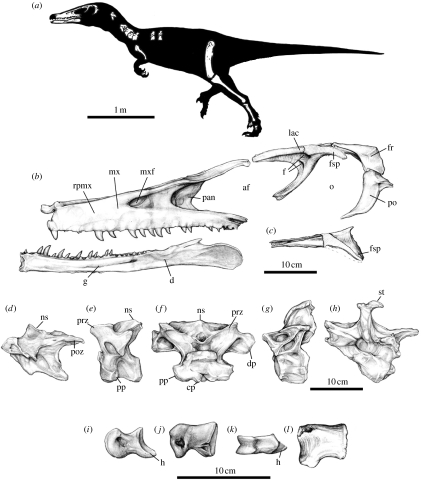
Figure 1
Figure 1
Austroraptor cabazai MML 195, holotype. (a) Skeletal reconstruction and body shape, indicating discovered bones. Body length was estimated following equations described by Turner et al. (2007). (b) Skull reconstruction in left lateral view. (c) Left lacrimal in dorsal aspect. (d) Cervical 3? in left lateral view. (e,f) Cervical 8? in (e) left lateral and (f) cranial views. (g,h) Dorsal 4? in (g) left lateral and (h) cranial views. (i,k) Pedal phalanx II-2 in (i) left lateral and (k) dorsal views. (j,l) Pedal phalanx IV-2 in (j) left lateral and (l) dorsal views. af, antorbital fenestra; cp, carotid process; d, dentary; dp, diapophysis; f, foramina; fr, frontal; fsp, fan-shaped process of lacrimal; g, groove; h, caudoventral heel; lac, lacrimal; mx, maxilla; mxf, maxillary fenestra; ns, neural spine; o, orbit; pan, postantral wall; po, postorbital; poz, postzygapophysis; pp, parapophysis; prz, prezygapophysis; rpmx, rostral process of maxilla; st, spine table.
Figure 2
Figure 2
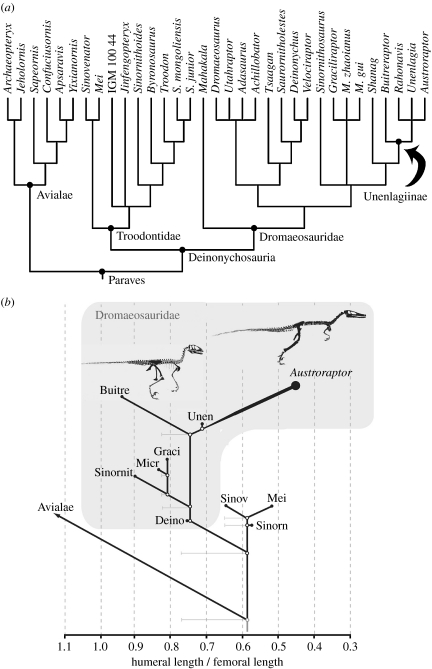
Phylogenetic relationships of Austroraptor cabazai. (a) Summarized strict consensus depicting the phylogenetic relationships of Austroraptor within Paraves. Austroraptor is deeply nested within Dromaeosauridae and Unenlagiinae. The affinities of A. cabazai were tested using recently published datasets within the broad context of Coelurosauria (Turner et al. 2007) and analysed with equally weighted parsimony in TNT27 (Goloboff et al. 2008). Further phylogenetic data and a complete strict consensus tree are offered in the electronic supplementary material. (b) Phylogenetic tree of paravian coelurosaurs displaying the evolution of forelimb/hindlimb proportions, as measured by the humeral length/femoral length ratio (H/F) optimized as a continuous character using linear parsimony in TNT27. Root of the tree located at the bottom of the figure (marked in grey) and derived branches to the top. The location of nodes and taxa along the horizontal axis represents the H/F ratio (filled circles, measured taxa; open circles, inferred ancestral values; error bars, ranges of possible ancestral values or intraspecific variation for terminal taxa). Grey box encloses dromaeosaurid maniraptorans, exemplified by two silhouettees: a generalized dromaeosaurid with elongated forelimbs, based on Deinonychus (Ostrom 1969), and Austroraptor with reduced forelimbs. See the electronic supplementary material for further explanation. Buitre, Buitreraptor; Deino, Deinonychus; Graci, Graciliraptor; Micr, Microraptor; Sinorn, Sinornithoides; Sinornit, Sinornithosaurus; Sinov, Sinovenator; Unen, Unenlagia.

References

    1. Agnolin, F. L., Novas, F. E., & Powell, J. E. 2006 New alvarezsaurid theropod from the Latest Cretaceous of Río Negro province, Patagonia, Argentina. XXII Jornadas Argentinas de Paleontología de Vertebrados (Boletín de Resúmenes), p. 1.
    1. Barsbold R. Saurornithoididae, a new family of small theropod dinosaurs from Central Asia and North America. Palaeontol. Pol. 1974;30:5–22.
    1. Barsbold R., Osmólska H. The skull of Velociraptor (Theropoda) from the Late Cretaceous of Mongolia. Acta Palaeontol. Pol. 1999;44:189–219.
    1. Calvo J.O., Porfiri J.D., Kellner A.W.A. On a new maniraptoran dinosaur (Theropoda) from the Upper Cretaceous of Neuquén, Patagonia, Argentina. Arquivos do Museu Nacional, Rio de Janeiro. 2004;62:549–566.
    1. Chiappe L.M. Wiley; Hoboken, NJ: 2007. Glorified dinosaurs: the origin and early evolution of birds.

Publication types