


Contact heterogeneity in deer mice: implications for Sin Nombre virus transmission
- PMID: 19129136
- PMCID: PMC2660967
- DOI: 10.1098/rspb.2008.1693
Contact heterogeneity in deer mice: implications for Sin Nombre virus transmission
Abstract
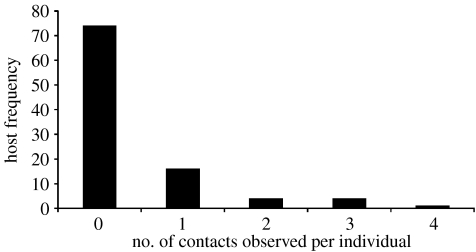
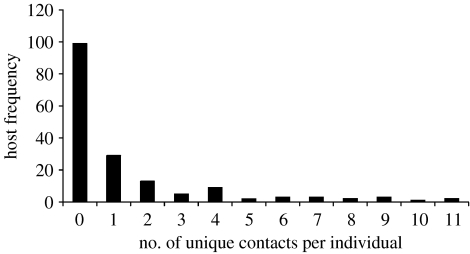
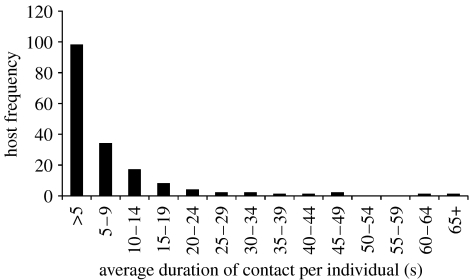
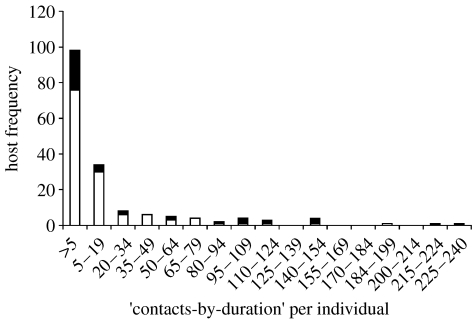
Heterogeneities within disease hosts suggest that not all individuals have the same probability of transmitting disease or becoming infected. This heterogeneity is thought to be due to dissimilarity in susceptibility and exposure among hosts. As such, it has been proposed that many host-pathogen systems follow the general pattern whereby a small fraction of the population accounts for a large fraction of the pathogen transmission. This disparity in transmission dynamics is often referred to as '20/80 Rule', i.e. approximately 20 per cent of the hosts are responsible for 80 per cent of pathogen transmission. We investigated the role of heterogeneity in contact rates among potential hosts of a directly transmitted pathogen by examining Sin Nombre virus (SNV) in deer mice (Peromyscus maniculatus). Using foraging arenas and powder marking, we documented contacts between wild deer mice in Great Basin Desert, central Utah. Our findings demonstrated heterogeneity among deer mice, both in frequency and in duration of contacts with other deer mice. Contact dynamics appear to follow the general pattern that a minority of the population accounts for a majority of the contacts. We found that 20 per cent of individuals in the population were responsible for roughly 80 per cent of the contacts observed. Larger-bodied individuals appear to be the functional group with the greatest SNV transmission potential. Contrary to our predictions, transmission potential was not influenced by breeding condition or sex.
Figures
References
-
- Altizer S., Dobson D., Hosseini P., Hudson P., Rohani P. Seasonality and the dynamics of infectious diseases. Ecol. Lett. 2006;9:467–484. doi:10.1111/j.1461-0248.2005.00879.x - DOI - PubMed
-
- Boone J.D., Otteson E.W., McGwire K.C., Villard P., Rowe J.E., St Jeor S.C. Ecology and demographics of hantavirus infection in rodent populations in the Walker river basin of Nevada and California. Am. J. Trop. Med. Hyg. 1998;59:445–451. - PubMed
-
- Borucki M.K., Boone J.D., Rowe J.E., Bohlman M.C., Kuhn E.A., DeBacca R., St Jeor S.C. Role of maternal antibody in natural infection of Peromyscus maniculatus with Sin Nombre virus. J. Virol. 2000;74:2426–2429. doi:10.1128/JVI.74.5.2426-2429.2000 - DOI - PMC - PubMed
-
- Botten J., Mirowsky K., Ye C., Gottlieb K., Saavedra M., Ponce L., Hjelle B. Shedding and intracage transmission of Sin Nombre hantavirus in the deer mouse (Peromyscus maniculatus) model. J. Virol. 2002;76:7587–7594. doi:10.1128/JVI.76.15.7587-7594.2002 - DOI - PMC - PubMed
Publication types
MeSH terms
Grants and funding
LinkOut - more resources
Full Text Sources
Research Materials
