. 2009;60(3):765-78.
doi: 10.1093/jxb/ern327. Epub 2009 Jan 6.

Gene expression studies in kiwifruit and gene over-expression in Arabidopsis indicates that GDP-L-galactose guanyltransferase is a major control point of vitamin C biosynthesis

Affiliations

Gene expression studies in kiwifruit and gene over-expression in Arabidopsis indicates that GDP-L-galactose guanyltransferase is a major control point of vitamin C biosynthesis

Sean M Bulley et al. J Exp Bot. 2009.

Abstract

Vitamin C (L-ascorbic acid, AsA) is an essential metabolite for plants and animals. Kiwifruit (Actinidia spp.) are a rich dietary source of AsA for humans. To understand AsA biosynthesis in kiwifruit, AsA levels and the relative expression of genes putatively involved in AsA biosynthesis, regeneration, and transport were correlated by quantitative polymerase chain reaction in leaves and during fruit development in four kiwifruit genotypes (three species; A. eriantha, A. chinensis, and A. deliciosa). During fruit development, fruit AsA concentration peaked between 4 and 6 weeks after anthesis with A. eriantha having 3-16-fold higher AsA than other genotypes. The rise in AsA concentration typically occurred close to the peak in expression of the L-galactose pathway biosynthetic genes, particularly the GDP-L-galactose guanyltransferase gene. The high concentration of AsA found in the fruit of A. eriantha is probably due to higher expression of the GDP-mannose-3',5'-epimerase and GDP-L-galactose guanyltransferase genes. Over-expression of the kiwifruit GDP-L-galactose guanyltransferase gene in Arabidopsis resulted in up to a 4-fold increase in AsA, while up to a 7-fold increase in AsA was observed in transient expression studies where both GDP-L-galactose guanyltransferase and GDP-mannose-3',5'-epimerase genes were co-expressed. These studies show the importance of GDP-L-galactose guanyltransferase as a rate-limiting step to AsA, and demonstrate how AsA can be significantly increased in plants.


Figures
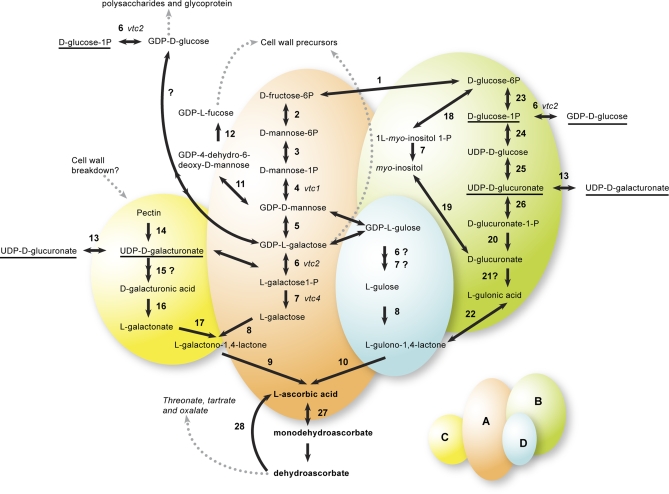
Fig. 1.
Fig. 1.
Reactions, enzymes, and context of ascorbic acid biosynthesis and regeneration in plants. (A) L-Galactose pathway, reactions 2–9. (B) myo-Inositol/glucuronate pathway, reactions 7, 18–26. (C) Galacturonate pathway, reactions 14–17. (D) L-Gulose pathway, possible reactions 5, 6, 7, 8, and 10. Reactions with question marks after the number are hypothetical and the exact enzyme is yet to be identified. Underlined chemical names are those that appear in more than one position in the diagram. Gene expression of transcripts of numbered enzymes in bold type were analysed. 1, glucose-6-phosphate isomerase; 2, mannose-6-phosphate isomerase; 3, phosphomannomutase; 4, GDP-mannose pyrophosphorylase; 5, GDP-mannose-3′,5′-epimerase; 6, GDP-L-galactose transferase; 7, L-galactose-1-phosphate phosphatase; 8, L-galactose dehydrogenase; 9, L-galactono-1,4-lactone dehydrogenase; 10, L-gulono-1,4-lactone oxidase; 11, GDP-D-mannose-4,6-dehydratase; 12, GDP-L-fucose synthase; 13, UDP-galacturonate epimerase; 14, polygalacturonate 4-α-galacturonosyltransferase; 15, galacturonate-1-phosphate uridylyltransferase and galacturonate-1-phosphate phosphatase (hypothetical); 16, D-galacturonic acid reductase; 17, aldonolactonase; 18, L-myo-inositol 1-phosphate synthase; 19, myo-inositol oxygenase; 20, D-glucurono-1-phosphate phosphatase; 21, glucuronate reductase; 22, gulonolactonase; 23, phosphoglucomutase; 24, UDP-glucose-pyrophosphorylase; 25, UDP-glucose dehydrogenase; 26, glucuronate-1-phosphate uridylyltransferase; 27, monodehydroascorbate reductase; 28, dehydroascorbate reductase; vtc, vitamin C content.
Fig. 2.
Fig. 2.
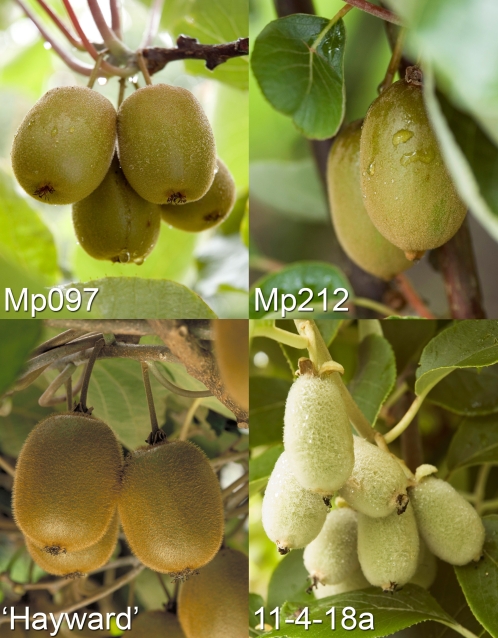
Fruit (nearing maturity) of the four Actinidia genotypes assayed in this study. Mp097 and Mp212 are two mapping population genotypes of A. chinensis, ‘Hayward’ is the green A. deliciosa, and 11-4-18a is A. eriantha.
Fig. 3.
Fig. 3.
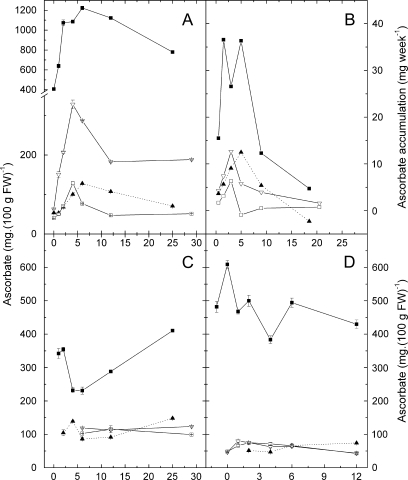
Change in L-ascorbic acid (AsA) concentration in Actinidia genotypes during the growing season. (A) AsA concentration in fruit. (B) Rate of change of ascorbate concentration (accumulation) calculated over adjacent time points from (A) and plotted at the mean time interval. Rates were calculated from measured fruit ascorbate and fruit size. Fruit size was measured from 6 weeks and estimated at earlier stages assuming linear growth during this early period. Rates were calculated as the difference in total fruit ascorbate over consecutive time periods divided by the difference in time. (C) AsA concentration in mature leaves (fully expanded leaves ∼20 cm diameter) over the period of a growing season. (D) AsA concentration in young leaves (1–3 cm in diameter) over the period of a growing season. (Open inverted triangles) A. chinensis MP097; (closed squares) A. eriantha; (open squares) A. chinensis MP212; (closed triangles) A. deliciosa. Bars show standard errors.
Fig. 4.
Fig. 4.
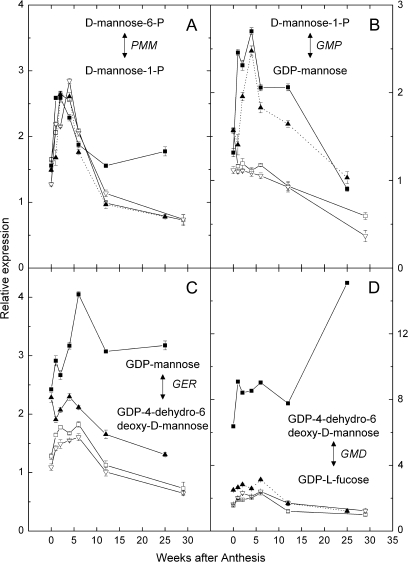
Relative expression in a developmental series of kiwifruit fruit of genes encoding enzymes leading up to and from GDP-Mannose. (A) PMM (enzyme 3 in Fig. 1); (B) GMP (4); (C) GER (11); and (D) GMD (12). Results are expressed relative to the calibrating internal control gene: kiwifruit orthologue of At1g13320 [65 kDa regulatory subunit of protein phosphatase 2A (PP2A)]. Expression of the target gene in sample 12 weeks after anthesis was assigned the expression value of 1. Symbols as for Fig. 3.
Fig. 5.
Fig. 5.
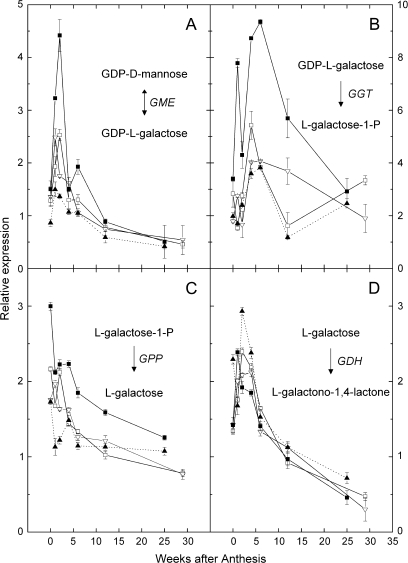
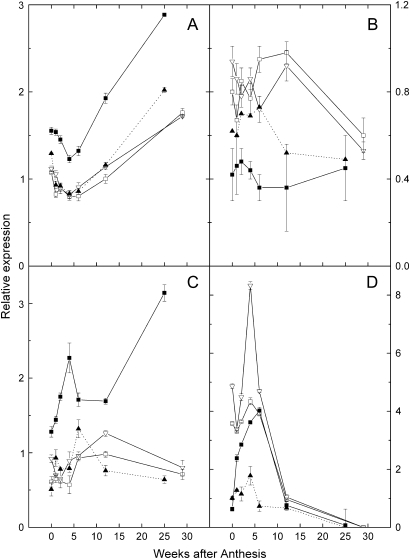
Relative expression in a developmental series of kiwifruit fruit of genes encoding enzymes of the L-galactose pathway. (A) GME (5); (B) GGT (6); (C) GPP (7); (D) GDH (8). Symbols as for Fig. 3. In (C), the same enzyme also catalyses the conversion of myo-inositol-1-P to myo-inositol. The gene sequence of the final enzyme leading to ascorbate [L-galactono-1,4-lactone dehydrogenase (9)] was not available and so no PCR results are available. Calibrating internal control gene: kiwifruit orthologue of At1g13320. Expression of the target gene in sample 12 weeks after anthesis was assigned the expression value of 1. The L-myo-inositol-1-P phosphatase that converts L-myo-inositol-1-P to myo-inositol (reaction 7 in Fig. 1) is shown in Fig. 5C. Symbols as for Fig. 3.
Fig. 6.
Fig. 6.
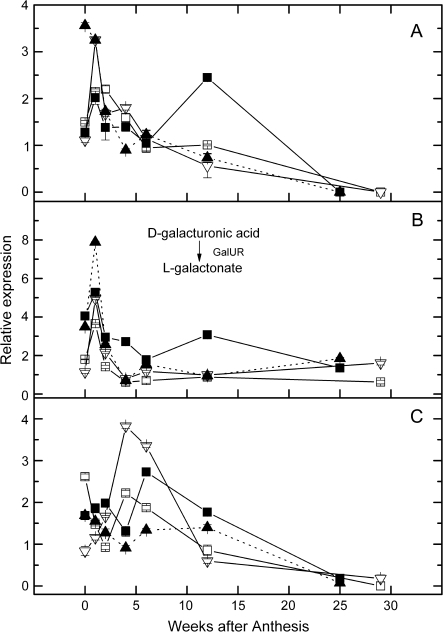
Relative expression in a developmental series of kiwifruit fruit of galacturonic acid reductase genes. (A) GalUR1 (16); (B) GalUR2; (C) GalUR3. Calibrating internal control gene: kiwifruit orthologue of At1g13320. Expression of the target gene in sample 12 weeks after anthesis was assigned the expression value of 1. Symbols as for Fig. 3.
Fig. 7.
Fig. 7.
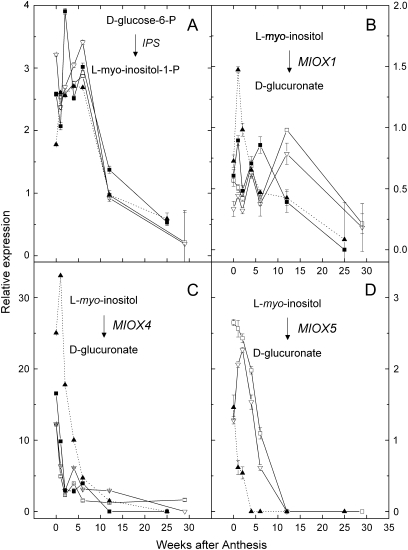
Relative expression in a developmental series of kiwifruit fruit of genes involved in inositol metabolism. (A) IPS (18); (B) MIOX1 (19); (C) MIOX4; (D) MIOX5. Calibrating internal control gene: kiwifruit orthologue of At1g13320. Expression of the target gene in sample 12 weeks after anthesis was assigned the expression value of 1 for all except MIOX5, for which no target was detected. In this case the Mp212 6 WAA sample was assigned the expression value of 1. Symbols as for Fig. 3.
Fig. 8.
Fig. 8.
Relative expression in a developmental series of kiwifruit fruit of genes involved in L-ascorbic acid (AsA) recycling and oxidation. (A) MDHAR (27), (B) DHAR1 (28); (C) DHAR2; (D) AO. Calibrating internal control gene: kiwifruit orthologue of At1g13320. Expression of the target gene in sample 12 weeks after anthesis was assigned the expression value of 1. Symbols as for Fig. 3.
Fig. 9.
Fig. 9.
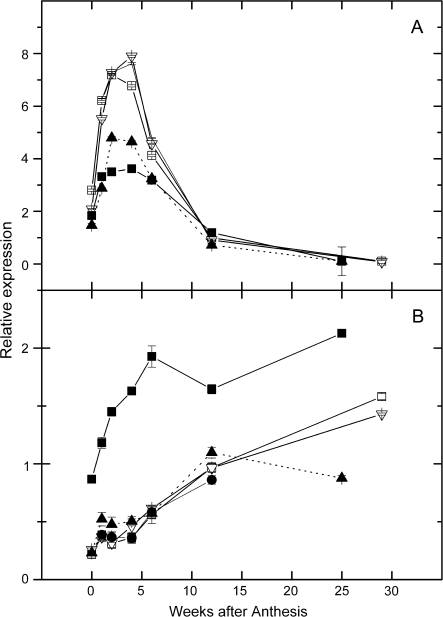
Relative expression in a developmental series of kiwifruit fruit of putative L-ascorbic acid (AsA) transporter genes. (A) T1; (B) T2. Calibrating internal control gene: kiwifruit orthologue of At1g13320. Expression of the target gene in sample 12 weeks after anthesis was assigned the expression value of 1. Symbols as for Fig. 3.

References

    1. Agius F, Gonzalez-Lamothe R, Caballero JL, Munoz-Blanco J, Botella MA, Valpuesta V. Engineering increased vitamin C levels in plants by over-expression of a D-galacturonic acid reductase. Nature Biotechnology. 2003;21:177–181. - PubMed
    1. Alhagdow M, Mounet F, Gilbert L, et al. Silencing of the mitochondrial ascorbate synthesizing enzyme L-galactono-1,4-lactone dehydrogenase affects plant and fruit development in tomato. Plant Physiology. 2007;145:1408–1422. - PMC - PubMed
    1. Anderson E. The preparation of L-galactose from flax seed mucilage. Journal of Biological Chemistry. 1933;100:249–253.
    1. Arrigoni O, De Tullio MC. The role of ascorbic acid in cell metabolism: between gene-directed functions and unpredictable chemical reactions. Journal of Plant Physiology. 2000;157:481–488.
    1. Baig MM, Kelly S, Loewus F. L-ascorbic acid biosynthesis in higher plants from L-gulono-1,4-lactone and L-galactono-1,4-lactone. Plant Physiology. 1970;46:277–280. - PMC - PubMed

Publication types

MeSH terms