Comorbidity and repeat admission to hospital for adverse drug reactions in older adults: retrospective cohort study
- PMID: 19129307
- PMCID: PMC2615549
- DOI: 10.1136/bmj.a2752
Comorbidity and repeat admission to hospital for adverse drug reactions in older adults: retrospective cohort study
Abstract
Objectives: To identify factors that predict repeat admission to hospital for adverse drug reactions (ADRs) in older adults.
Design: Population based retrospective cohort study.
Setting: All public and private hospitals in Western Australia.
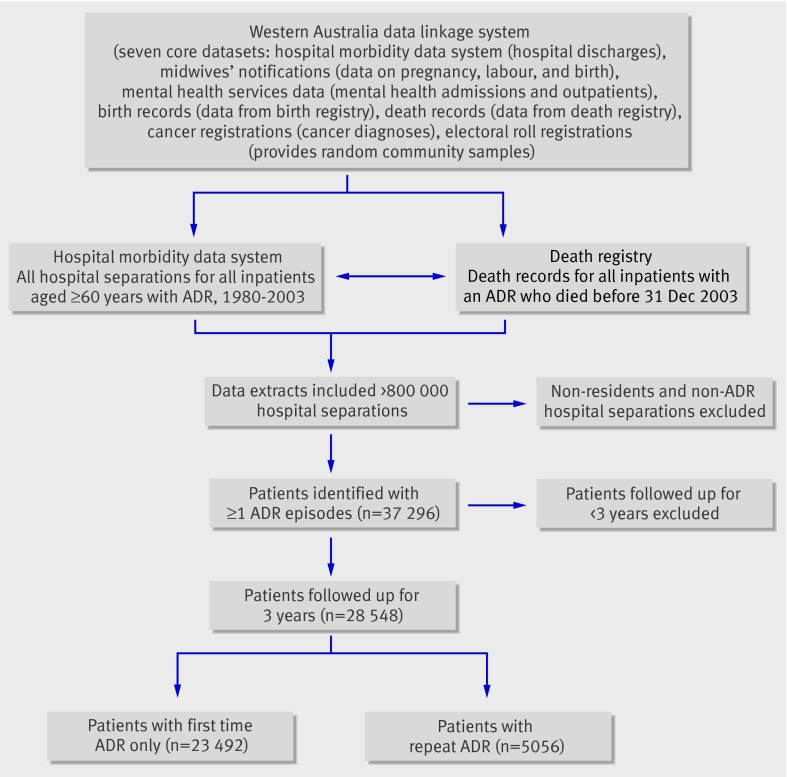
Participants: 28 548 patients aged >or=60 years with an admission for an ADR during 1980-2000 followed for three years using the Western Australian data linkage system.
Results: 5056 (17.7%) patients had a repeat admission for an ADR. Repeat ADRs were associated with sex (hazard ratio 1.08, 95% confidence interval 1.02 to 1.15, for men), first admission in 1995-9 (2.34, 2.00 to 2.73), length of hospital stay (1.11, 1.05 to 1.18, for stays >or=14 days), and Charlson comorbidity index (1.71, 1.46 to 1.99, for score >or=7); 60% of comorbidities were recorded and taken into account in analysis. In contrast, advancing age had no effect on repeat ADRs. Comorbid congestive cardiac failure (1.56, 1.43 to 1.71), peripheral vascular disease (1.27, 1.09 to 1.48), chronic pulmonary disease (1.61, 1.45 to 1.79), rheumatological disease (1.65, 1.41 to 1.92), mild liver disease (1.48, 1.05 to 2.07), moderate to severe liver disease (1.85, 1.18 to 2.92), moderate diabetes (1.18, 1.07 to 1.30), diabetes with chronic complications (1.91, 1.65 to 2.22), renal disease (1.93, 1.71 to 2.17), any malignancy including lymphoma and leukaemia (1.87, 1.68 to 2.09), and metastatic solid tumours (2.25, 1.92 to 2.64) were strong predictive factors. Comorbidities requiring continuing care predicted a reduced likelihood of repeat hospital admissions for ADRs (cerebrovascular disease 0.85, 0.73 to 0.98; dementia 0.62, 0.49 to 0.78; paraplegia 0.73, 0.59 to 0.89).
Conclusions: Comorbidity, but not advancing age, predicts repeat admission for ADRs in older adults, especially those with comorbidities often managed in the community. Awareness of these predictors can help clinicians to identify which older adults are at greater risk of admission for ADRs and, therefore, who might benefit from closer monitoring.
Figures
Comment in
-
Readmissions as a result of adverse drug reactions in older people.BMJ. 2009 Jan 7;338:a2436. doi: 10.1136/bmj.a2436. BMJ. 2009. PMID: 19129306 No abstract available.
References
-
- Lazarou J, Pomeranz BH, Corey PN. Incidence of adverse drug reactions in hospitalized patients: a meta-analysis of prospective studies. JAMA 1998;279:1200-5. - PubMed
-
- Roughead EE. The nature and extent of drug-related hospitalisations in Australia. J Qual Clin Pract 1999;19:19-22. - PubMed
-
- Onder G, Pedone C, Landi F, Cesari M, Della Vedova C, Bernabei R, et al. Adverse drug reactions as cause of hospital admissions: results from the Italian Group of Pharmacoepidemiology in the Elderly (GIFA). J Am Geriatr Soc 2002;50:1962-8. - PubMed
-
- Suh DC, Woodall BS, Shin SK, Hermes-De Santis ER. Clinical and economic impact of adverse drug reactions in hospitalized patients. Ann Pharmacother 2000;34:1373-9. - PubMed
Publication types
MeSH terms
LinkOut - more resources
Full Text Sources
Medical
Research Materials