


Review
doi: 10.1038/nrc2562.
Epub 2008 Dec 29.
How does SIRT1 affect metabolism, senescence and cancer?
Affiliations
- PMID: 19132007
- PMCID: PMC2857763
- DOI: 10.1038/nrc2562
Item in Clipboard
Review
How does SIRT1 affect metabolism, senescence and cancer?
Nat Rev Cancer.
2009 Feb.
Abstract
SIRT1 is a multifaceted, NAD(+)-dependent protein deacetylase that is involved in a wide variety of cellular processes from cancer to ageing. The function of SIRT1 in cancer is complex: SIRT1 has been shown to have oncogenic properties by downregulating p53 activity, but recent studies indicate that SIRT1 acts as a tumour suppressor in a mutated p53 background, raising intriguing questions regarding its mechanism of action. Here we discuss the current understanding of how SIRT1 functions in light of recent discoveries and propose that the net outcome of the seemingly opposite oncogenic and tumour-suppressive effects of SIRT1 depends on the status of p53.
Figures
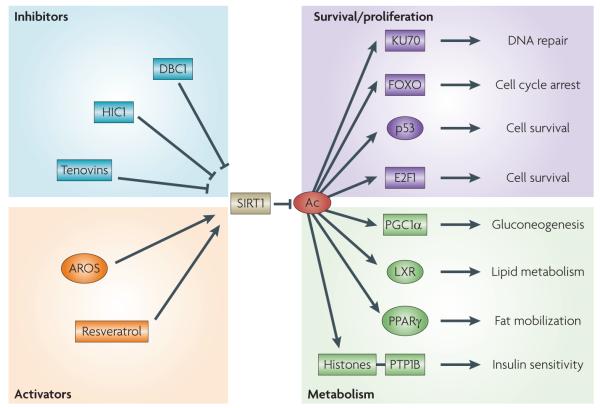
SIRT1 is an NAD+-dependent histone deacetylase that catalyses the removal of acetyl (Ac) groups from a number of non-histone targets. The downstream effects of target deacetylation include changes in cellular metabolism (lipid metabolism, insulin sensitivity, reverse cholesterol transport and gluconeogenesis) as well as cell survival and senescence effects (cell survival and DNA repair). Several protein regulators and small-molecule compounds that can activate or inhibit SIRT1 function have also been described. AROS, active regulator of SIRT1; DBC1, deleted in breast cancer 1; FOXO, forkhead box; HIC1, hypermethylated in cancer 1; LXR, liver X receptor; PGc1α, PPARγ coactivator 1α; PPARγ, peroxisome proliferator-activated receptor-γ; PTP1B, protein-tyrosine phosphatase 1B.
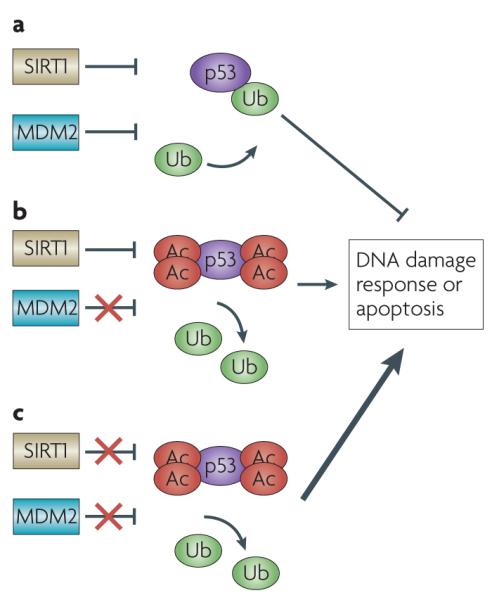
a | MDM2 and SIRT1 negatively regulate p53 and prevent upregulation of p53 under normal conditions. b | Small-molecule inhibitors of MDM2 have been shown to inhibit cell growth and induce apoptosis in some tumour cell lines. c | Use of small-molecule inhibitors of SIRT1 in tumour cells that overexpress the protein may sensitize the cells to a combination of therapeutics, inducing a stronger p53 response and promoting apoptosis of tumour cells. Ac, acetyl; Ub, ubiquitin.
References
-
- Bordone L, Guarente L. Calorie restriction, SIRT1 and metabolism: understanding longevity. Nature Rev. Mol. Cell Biol. 2005;6:298–305. - PubMed
-
- Campisi J. Suppressing cancer: the importance of being senescent. Science. 2005;309:886–887. - PubMed
-
- Wang C, et al. Interactions between E2F1 and SirT1 regulate apoptotic response to DNA damage. Nature Cell Biol. 2006;8:1025–1031. - PubMed
-
- Nahle Z, et al. Direct coupling of the cell cycle and cell death machinery by E2F. Nature Cell Biol. 2002;4:859–864. - PubMed
-
- Ford J, Jiang M, Milner J. Cancer-specific functions of SIRT1 enable human epithelial cancer cell growth and survival. Cancer Res. 2005;65:10457–10463. - PubMed
Publication types
MeSH terms
Substances
Grants and funding
LinkOut - more resources
Full Text Sources
Other Literature Sources
Medical
Research Materials
Miscellaneous
