


Drug-Induced Liver Injury Network (DILIN) prospective study: rationale, design and conduct
- PMID: 19132805
- PMCID: PMC3637941
- DOI: 10.2165/00002018-200932010-00005
Drug-Induced Liver Injury Network (DILIN) prospective study: rationale, design and conduct
Abstract
Background: Drug-induced liver injury (DILI) is an uncommon adverse drug reaction of increasing importance to the medical community, pharmaceutical industry, regulatory agencies and the general public.
Objectives: The Drug-Induced Liver Injury Network (DILIN) was established to advance understanding and research into DILI by initiating a prospective registry of patients with bona fide DILI for future studies of host clinical, genetic, environmental and immunological risk factors. The DILIN was also charged with developing standardized nomenclature, terminology and causality assessment instruments.
Methods: Five clinical sites, a data coordinating centre and senior scientists from the National Institute of Diabetes and Digestive and Kidney Diseases initiated the DILIN prospective study in September 2004. Eligible patients are required to meet minimal laboratory or histological criteria within 6 months of DILI onset and have other competing causes of liver injury excluded. Patients in the general community setting with pre-existing HIV, hepatitis B virus or hepatitis C virus infections and/or abnormal baseline liver biochemistries are eligible for enrollment. In addition, subjects with liver injury due to herbal products are eligible to participate. Control patients without DILI are also to be recruited in the future.
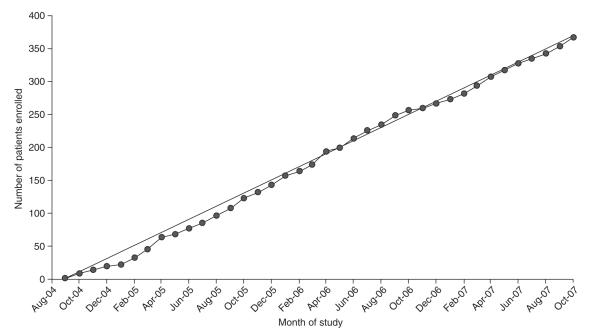
Results: All referred subjects undergo an extensive review of available laboratory, pathology and imaging studies. Subjects who meet pre-defined eligibility criteria at the 6-month study visit are followed for 2 years to better define the natural history of chronic DILI. Causality assessment is determined by a panel of three hepatologists who independently assign a causality score ranging from 1 (definite) to 5 (unlikely) as well as a severity score ranging from 1 (mild) to 5 (fatal). During the first 3 years, 367 subjects were enrolled into the DILIN prospective study.
Conclusion: DILIN is a multicentre research network charged with improving our understanding of the aetiologies, risk factors and outcomes of DILI in the US. The network is meeting the targeted enrollment of ten patients per month and is developing a repository of clinical data and biological samples for future studies of DILI pathogenesis and outcome.
Figures
References
-
- Ostapowicz G, Fontana RJ, Schiodt RV, et al. Results of a prospective study of acute liver failure at 17 tertiary care centers in the United States. Ann Intern Med. 2002;137:947–54. - PubMed
-
- Lee WM, Senior JR. Recognizing drug-induced liver injury: current problems, possible solutions. Toxciol Pathol. 2005;33:155–64. - PubMed
-
- Favreau JT, Ryu ML, Braunstein G, et al. Severe hepatoxicity associated with the dietary supplement Lipokinetix. Ann Intern Med. 2002;136:590–5. - PubMed
-
- Stickel F, Baumuller HM, Seitz K, et al. Hepatitis induced by Kava (Piper methysticum rhizome) J Hepatol. 2003;39:62–7. - PubMed
-
- Bjornson E, Olsson R. Outcome and prognostic markers in severe drug-induced liver disease. Hepatology. 2005;42:481–9. - PubMed
Publication types
MeSH terms
Grants and funding
- U01 DK065211/DK/NIDDK NIH HHS/United States
- 1U01DK065238/DK/NIDDK NIH HHS/United States
- U24 DK065176/DK/NIDDK NIH HHS/United States
- U01 DK065201/DK/NIDDK NIH HHS/United States
- U01 DK065238/DK/NIDDK NIH HHS/United States
- U01 DK065193/DK/NIDDK NIH HHS/United States
- 1U01DK065201/DK/NIDDK NIH HHS/United States
- U01 DK065176/DK/NIDDK NIH HHS/United States
- 1U01DK065176/DK/NIDDK NIH HHS/United States
- 1U01DK065193/DK/NIDDK NIH HHS/United States
- 1U01DK065211/DK/NIDDK NIH HHS/United States
- 1U01DK065184/DK/NIDDK NIH HHS/United States
- U01 DK065184/DK/NIDDK NIH HHS/United States
LinkOut - more resources
Full Text Sources
Other Literature Sources
Medical
Molecular Biology Databases
