


Omega 3 fatty acids induce a marked reduction of apolipoprotein B48 when added to fluvastatin in patients with type 2 diabetes and mixed hyperlipidemia: a preliminary report
- PMID: 19133114
- PMCID: PMC2631503
- DOI: 10.1186/1475-2840-8-1
Omega 3 fatty acids induce a marked reduction of apolipoprotein B48 when added to fluvastatin in patients with type 2 diabetes and mixed hyperlipidemia: a preliminary report
Abstract
Background: Mixed hyperlipidemia is common in patients with diabetes. Statins, the choice drugs, are effective at reducing lipoproteins that contain apolipoprotein B100, but they fail to exert good control over intestinal lipoproteins, which have an atherogenic potential. We describe the effect of prescription omega 3 fatty acids on the intestinal lipoproteins in patients with type 2 diabetes who were already receiving fluvastatin 80 mg per day.
Methods: Patients with type 2 diabetes and mixed hyperlipidemia were recruited. Fasting lipid profile was taken when patients were treated with diet, diet plus 80 mg of fluvastatin and diet plus fluvastatin 80 mg and 4 g of prescription omega 3 fatty acids. The intestinal lipoproteins were quantified by the fasting concentration of apolipoprotein B48 using a commercial ELISA.
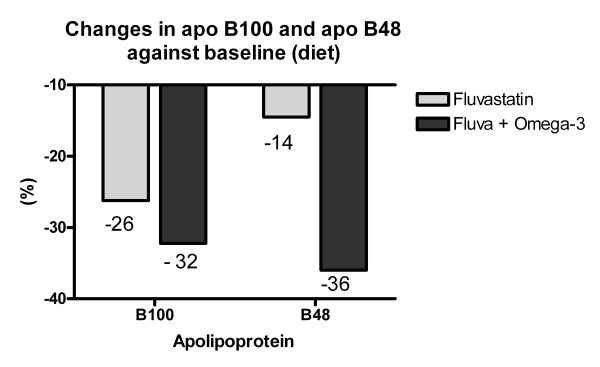
Results: The addition of 4 g of prescription omega 3 was followed by significant reductions in the levels of triglycerides, VLDL triglycerides and the triglyceride/HDL cholesterol ratio, and an increase in HDL cholesterol (P < 0.05). Fluvastatin induced a reduction of 26% in B100 (P < 0.05) and 14% in B48 (NS). However, the addition of omega 3 fatty acids enhanced this reduction to 32% in B100 (NS) and up to 36% in B48 (P < 0.05).
Conclusion: Our preliminary findings therefore suggest an additional benefit on postprandial atherogenic particles when omega 3 fatty acids are added to standard treatment with fluvastatin.
Figures
References
-
- Grundy SM, Cleeman JI, Merz CNB, Brewer HBJ, Clark LT, Hunninghake DB, Pasternak RC, Smith SCJ, Stone NJ, for the Coordinating Committee of the National Cholesterol Education Program, Endorsed by the National Heart, Lung and Blood Institute American College of Cardiology Foundation and American Heart Association Implications of Recent Clinical Trials for the National Cholesterol Education Program Adult Treatment Panel III Guidelines. Circulation. 2004;110:227–239. doi: 10.1161/01.CIR.0000133317.49796.0E. - DOI - PubMed
-
- Proctor SD, Mamo JC. Intimal retention of cholesterol derived from apolipoprotein B100- and apolipoprotein B48-containing lipoproteins in carotid arteries of Watanabe heritable hyperlipidemic rabbits. Arterioscler Thromb Vasc Biol. 2003;23:1595–1600. doi: 10.1161/01.ATV.0000084638.14534.0A. - DOI - PubMed
-
- Nakano T, Nakajima K, Niimi M, Fujita MQ, Nakajima Y, Takeichi S, Kinoshita M, Matsushima T, Teramoto T, Tanaka A. Detection of apolipoproteins B-48 and B-100 carrying particles in lipoprotein fractions extracted from human aortic atherosclerotic plaques in sudden cardiac death cases. Clinica Chimica Acta. 2008;390:38–43. doi: 10.1016/j.cca.2007.12.012. - DOI - PubMed
Publication types
MeSH terms
Substances
LinkOut - more resources
Full Text Sources
Medical
Miscellaneous
