


Integration and acceleration of virtual microscopy as the key to successful implementation into the routine diagnostic process
- PMID: 19134181
- PMCID: PMC2654030
- DOI: 10.1186/1746-1596-4-3
Integration and acceleration of virtual microscopy as the key to successful implementation into the routine diagnostic process
Abstract
Background: The virtual microscopy is widely accepted in Pathology for educational purposes and teleconsultation but is far from the routine use in surgical pathology due to the technical requirements and some limitations. A technical problem is the limited bandwidth of a usual network and the delayed transmission rate and presentation time on the screen.
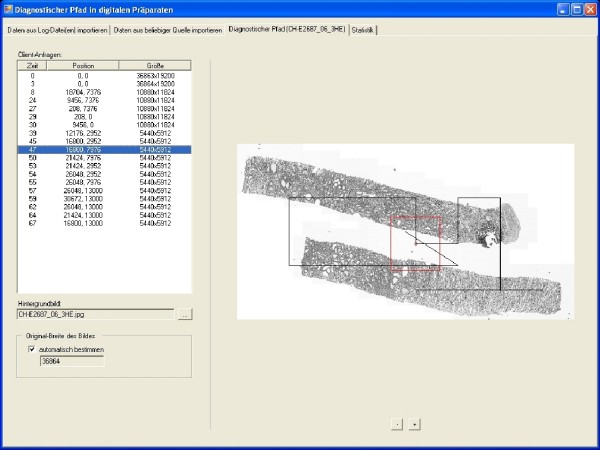
Methods: In this study the process of secondary diagnostic was evaluated using the "T.Konsult Pathologie" service of the Professional Association of German Pathologists within the German breast cancer screening program. The characteristics of the access to the WSI (Whole Slide Images) have been analyzed to explore the possibilities of prefetching and caching to reduce the presentation and transfer time with the goal to increase user acceptance. The log files of the web server were analyzed to reconstruct the movements of the pathologist on the WSI and to create the observation path. Using a specialized tool the observation paths were extracted automatically from the log files. The attributes linearity, 3-point-linearity, changes per request, and number of consecutive requests were calculated to design, develop and evaluate different caching and prefetching strategies.
Results: The analysis of the observation paths showed that a complete accordance of two image requests is a very rare event. But more frequently a partial covering of two requested image areas can be found. In total 257 diagnostic paths from 131 WSI have been extracted and analysed. On average a diagnostic path consists of 16 image requests and takes 189 seconds between first and last image request. The mean linearity was 0,41 and the mean 3-point-linearity 0,85. Three different caching algorithms have been compared with respect to hit rate and additional image requests on the WSI server. Tests demonstrated that 95% of the diagnostic paths could be loaded without any deletion of entries in the cache (cache size 12,2 Megapixel). If the image parts are stored after JPEG compression this complies with less than 2 MB.
Discussion: WSI telepathology is a technology which offers the possibility to break the limitations of conventional static telepathology. The complete histological slide may be investigated instead of sets of images of lesions sampled by the presenting pathologist. The benefit is demonstrated by the high diagnostic security of 95% accordance between first and second diagnosis.
Figures



References
-
- Ficsor L, Varga V, Berczi L, Miheller P, Tagscherer A, Wu ML, Tulassay Z, Molnar B. Automated virtual microscopy of gastric biopsies. Cytometry B Clin Cytom. 2006;70:423–31. - PubMed
-
- Schrader T, Beil M, Schmidt D, Dietel M, Lindemann G. SPIE: Medical Imaging 2007. San Diego, USA: SPIE; 2007. Virtual microscopy in medical research: Open European Nephrology Science Center (OpEN.SC)
LinkOut - more resources
Full Text Sources
Miscellaneous
