Review
. 2009 Apr;122(1):1-8.
doi: 10.1016/j.pharmthera.2008.11.008. Epub 2008 Dec 16.

Functional selectivity of EGF family peptide growth factors: implications for cancer

Affiliations
Review

Functional selectivity of EGF family peptide growth factors: implications for cancer

Kristy J Wilson et al. Pharmacol Ther. 2009 Apr.

Abstract

Breast, prostate, pancreatic, colorectal, lung, and head and neck cancers exploit deregulated signaling by ErbB family receptors and their ligands, EGF family peptide growth factors. EGF family members that bind the same receptor are able to stimulate divergent biological responses both in cell culture and in vivo. This is analogous to the functional selectivity exhibited by ligands for G-protein coupled receptors. Here we review this literature and propose that this functional selectivity of EGF family members is due to distinctions in the conformation of the liganded receptor and subsequent differences in the sites of receptor tyrosine phosphorylation and receptor coupling to signaling effectors. We also discuss the roles of divergent ligand activity in establishing and maintaining malignant phenotypes. Finally, we discuss the potential of mutant EGF family ligands as cancer chemotherapeutics targeted to ErbB receptors.


Figures
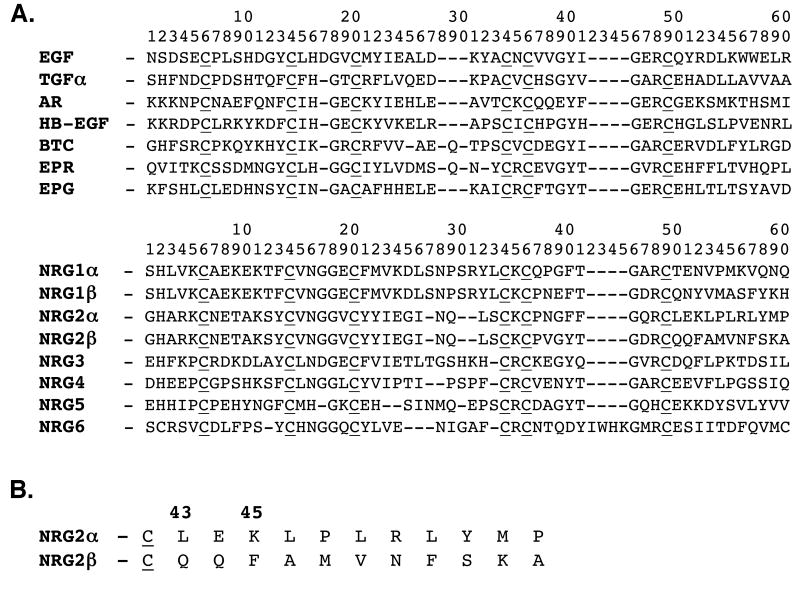
Figure 1
Figure 1. Amino acid sequence of the EGF homology domain of selected EGF family peptide growth factors
(A) Underlined are the six conserved cysteine residues that form the three intramolecular disulfide bridges present in the mature ligands. Selected EGF family peptide growth factors include EGF (NCBI Protein database # NP_001954), TGFα (#AAA61159), AR (#AAA51781), HB-EGF (AAA35956), BTC (#AAB25452), EPR (#BAA22146), EPG (#Q6UW88), NRG1α (#NP_039258), NRG1β (#ABR13844), NRG2α (#NP_004874), NRG2β (#NP_053584), NRG3 (#NP_001010848), NRG4 (#AAH17568), NRG5 (#BAA90820), and NRG6 (#AAC69612). NRG5 is also known as tomoregulin and NRG6 is also known as neuroglycan-C. (B) Carboxyl-terminal NRG2 residues that regulate differences in ligand potency, receptor affinity (residue 43), and intrinsic activity (residue 45) are noted.
Figure 2
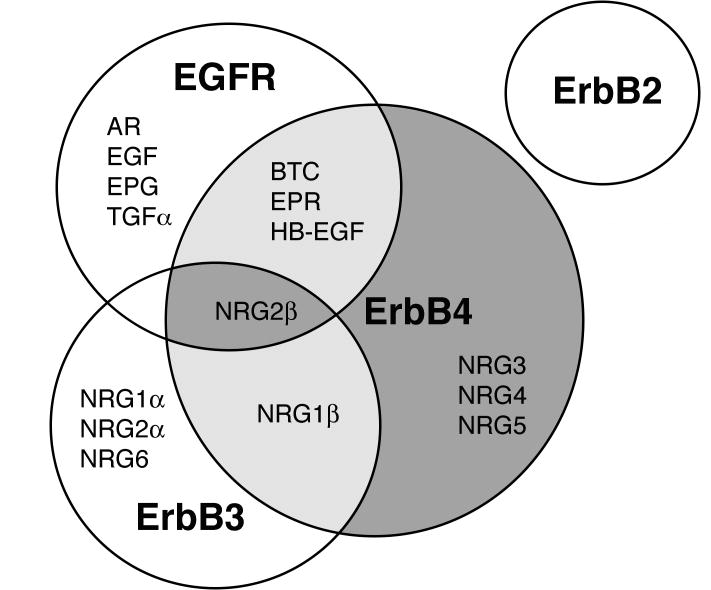
Figure 2. EGF family ligands bind and activate multiple ErbB receptors
A Venn diagram illustrates the interactions of the four ErbB family receptors with EGF family members. This figure summarizes published data (Hobbs et al., 2002; Kinugasa et al., 2004; Kochupurakkal et al., 2005; Normanno et al., 2005).
Figure 3
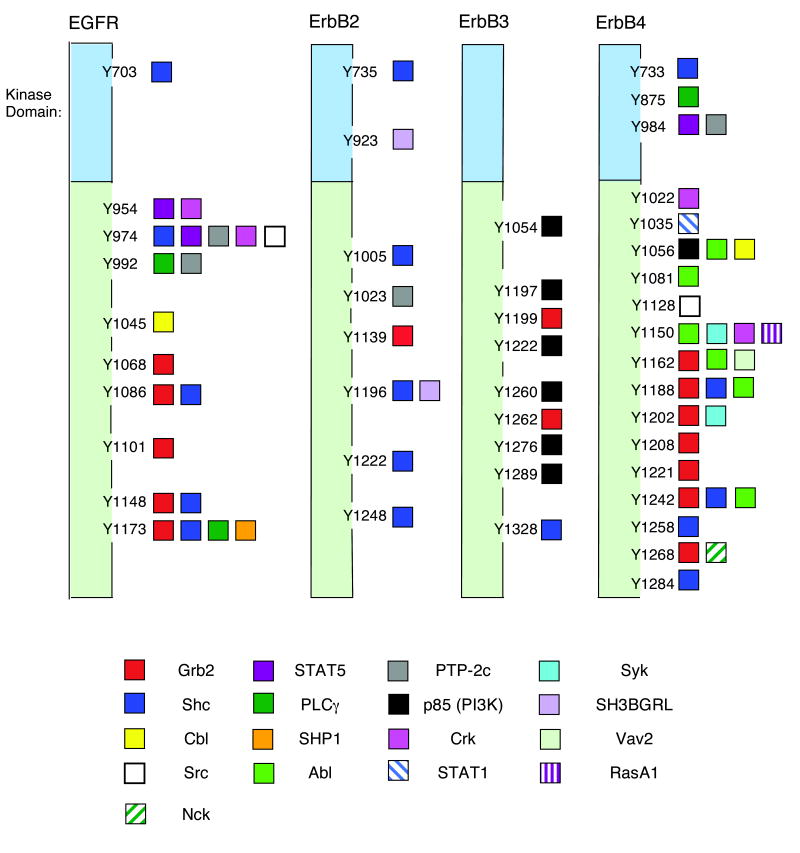
Figure 3. Ligand stimulation of ErbB receptor tyrosine phosphorylation creates docking sites for numerous signaling effectors
Putative sites of EGFR, ErbB2, ErbB3, and ErbB4 tyrosine phosphorylation are denoted, as well as signaling effectors predicted or shown to bind to these sites of phosphorylation (Cohen et al., 1996; Hellyer et al., 2001; Kaushansky et al., 2008; Keilhack et al., 1998; Rotin et al., 1992; Schulze et al., 2005; Sorkin et al., 1996; Zrihan-Licht et al., 1998). The ErbB receptors are not drawn to scale.
Figure 4
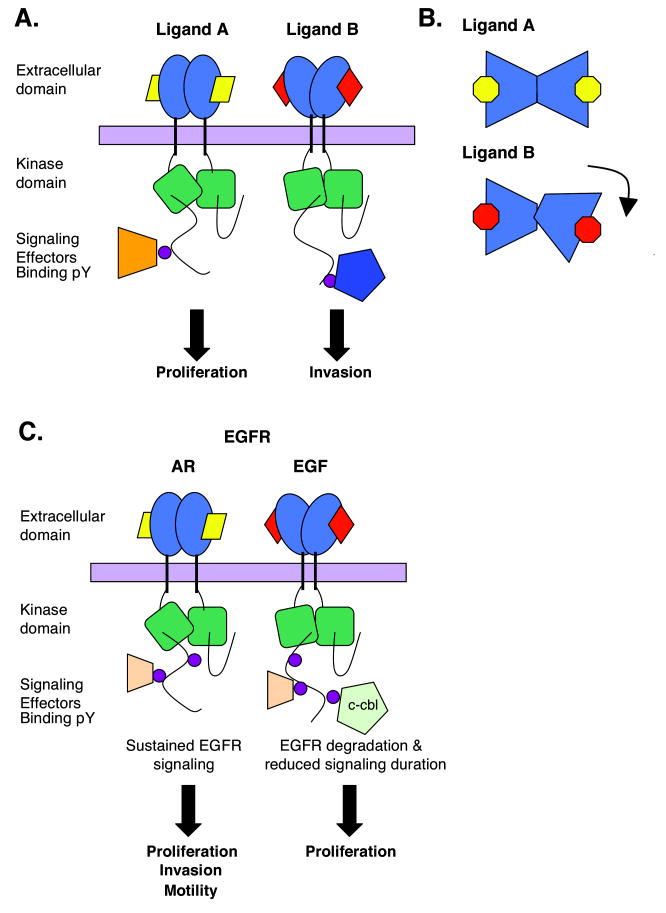
Figure 4. Model for differential ligand-induced ErbB receptor coupling to biological responses
(A) Hypothetical depiction of differences in the conformation of receptor extracellular and intracellular domains and distinctions in the sites of receptor tyrosine phosphorylation following ligand binding. (B) Hypothetical depiction of the difference in the juxtapositioning of receptor extracellular domain monomers within a ligand-induced dimer. (C) Depiction of the distinctions in EGF and AR stimulation of EGFR phosphorylation at Tyr1045, resulting in differences in the binding of c-cbl, alterations in signaling duration, and changes in the biological consequences of EGFR signaling (Gilmore et al., 2008; Stern et al., 2008; Willmarth & Ethier, 2006).
Figure 5
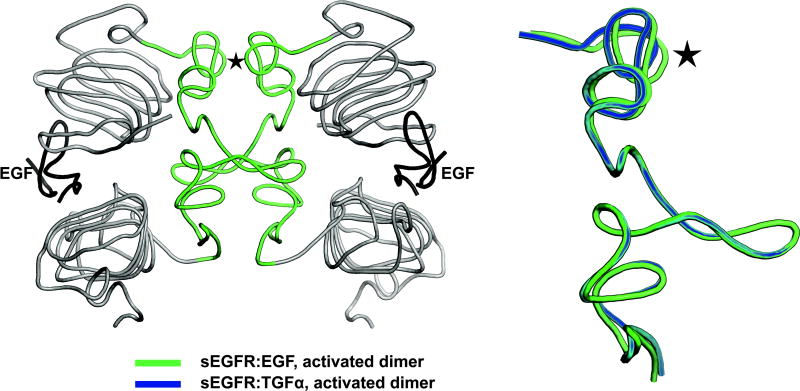
Figure 5. Differences in the conformation of the EGFR extracellular domain following EGF or TGFα binding
(A) A worm representation of an EGFR extracellular domain dimer, with subdomain II colored green at the dimer interface. (B) A worm representation of EGFR extracellular subdomain II conformation following binding of EGF (green) or TGFα (blue). Subtle differences, particularly at the upper site of dimerization, are marked with a star.

References

    1. Blackball F, Ranson M, Thatcher N. Where next for gefitinib in patients with lung cancer? Lancet Oncol. 2006;7:499–507. - PubMed
    1. Booth BW, Smith GH. Roles of transforming growth factor-alpha in mammary development and disease. Growth Factors. 2007;25:227–235. - PubMed
    1. Britsch S. The neuregulin-I/ErbB signaling system in development and disease. Adv Anat Embryol Cell Biol. 2007;190:1–65. - PubMed
    1. Burgess AW, Cho HS, Eigenbrot C, Ferguson KM, Garrett TP, Leahy DJ, et al. An open-and-shut case? Recent insights into the activation of EGF/ErbB receptors. Mol Cell. 2003;12:541–552. - PubMed
    1. Burke CL, Stern DF. Activation of Neu (ErbB-2) mediated by disulfide bond-induced dimerization reveals a receptor tyrosine kinase dimer interface. Mol Cell Biol. 1998;18:5371–5379. - PMC - PubMed

Publication types