. 2009 Jan 12:9:10.
doi: 10.1186/1471-2148-9-10.

Evolution of prokaryotic SPFH proteins

Affiliations

Evolution of prokaryotic SPFH proteins

Markus Hinderhofer et al. BMC Evol Biol. .

Erratum in

  • BMC Evol Biol. 2009;9:22

Abstract

Background: The SPFH protein superfamily is a diverse family of proteins whose eukaryotic members are involved in the scaffolding of detergent-resistant microdomains. Recently the origin of the SPFH proteins has been questioned. Instead, convergent evolution has been proposed. However, an independent, convergent evolution of three large prokaryotic and three eukaryotic families is highly unlikely, especially when other mechanisms such as lateral gene transfer which could also explain their distribution pattern have not yet been considered.To gain better insight into this very diverse protein family, we have analyzed the genomes of 497 microorganisms and investigated the pattern of occurrence as well as the genomic vicinity of the prokaryotic SPFH members.

Results: According to sequence and operon structure, a clear division into 12 subfamilies was evident. Three subfamilies (SPFH1, SPFH2 and SPFH5) show a conserved operon structure and two additional subfamilies are linked to those three through functional aspects (SPFH1, SPFH3, SPFH4: interaction with FtsH protease). Therefore these subgroups most likely share common ancestry. The complex pattern of occurrence among the different phyla is indicative of lateral gene transfer. Organisms that do not possess a single SPFH protein are almost exclusively endosymbionts or endoparasites.

Conclusion: The conserved operon structure and functional similarities suggest that at least 5 subfamilies that encompass almost 75% of all prokaryotic SPFH members share a common origin. Their similarity to the different eukaryotic SPFH families, as well as functional similarities, suggests that the eukaryotic SPFH families originated from different prokaryotic SPFH families rather than one. This explains the difficulties in obtaining a consistent phylogenetic tree of the eukaryotic SPFH members. Phylogenetic evidence points towards lateral gene transfer as one source of the very diverse patterns of occurrence in bacterial species.


Figures

Figure 1
Figure 1
Size, domain structure and phylogenetic tree of SPFH subfamilies. This figure shows the upper half, for the full image please see Additional file 3. (a) Schematic representation of sizes and domain structure of all identified SPFH subfamilies, as well as the accompanying NfeD proteins. (b) Phylogenetic tree of prokaryotic SPFH proteins. The tree was created using the most diverse members of each subfamily, after alignment with ClustalW. Tree creation was performed with MEGA 4 (BLOSUM matrix and Neighbor joining algorithm, 1000 bootstrap replications).
Figure 2
Figure 2
Comparison of SPFH1,2 and 5 subgroup members. Partial alignment and secondary structure annotation between SPFH1,2 and 5, using the already known 3D structure of Flotillin2 (PDB ID: 1WIN). The alignment of the SPFH domains of different SPFH1,2 and SPFH5 members reveals a continuum of similarity between both groups, suggesting that SPFH5 members belong to the SPFH superfamily.
Figure 3
Figure 3
Hydropathy plots and coiled-coil prediction of SPFH1b and SPFH 5 member proteins showing similar general structure. (A) Superimposed hydropathy plots and (B) coiled-coil predictions; purple: SPFH5 of Bacillus. subtilis (NP_390416); green: SPFH5 of Thermus thermophilus (YP_144314); blue: SPFH1b of Pseudomonas entomophila (YP_605957); red: SPFH1b of Chloroflexus aggregans (ZP_01514636).
Figure 4
Figure 4
Evidence for lateral gene transfer. (a) Phylogenetic tree of SPFH1 member proteins (BLOSUM matrix and neighbor joining algorithm, 1000 bootstrap replications). The ZP_01189338, YP_846427 and NP_905503 proteins, originating from bacterial species belonging to different phyla, are more closely related to each other than to SPFH1 proteins from bacterial species originating from the same phylum. (b) Phylogenetic tree of SPFH4 member proteins (BLOSUM matrix and neighbor joining algorithm, 1000 bootstrap replications). The ZP_01910769 gene from the deltaproteobacterium P. pacifica shows a closer evolutionary relationship to proteins from other phyla than to SPFH4 proteins from other deltaproteobacteria. (c) A common insertion in SPFH1 members in only distantly related species suggests lateral gene transfer. A 22 aa Insertion (aa 236–257) can be found in a few distantly related species, but in more closely related species it is missing, thereby suggesting lateral gene transfer. Compare YP_846427 of Syntrophobacter fumaroxidans (with the insertion) and YP_356078 of Pelobacter carbinolicus, both belonging to proteobacteria; compare ZP_01189338 (with insertion) of Halothermothrix orenii and NP_844475 of Bacillus anthracis, which belong to firmicutes; compare NP_905503 (with insertion) of Porphyromonas gingivalis and ZP_00593072 from Prosthecochloris aestuarii which belong to bacteroidetes. (d) Codon usage of the NP_905503 gene (1) compared with codon usage of total coding sequences in P. gingivalis (2), for the YP_846427 gene (3) compared with total coding sequences of P. fumaroxidans (4), of the ZP_01189338 gene (5) compared with total coding sequences of H. orenii (6) and of the YP_144313-15 operon (7) compared with T. thermophilus total coding sequences (8). Synonymous codons are shown to the right of each amino acid and color-coded to match the percent usage indicated by the bars.
Figure 5
Figure 5
Hypothetical scenario of a recombination event that created the NfeD1b protein.
Figure 6
Figure 6
Comparison of YuaF and PH0471 structures. Superposition of the C-terminal domain of YuaF from B. subtilis as determined by NMR (PDB entry 2K12) [26] with the NfeD homolog PH0471 from P. horikoshii (PDB code: 2EXD). β-sheets are blue, the N-terminal α-helix of YuaF is red. Random coil regions are yellow. Both protein domains display a striking similarity in their β-barrel cores.
Figure 7
Figure 7
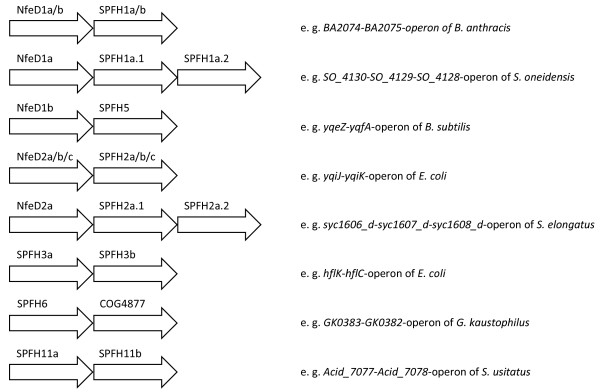
Representative operon structures of SPFH and accompanying NfeD genes. In some cases, there may be additional genes organized inside these operons that have been left out for clarity.
Figure 8
Figure 8
Model of SPFH and NfeD coevolution. Hypothetical model of prokaryotic SPFH and NfeD protein coevolution, based on the phylogenetic relationships and operon structures.

References

    1. Tavernarakis N, Driscoll M, Kyrpides NC. The SPFH domain: implicated in regulating targeted protein turnover in Stomatins and other membrane-associated proteins. Trends Biochem Sci. 1999;24:425–427. doi: 10.1016/S0968-0004(99)01467-X. - DOI - PubMed
    1. Browman DT, Hoegg MB, Robbins SM. The SPFH domain-containing proteins: more than lipid raft markers. Trends Cell Biol. 2007;17:394–402. doi: 10.1016/j.tcb.2007.06.005. - DOI - PubMed
    1. Morrow IC, Parton RG. Flotillins and the PHB domain protein family: rafts, worms and anaesthetics. Traffic. 2005;6:725–740. doi: 10.1111/j.1600-0854.2005.00318.x. - DOI - PubMed
    1. Rivera-Milla E, Stuermer CAO, Malaga-Trillo E. Ancient origin of reggie (Flotillin), reggie-like, and other lipid-raftproeins: convergent evolution of SPFH domain. Cell Mol Life Sci. 2006;63:343–357. doi: 10.1007/s00018-005-5434-3. - DOI - PMC - PubMed
    1. Xie G, Bonner CA, Brettin T, Gottardo R, Keyhani NO, Jensen RA. Lateral gene transfer and ancient paralogy of operons containing redundant copies of tryptophan-pathway genes in Xylella species and in heterocystous cyanobacteria. Genome Biology. 2003;4:R14. doi: 10.1186/gb-2003-4-2-r14. - DOI - PMC - PubMed

Publication types

LinkOut - more resources