. 2009 Jan 12:8:2.
doi: 10.1186/1477-5751-8-2.

Oxaliplatin neurotoxicity--no general ion channel surface-charge effect

Affiliations

Oxaliplatin neurotoxicity--no general ion channel surface-charge effect

Amir Broomand et al. J Negat Results Biomed. .

Abstract

Background: Oxaliplatin is a platinum-based chemotherapeutic drug. Neurotoxicity is the dose-limiting side effect. Previous investigations have reported that acute neurotoxicity could be mediated via voltage-gated ion channels. A possible mechanism for some of the effects is a modification of surface charges around the ion channel, either because of chelation of extracellular Ca2+, or because of binding of a charged biotransformation product of oxaliplatin to the channel. To elucidate the molecular mechanism, we investigated the effects of oxaliplatin and its chloride complex [Pt(dach)oxCl](-) on the voltage-gated Shaker K channel expressed in Xenopus oocytes. The recordings were made with the two-electrode and the cut-open oocyte voltage clamp techniques.

Conclusion: To our surprise, we did not see any effects on the current amplitudes, on the current time courses, or on the voltage dependence of the Shaker wild-type channel. Oxaliplatin is expected to bind to cysteines. Therefore, we explored if there could be a specific effect on single (E418C) and double-cysteine (R362C/F416C) mutated Shaker channels previously shown to be sensitive to cysteine-specific reagents. Neither of these channels were affected by oxaliplatin. The clear lack of effect on the Shaker K channel suggests that oxaliplatin or its monochloro complex has no general surface-charge effect on the channels, as has been suggested before, but rather a specific effect to the channels previously shown to be affected.


Figures
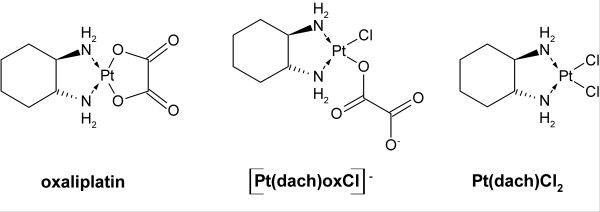
Figure 1
Figure 1
Chemical structures. Chemical structures of oxaliplatin, the monochloro monooxalato oxaliplatin complex ([Pt(dach)oxCl]-), and the dichloro oxaliplatin complex (Pt(dach)Cl2).
Figure 2
Figure 2
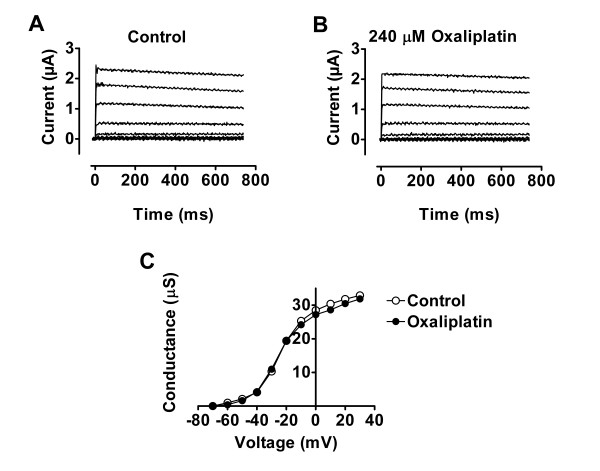
Shaker wild-type channel. Oxaliplatin does not affect the Shaker wild-type channel. A) Current family in control solution. Voltage steps between -80 mV and 0 mV in steps of 10 mV. Holding voltage = -80 mV. Time between each step is 2 s. Recordings done by the two-electrode voltage clamp technique. B) Current family with 240 μM oxaliplatin added to the extracellular solution. C) Conductance versus voltage curve for the data from A and B.
Figure 3
Figure 3
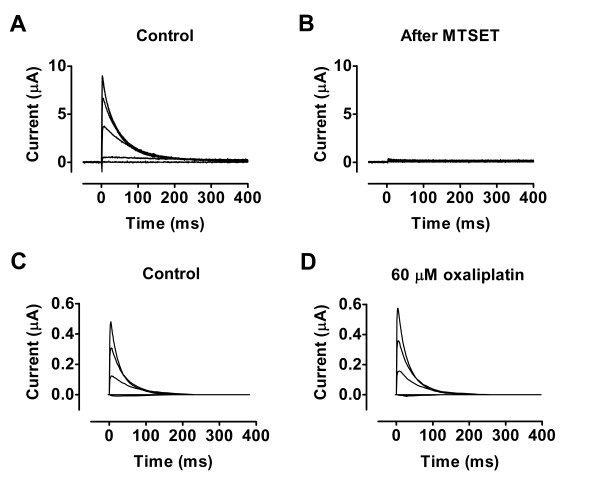
Cysteine-enriched Shaker channel. Oxaliplatin does not affect a cysteine-enriched Shaker (E418C) channel. A) Current family in control solution. Voltage steps between -40 and +60 mV in steps of 20 mV. Holding voltage = -80 mV. Time between each step is 2 min to allow complete recovery after inactivation [16]. Two-electrode voltage clamp in A and B. B) Current family after complete modification of the positively charged MTSET. This shows that 418C is very sensitive to modification. C) Another control recording similar to that in A. Cut-open oocyte voltage clamp in C and D. D) Addition of 60 μM oxaliplatin does not affect the currents.
Figure 4
Figure 4
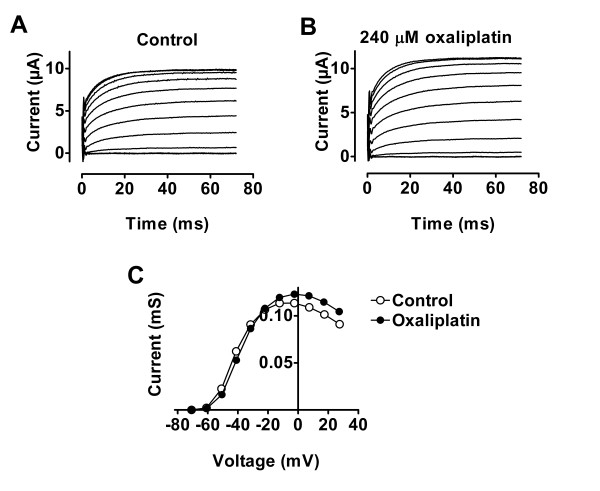
Double-cysteine-mutated Shaker channel. Oxaliplatin does not affect a double-cysteine-mutated Shaker (R362C/F416C) channel. A) Current family in control solution. Voltage steps between -80 and +30 mV in steps of 10 mV. Holding voltage = -80 mV. Time between each step is 2 s. B) Current family with 240 μM oxaliplatin added to the extracellular solution. C) Conductance versus voltage curve for the data from A and B. The experiments were carried out in Cl- -containing solutions with the two-electrode voltage clamp technique.

References

    1. Mani S, Graham MA, Bregman DB, Ivy P, Chaney SG. Oxaliplatin: a review of evolving concepts. Cancer Invest. 2002;20:246–263. doi: 10.1081/CNV-120001152. - DOI - PubMed
    1. Gamelin E, Gamelin L, Bossi L, Quasthoff S. Clinical aspects and molecular basis of oxaliplatin neurotoxicity: current management and development of preventive measures. Semin Oncol. 2002;29:21–33. doi: 10.1053/sonc.2002.35525. - DOI - PubMed
    1. Wilson RH, Lehky T, Thomas RR, Quinn MG, Floeter MK, Grem JL. Acute oxaliplatin-induced peripheral nerve hyperexcitability. J Clin Oncol. 2002;20:1767–1774. doi: 10.1200/JCO.2002.07.056. - DOI - PubMed
    1. Ehrsson H, Wallin I, Yachnin J. Pharmacokinetics of oxaliplatin in humans. Med Oncol. 2002;19:261–265. doi: 10.1385/MO:19:4:261. - DOI - PubMed
    1. Jerremalm E, Wallin I, Yachnin J, Ehrsson H. Oxaliplatin degradation in the presence of important biological sulphur-containing compounds and plasma ultrafiltrate. Eur J Pharm Sci. 2006;28:278–283. doi: 10.1016/j.ejps.2006.03.001. - DOI - PubMed

Publication types

MeSH terms

LinkOut - more resources