Comment
doi: 10.1158/1940-6207.CAPR-08-0080.
Deregulated EGFR signaling during lung cancer progression: mutations, amplicons, and autocrine loops
Affiliations
- PMID: 19138950
- PMCID: PMC2849648
- DOI: 10.1158/1940-6207.CAPR-08-0080
Item in Clipboard
Comment
Deregulated EGFR signaling during lung cancer progression: mutations, amplicons, and autocrine loops
Cancer Prev Res (Phila).
2008 Aug.
No abstract available
Conflict of interest statement
No potential conflicts of interest were disclosed.
Figures
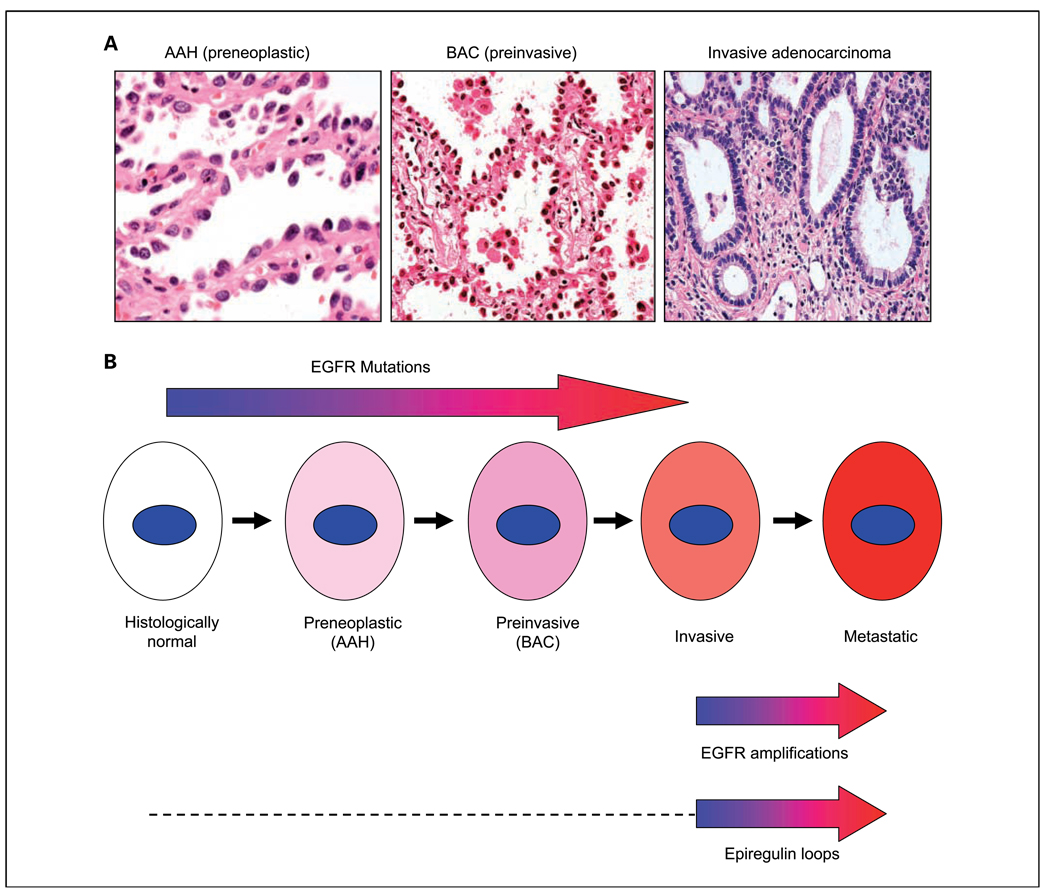
Deregulation of the EGFR gene during the multistage pathogenesis of peripheral lung adenocarcinomas. A, peripheral adenocarcinomas are believed to arise from preneoplastic lesions known as atypical adenomatous hyperplasias (AAH), which first progress to a preinvasive neoplastic stage called bronchioloalveolar carcinoma (BAC). Foci of invasion may develop in the fibrotic centers of bronchioloalveolar carcinomas, which then are called invasive adenocarcinomas, although noninvasive elements may persist at the edges of the tumors. Metastases ultimately develop (not shown). B, from the article by Tang et al. (5) and from the literature cited in the text, EGFR mutations commence early during pathogenesis and can be detected in histologically normal respiratory epithelium near tumors (localized field effect). Mutations are more frequent in preneoplastic (atypical adenomatous hyperplasia) and preinvasive (bronchioloalveolar carcinoma) stages than in normal epithelium. Therefore, there is relatively little heterogeneity of mutations in invasive carcinomas, and the mutations contribute to tumor pathogenesis. In contrast, gene copy number gains, often in the form of amplifications, commence relatively late in pathogenesis, usually at the tumor stage. They are more frequent in metastatic lesions, suggesting that they may be progression events involved in the metastatic phenotype. Much less is known about the timing of epiregulin loops (either autocrine, paracrine, or juxtacrine). From the data of Zhang et al. (4), however, it would seem that epiregulin loops can be detected in primary invasive tumors but are more frequent or active during the metastatic stage. The dashed line indicates that the timing of the appearance of these loops during earlier preinvasive stages is unknown.
Comment on
-
Intratumoral epiregulin is a marker of advanced disease in non-small cell lung cancer patients and confers invasive properties on EGFR-mutant cells.Cancer Prev Res (Phila). 2008 Aug;1(3):201-7. doi: 10.1158/1940-6207.CAPR-08-0014. Epub 2008 Mar 31. Cancer Prev Res (Phila). 2008. PMID: 19138957 Free PMC article.
References
Publication types
MeSH terms
Grants and funding
LinkOut - more resources
Full Text Sources
Other Literature Sources
Medical
Research Materials
Miscellaneous