A pilot study of sampling subcutaneous adipose tissue to examine biomarkers of cancer risk
- PMID: 19139016
- PMCID: PMC2785801
- DOI: 10.1158/1940-6207.CAPR-08-0073
A pilot study of sampling subcutaneous adipose tissue to examine biomarkers of cancer risk
Abstract
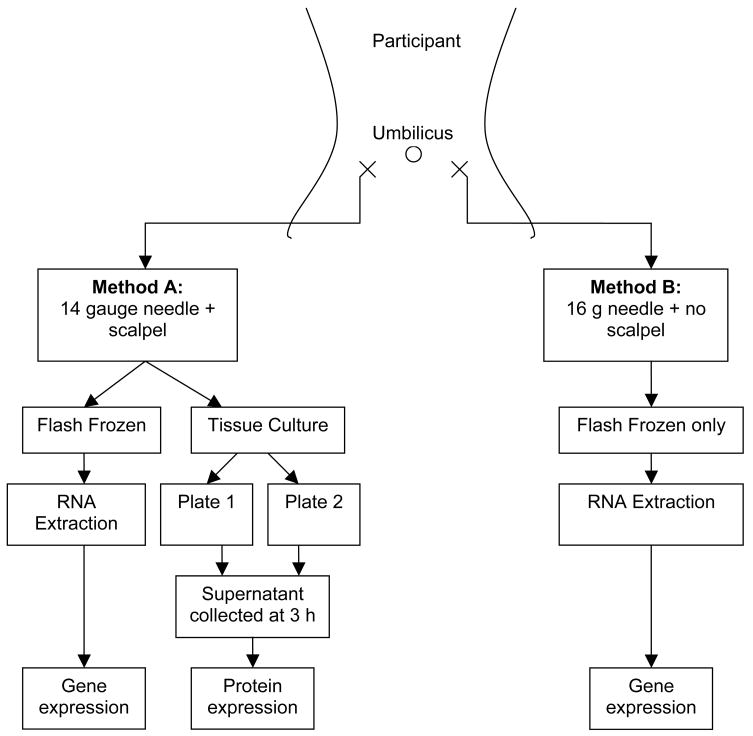
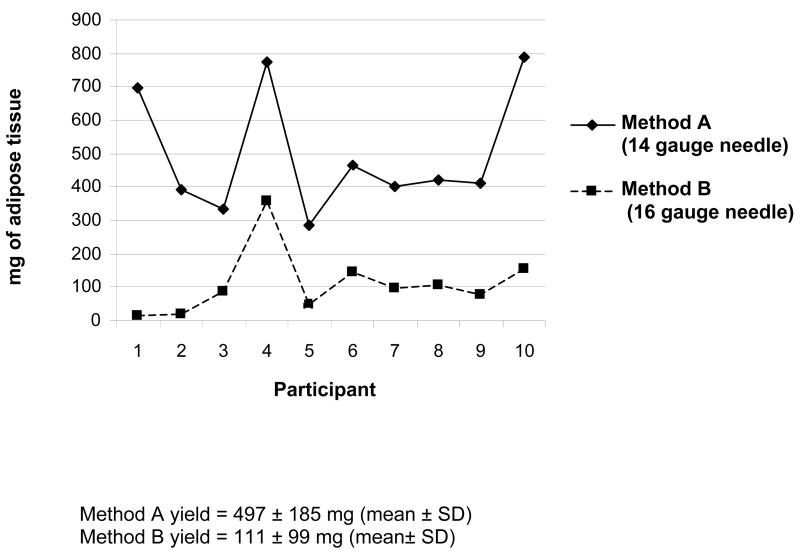
Examination of adipose tissue biology may provide important insight into mechanistic links for the observed association between higher body fat and risk of several types of cancer, in particular colorectal and breast cancer. We tested two different methods of obtaining adipose tissue from healthy individuals. Ten overweight or obese (body mass index, 25-40 kg/m(2)), postmenopausal women were recruited. Two subcutaneous abdominal adipose tissue samples were obtained per individual (i.e., right and left lower abdominal regions) using two distinct methods (method A: 14-gauge needle with incision, versus method B: 16-gauge needle without incision). Gene expression was examined at the mRNA level for leptin, adiponectin, aromatase, interleukin 6 (IL-6), and tumor necrosis factor-alpha (TNF-alpha) in flash-frozen tissue, and at the protein level for leptin, adiponectin, IL-6, and TNF-alpha following short-term culture. Participants preferred biopsy method A and few participants reported any of the usual minor side effects. Gene expression was detectable for leptin, adiponectin, and aromatase, but was below detectable limits for IL-6 and TNF-alpha. For detectable genes, relative gene expression in adipose tissue obtained by methods A and B was similar for adiponectin (r = 0.64, P = 0.06) and leptin (r = 0.80, P = 0.01), but not for aromatase (r = 0.37,P = 0.34). Protein levels in tissue culture supernatant exhibited good intra-assay agreement [coefficient of variation (CV), 1-10%], with less agreement for intraindividual agreement (CV, 17-29%) and reproducibility, following one freeze-thaw cycle (CV, >14%). Subcutaneous adipose tissue biopsies from healthy, overweight individuals provide adequate amounts for RNA extraction, gene expression, and other assays of relevance to cancer prevention research.
Figures
References
-
- Vainio H, Bianchini F, editors. IARC Handbooks of Cancer Prevention. Lyon: IARC Press; 2002. Weight Control and Physical Activity. - PubMed
-
- Friedenreich CM. Review of anthropometric factors and breast cancer risk. European J Cancer Prev. 2001;10:15–32. - PubMed
-
- Friedenreich CM, Cust AE. Physical Activity and Breast Cancer Risk: Impact of Timing, Type and Dose of Activity and Population Sub-group Effects. Br J Sports Med. 2008 - PubMed
-
- McTiernan A, Ulrich C, Slate S, Potter J. Physical activity and cancer etiology: associations and mechanisms. Cancer Causes & Control. 1998;9:487–509. - PubMed
-
- Rogers CJ, Colbert LH, Greiner JW, Perkins SN, Hursting SD. Physical activity and cancer prevention: pathways and targets for intervention. Sports Med. 2008;38:271–96. - PubMed
Publication types
MeSH terms
Substances
Grants and funding
LinkOut - more resources
Full Text Sources
Medical