


Human predators outpace other agents of trait change in the wild
- PMID: 19139415
- PMCID: PMC2630061
- DOI: 10.1073/pnas.0809235106
Human predators outpace other agents of trait change in the wild
Abstract
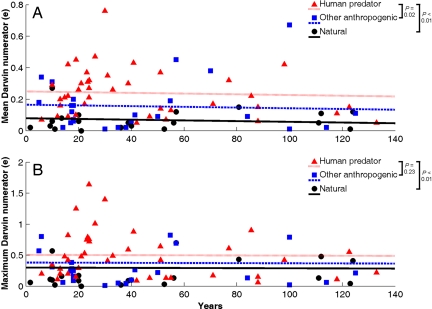
The observable traits of wild populations are continually shaped and reshaped by the environment and numerous agents of natural selection, including predators. In stark contrast with most predators, humans now typically exploit high proportions of prey populations and target large, reproductive-aged adults. Consequently, organisms subject to consistent and strong 'harvest selection' by fishers, hunters, and plant harvesters may be expected to show particularly rapid and dramatic changes in phenotype. However, a comparison of the rate at which phenotypic changes in exploited taxa occurs relative to other systems has never been undertaken. Here, we show that average phenotypic changes in 40 human-harvested systems are much more rapid than changes reported in studies examining not only natural (n = 20 systems) but also other human-driven (n = 25 systems) perturbations in the wild, outpacing them by >300% and 50%, respectively. Accordingly, harvested organisms show some of the most abrupt trait changes ever observed in wild populations, providing a new appreciation for how fast phenotypes are capable of changing. These changes, which include average declines of almost 20% in size-related traits and shifts in life history traits of nearly 25%, are most rapid in commercially exploited systems and, thus, have profound conservation and economic implications. Specifically, the widespread potential for transitively rapid and large effects on size- or life history-mediated ecological dynamics might imperil populations, industries, and ecosystems.
Conflict of interest statement
The authors declare no conflict of interest.
Figures
Comment in
-
Does harvest select for maladaptation in an increasingly variable world?Proc Natl Acad Sci U S A. 2009 Mar 31;106(13):E32; author reply E33. doi: 10.1073/pnas.0900520106. Epub 2009 Mar 20. Proc Natl Acad Sci U S A. 2009. PMID: 19304796 Free PMC article. No abstract available.
References
-
- Futuyma DJ. Evolutionary Biology. Sunderland: Sineauer Associates; 2001.
-
- Endler JA. Natural Selection in the Wild. Princeton: Princeton Univ Press; 1986.
-
- Palumbi SR. Humans as the world's greatest evolutionary force. Science. 2001;293:1786–1790. - PubMed
-
- Hendry AP, Farrugia TJ, Kinnison MT. Human influences on the rate of phenotypic change in wild animal populations. Mol Ecol. 2008;17:20–29. - PubMed
-
- Law R. Fishing, selection, and phenotypic evolution. ICES J Mar Sci. 2000;57:659–668.
Publication types
MeSH terms
LinkOut - more resources
Full Text Sources
Other Literature Sources
