


Phase II trial of bevacizumab in the treatment of persistent or recurrent squamous cell carcinoma of the cervix: a gynecologic oncology group study
- PMID: 19139430
- PMCID: PMC2667811
- DOI: 10.1200/JCO.2008.18.9043
Phase II trial of bevacizumab in the treatment of persistent or recurrent squamous cell carcinoma of the cervix: a gynecologic oncology group study
Abstract
Purpose: Vascular endothelial growth factor is a key promoter of tumor progression in cervical carcinoma. The Gynecologic Oncology Group (GOG) conducted a phase II trial to assess the efficacy and tolerability of bevacizumab, a recombinant humanized anti-vascular endothelial growth factor monoclonal antibody.
Patients and methods: Eligible patients had recurrent cervical cancer, measurable disease, and GOG performance status < or = 2. Treatment consisted of bevacizumab 15 mg/kg intravenously every 21 days until disease progression or prohibitive toxicity. Primary end points were progression-free survival (PFS) at 6 months and toxicity.
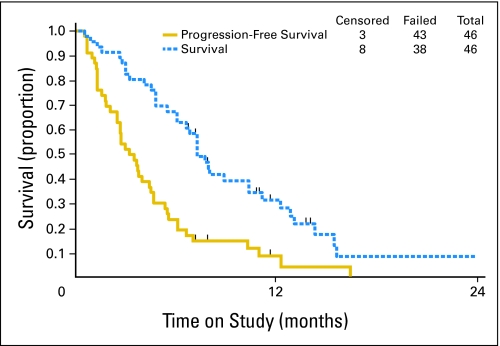
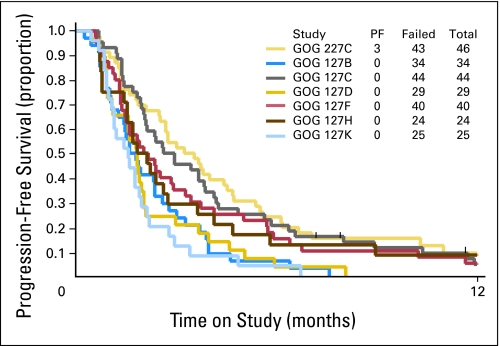
Results: Forty-six patients were enrolled (median age, 46 years); 38 patients (82.6%) received prior radiation as well as either one (n = 34, 73.9%) or two (n = 12, 26.1%) prior cytotoxic regimens for recurrent disease. Grade 3 or 4 adverse events at least possibly related to bevacizumab included hypertension (n = 7), thrombo-embolism (n = 5), GI (n = 4), anemia (n = 2), other cardiovascular (n = 2), vaginal bleeding (n = 1), neutropenia (n = 1), and fistula (n = 1). One grade 5 infection was observed. Eleven patients (23.9%; two-sided 90% CI, 14% to 37%) survived progression free for at least 6 months, and five patients (10.9%; two-sided 90% CI, 4% to 22%) had partial responses. The median response duration was 6.21 months (range, 2.83 to 8.28 months). The median PFS and overall survival times were 3.40 months (95% CI, 2.53 to 4.53 months) and 7.29 months (95% CI, 6.11 to 10.41 months), respectively. This compared favorably with historical phase II GOG trials in this setting. CONCLUSION Bevacizumab seems to be well tolerated and active in the second- and third-line treatment of patients with recurrent cervical cancer and merits phase III investigation.
Conflict of interest statement
Authors' disclosures of potential conflicts of interest and author contributions are found at the end of this article.
Figures
References
-
- Parkin DM, Bray F, Ferlay J, et al. Global cancer statistics, 2002. CA Cancer J Clin. 2005;55:74–108. - PubMed
-
- American Cancer Society. Cancer facts and figures. 2007. http://www.cancer.org/downloads/STT/CAFF2007PWSecured.pdf.
-
- Monk BJ, Herzog TJ. The evolution of cost-effective screening and prevention of cervical carcinoma: Implications of the 2006 consensus guidelines and human papillomavirus vaccination. Am J Obstet Gynecol. 2007;197:337–339. - PubMed
-
- Monk BJ, Tewari KSL. Invasive cervical cancer. In: DiSaia PJ, Creasman WT, editors. Clinical Gynecologic Oncology. ed 7. New York, NY: Mosby, Inc; 2007. pp. 55–124. Chapter 3.
-
- Monk BJ, Tewari KS, Koh WJ. Multimodality therapy for locally advanced cervical carcinoma: State of the art and future directions. J Clin Oncol. 2007;25:2952–2965. - PubMed
Publication types
MeSH terms
Substances
Grants and funding
LinkOut - more resources
Full Text Sources
Other Literature Sources
Medical
