


Use of a lidocaine patch in the management of postsurgical neuropathic pain in patients with cancer: a phase III double-blind crossover study (N01CB)
- PMID: 19142669
- PMCID: PMC5653964
- DOI: 10.1007/s00520-008-0542-x
Use of a lidocaine patch in the management of postsurgical neuropathic pain in patients with cancer: a phase III double-blind crossover study (N01CB)
Abstract
Objective: Current therapies often have limited efficacy and untenable side effects when used to treat persistent incisional pain following cancer-related surgery. Lidocaine patches reduce neuropathic pain from herpes zoster but their benefits for persistent cancer-related postsurgical incisional pain remain unclear.
Study design: Multicenter, double-blind, randomized, two-period crossover trial.
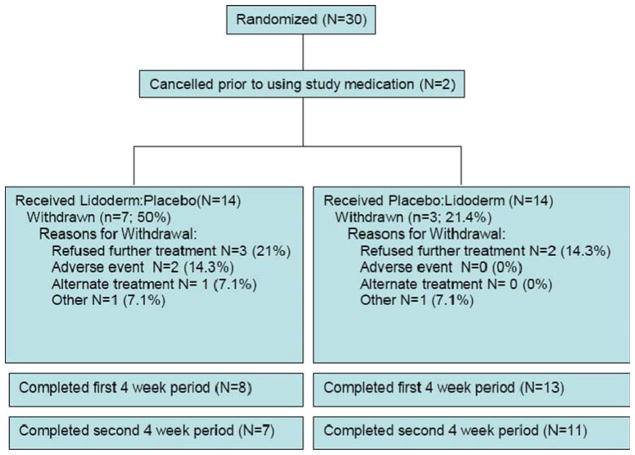
Materials and methods: Twenty-eight cancer patients with postsurgical incisional pain were randomly assigned to receive either lidocaine patches followed by placebo patches or the reverse. Each study period lasted 4 weeks. Patches were applied daily upon waking and left in place for a maximum of 18 h. The primary outcome measure, an 11-point pain intensity rating scale, was administered weekly. Secondary outcomes were administered weekly (Brief Pain Inventory-Short Form(BPI-SF), Subject Global Impression of Change) and at the end of each study period (Short Form-Magill Pain Questionnaire, Linear Analogue Self Assessment Scale, Neuropathy Pain Scale, Pain Catastrophizing Scale, Profile of Mood States Short Form).
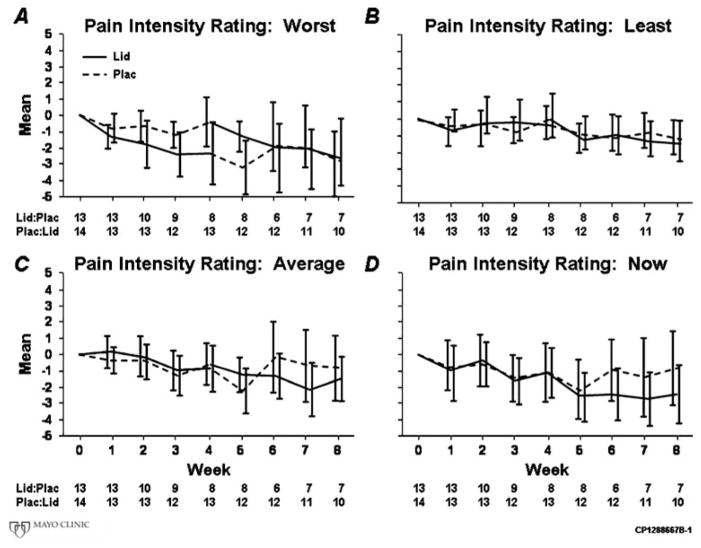
Results: Twenty-one patients completed the first period and 18 completed their crossover second phase. No significant intergroup differences were detected in pain intensity ratings. Few secondary end points were significantly different when subjects used the lidocaine versus placebo patches. BPI-SF interference scores were lower in patients using the lidocaine patch during the first study period, including several scores that achieved statistical significance, general activity (p = 0.02), work (p = 0.04), and relations with others (p = 0.02).
Conclusion: Lidocaine patch use did not significantly reduce pain intensity ratings or the majority of related secondary end points in cancer patients with persistent incisional pain.
Figures

References
-
- Cleeland C, et al. How to assess cancer pain. In: Turk DC, Melzack R, editors. Handbook of pain assessment. Guilford; New York: 1992. pp. 360–387.
Publication types
MeSH terms
Substances
Grants and funding
- CA-37404/CA/NCI NIH HHS/United States
- N01 CA035119/CA/NCI NIH HHS/United States
- CA-35103/CA/NCI NIH HHS/United States
- CA-25224/CA/NCI NIH HHS/United States
- CA-35113/CA/NCI NIH HHS/United States
- U10 CA035113/CA/NCI NIH HHS/United States
- U10 CA035415/CA/NCI NIH HHS/United States
- CA-35119/CA/NCI NIH HHS/United States
- CA-35415/CA/NCI NIH HHS/United States
- U10 CA035119/CA/NCI NIH HHS/United States
- U10 CA025224/CA/NCI NIH HHS/United States
- U10 CA035103/CA/NCI NIH HHS/United States
- U10 CA037404/CA/NCI NIH HHS/United States
- U10 CA180821/CA/NCI NIH HHS/United States
LinkOut - more resources
Full Text Sources
Medical
