


Pubertal changes in emotional information processing: pupillary, behavioral, and subjective evidence during emotional word identification
- PMID: 19144220
- PMCID: PMC2629078
- DOI: 10.1017/S0954579409000029
Pubertal changes in emotional information processing: pupillary, behavioral, and subjective evidence during emotional word identification
Abstract
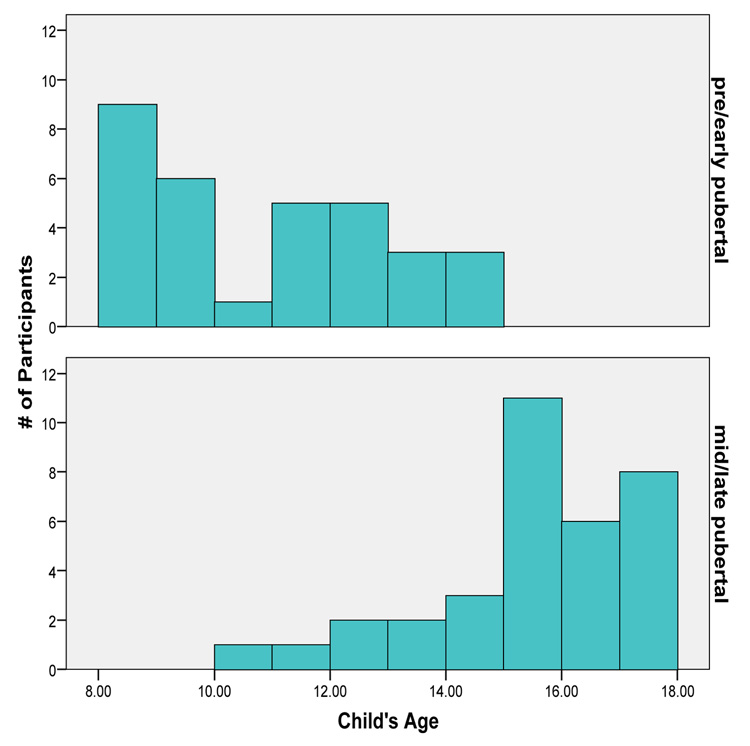
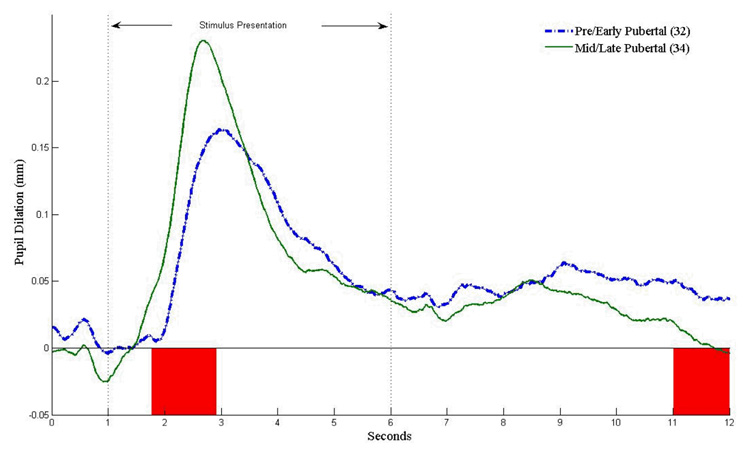
This study investigated pupillary and behavioral responses to an emotional word valence identification paradigm among 32 pre-/early pubertal and 34 mid-/late pubertal typically developing children and adolescents. Participants were asked to identify the valence of positive, negative, and neutral words while pupil dilation was assessed using an eyetracker. Mid-/late pubertal children showed greater peak pupillary reactivity to words presented during the emotional word identification task than pre-/early pubertal children, regardless of word valence. Mid-/late pubertal children also showed smaller sustained pupil dilation than pre-/early pubertal children after the word was no longer on screen. These findings were replicated controlling for participants' age. In addition, mid-/late pubertal children had faster reaction times to all words, and rated themselves as more emotional during their laboratory visit compared to pre-/early pubertal children. Greater recall of emotional words following the task was associated with mid-/late pubertal status, and greater recall of emotional words was also associated with higher peak pupil dilation. These results provide physiological, behavioral, and subjective evidence consistent with a model of puberty-specific changes in neurobehavioral systems underpinning emotional reactivity.
Figures
Comment in
-
Heightened stress responsivity and emotional reactivity during pubertal maturation: Implications for psychopathology.Dev Psychopathol. 2009 Winter;21(1):87-97. doi: 10.1017/S0954579409000066. Dev Psychopathol. 2009. PMID: 19144224 Free PMC article. Review.
References
-
- Achenbach TM. Manual for the child behavior checklist/4-18 and 1991 profile. Burlington: University of Vermont, Department of Psychiatry; 1991.
-
- Alpert JE, Maddocks A, Rosenbaum JF, Fava M. Childhood psychopathology retrospectively assessed among adults with early onset major depression. Journal of Affective Disorders. 1994;31:165–171. - PubMed
-
- Anderson JR, Qin Y, Jung K-J, Carter CS. Information-processing modules and their relative modality specificity. Cognitive Psychology. 2007;54:185–217. - PubMed
-
- Angold A, Costello EJ, Worthman CM. Puberty and depression: The roles of age, pubertal status and pubertal timing. Psychological Medicine. 1998;28:51–61. - PubMed
-
- American Psychological Association. Diagnostic and Statistical Manual of Mental Disorders. 4th ed. Washington, D.C.: Author; 1994.
Publication types
MeSH terms
Grants and funding
LinkOut - more resources
Full Text Sources
Other Literature Sources
Medical
