Review
. 2009 Feb;12(1):101-9.
doi: 10.1016/j.mib.2008.11.006. Epub 2009 Jan 12.

The effector repertoire of enteropathogenic E. coli: ganging up on the host cell

Affiliations
Review

The effector repertoire of enteropathogenic E. coli: ganging up on the host cell

Paul Dean et al. Curr Opin Microbiol. 2009 Feb.

Abstract

Diarrhoeal disease caused by enteropathogenic E. coli (EPEC) is dependent on a delivery system that injects numerous bacterial 'effector' proteins directly into host cells. The best-described EPEC effectors are encoded together on the locus of enterocyte effacement (LEE) pathogenicity island and display high levels of multifunctionality and cooperativity within the host cell. More recently, effectors encoded outside the LEE (non-LEE effectors) have been discovered and their functions are beginning to be uncovered. The recent completion of the EPEC genome sequence suggests its effector repertoire consists of at least 21 effector proteins. Here, we describe the genomic location of effectors and discuss recent advances made on effector cellular function as well as their role in the infection process.


Figures
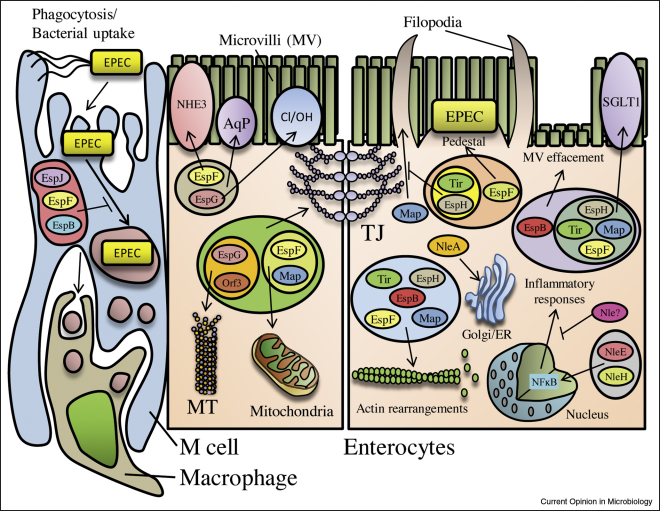
Figure 1
Figure 1
The complexity of EPEC effector function. The multifunctional and overlapping properties of the EPEC effectors are depicted here by grouping effector functions together. Three effectors have anti-phagocytic activities (shown here using the phagocytic-like gut-associated antigen presenting M-cells) whilst at least five effectors act on microvilli and four inhibit SGLT-1 and other transporter activity, four disrupt tight junctions and three are involved in pedestal and filopodia formation. At least three Nle effectors are also involved in inflammatory pathways. Microtubule and Golgi/ER disruption appears to be specific to EspG/Orf3 and NleA, respectively. Also shown are effectors which have known actin-modulating properties. TJ, tight junctions; MT, microtubules; AqP, aquaporins; NHE3, sodium hydrogen exchanger; Cl/OH, Cl/OH transporter; SGLT-1, sodium glucose cotransporter-1; ER, endoplasmic reticulum; MV, microvilli.
Figure 2
Figure 2
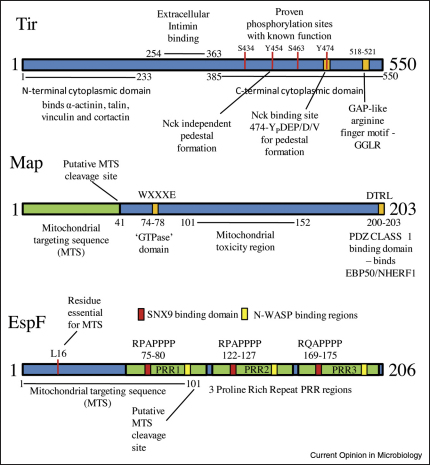
The modular nature of multifunctional LEE effector proteins. Tir, Map and EspF are the best-studied EPEC effectors and have been implicated in subverting multiple cellular processes. These proteins possess many eukaryotic-like motifs with many being assigned to elicit specific host cellular responses. Only those motifs/domains with proven and documented functions within the host cell are shown whilst chaperone binding sites or the N-terminal bacterial secretion and translocation signals are not shown. Other EPEC effectors are not shown because of the paucity of information regarding their functional domains. See text for abbreviations.
Figure 3
Figure 3
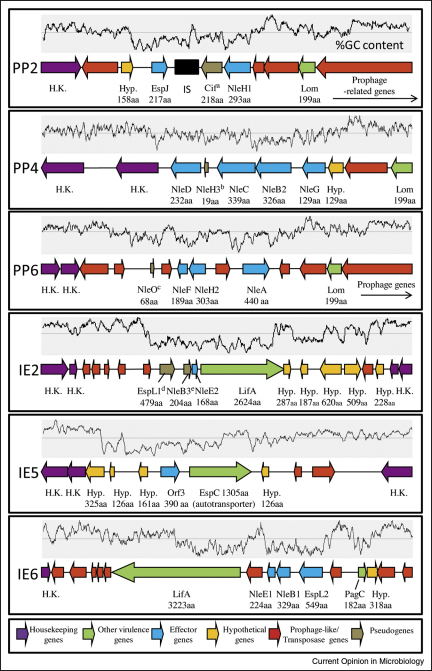
The six identified non-LEE effector encoding pathogenicity islands of EPEC E2348/69. Predicted effector genes were identified by mining the EPEC genome using over 400 known/predicted effector sequences. The identified effectors and genomic islands support the genome sequence published data (see text), from which the genomic island names were obtained. Only those genomic regions encoding the effectors and with low %GC content (graph above each island) are shown with most prophage-related genes surrounding these regions omitted. Genes and strand direction are shown by individual arrows which are drawn to scale within each island and colour coded (see inset). Multiple copies of genes are numbered according to close homologues in EHEC as explained in the legend to Table 1. Pseudogene key: (a) Cif; C-terminally truncated protein not produced or secreted in this EPEC strain [48]; (b) NleH3; C-terminal truncated; (c) NleO; no start codon; (d) EspL1; stop codon in middle of gene; (e) NleB3; N-terminal truncated.

References

    1. Chen H.D., Frankel G. Enteropathogenic Escherichia coli: unravelling pathogenesis. FEMS Microbiol Rev. 2005;29:83–98. - PubMed
    1. Mundy R., MacDonald T.T., Dougan G., Frankel G., Wiles S. Citrobacter rodentium of mice and man. Cell Microbiol. 2005;7:1697–1706. - PubMed
    1. Dean P., Maresca M., Kenny B. EPEC's weapons of mass subversion. Curr Opin Microbiol. 2005;8:28–34. - PubMed
    1. Deng W., Puente J.L., Gruenheid S., Li Y., Vallance B.A., Vazquez A., Barba J., Ibarra J.A., O’Donnell P., Metalnikov P. Dissecting virulence: systematic and functional analyses of a pathogenicity island. Proc Natl Acad Sci U S A. 2004;101:3597–3602. - PMC - PubMed
    1. Tobe T., Beatson S.A., Taniguchi H., Abe H., Bailey C.M., Fivian A., Younis R., Matthews S., Marches O., Frankel G. An extensive repertoire of type III secretion effectors in Escherichia coli O157 and the role of lambdoid phages in their dissemination. Proc Natl Acad Sci U S A. 2006;103:14941–14946. - PMC - PubMed

Publication types

MeSH terms