. 2009 Apr;296(4):F700-8.
doi: 10.1152/ajprenal.90548.2008. Epub 2009 Jan 14.

Moderate exercise attenuates caspase-3 activity, oxidative stress, and inhibits progression of diabetic renal disease in db/db mice

Affiliations

Moderate exercise attenuates caspase-3 activity, oxidative stress, and inhibits progression of diabetic renal disease in db/db mice

S Ghosh et al. Am J Physiol Renal Physiol. 2009 Apr.

Abstract

Diabetic nephropathy, the leading cause of end-stage renal disease, is characterized by a proapoptotic and prooxidative environment. The mechanisms by which lifestyle interventions, such as exercise, benefit diabetic nephropathy are unknown. We hypothesized that exercise inhibits early diabetic nephropathy via attenuation of the mitochondrial apoptotic pathway and oxidative damage. Type 2 diabetic db/db and normoglycemic wild-type mice were exercised for an hour everyday at a moderate intensity for 7 wk, following which renal function, morphology, apoptotic signaling, and oxidative stress were evaluated. Exercise reduced body weight, albuminuria, and pathological glomerular expansion in db/db mice independent of hyperglycemic status. Changes in renal morphology were also related to reduced caspase-3 (main effector caspase in renal apoptosis), caspase-8 (main initiator caspase of the "extrinsic" pathway) activities, and TNF-alpha expression. A role for the mitochondrial apoptotic pathway was unlikely as both caspase-9 activity (initiator caspase of this pathway) and expression of regulatory proteins such as Bax and Bcl-2 were unchanged. Kidneys from db/db mice also produced higher levels of superoxides and had greater oxidative damage concurrent with downregulation of superoxide dismutase (SOD) 1 and 3. Interestingly, although exercise also increased superoxides, there was also upregulation of multiple SODs that likely inhibited lipid (hydroperoxides) and protein (carbonyls and nitrotyrosine) oxidation in db/db kidneys. In conclusion, exercise can inhibit progression of early diabetic nephropathy independent of hyperglycemia. Reductions in caspase-3 and caspase-8 activities, with parallel improvements in SOD expression and reduced oxidative damage, could underlie the beneficial effects of exercise in diabetic kidney disease.


Figures
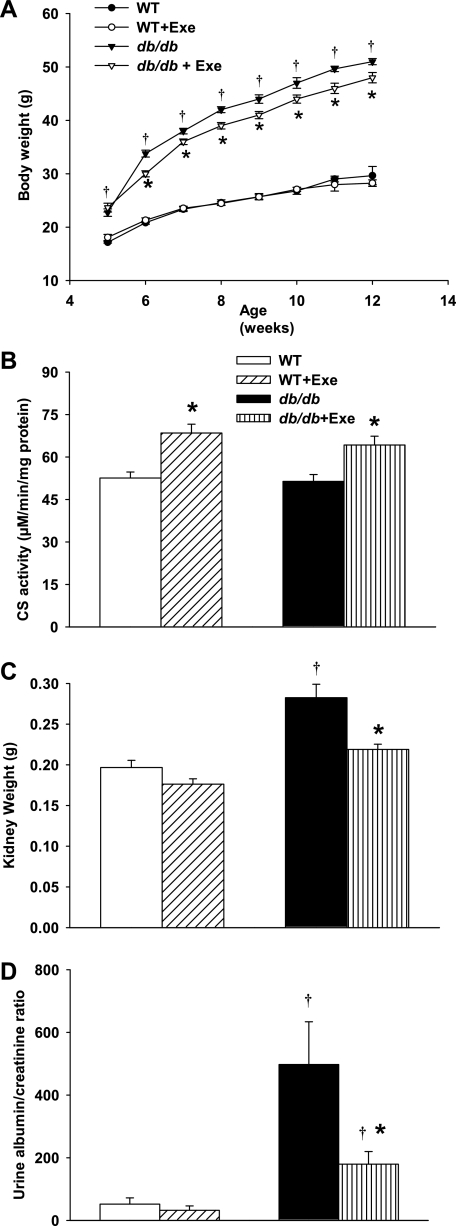
Fig. 1.
Fig. 1.
Exercise-related changes in body weight, citrate synthase (CS), and kidney parameters. A: db/db mice exercised with moderate intensity gained less weight compared with their sedentary littermates. This difference was apparent from 6 wk of age onward (n = 8–10 per group). Weight gain in wild-type (WT) mice was not affected by exercise. B: CS activity was used to monitor exercise-induced changes in metabolic activity in thigh adductor muscles. Both exercised db/db and WT groups demonstrated greater CS activity at all time points (n = 9–10 per group). C: sedentary db/db mice had higher kidney weights compared with WT. Exercise decreased kidney weights in db/db mice to WT levels after 7 wk. D: urinary albumin/creatinine (Cr) ratio is significantly higher in db/db mice compared with WT mice. Exercise significantly decreased this ratio in db/db mice, implicating improved renal function (n = 5–7 per group). Exe, exercise. Results are means ± SE. *Significantly different from sedentary littermate. †Significantly different from corresponding WT group, P < 0.05.
Fig. 2.
Fig. 2.
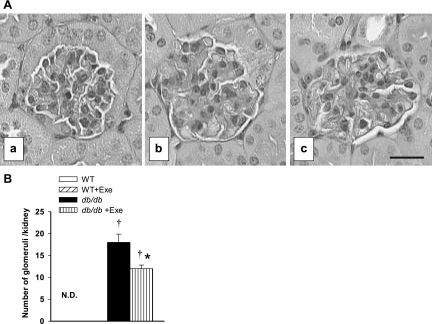
Exercise-related changes in kidney morphology. A: light microscopic appearance of glomeruli from male nondiabetic (WT) mice (a) and diabetic (db/db) mice (b) and diabetic mice exercised with moderate intensity (c) at 12 wk of age. There is diffuse mesangial matrix expansion and evidence of arteriolar hyalinosis (b) in db/db mice. Exercise prevented mesangial matrix expansion and arteriolar hyalinosis in db/db glomerulus (c). Renal tissue was fixed with 10% neutral buffered formalin, and 4-μm sections were stained with periodic acid-Schiff. Images are taken at ×400 magnification. B: pathological grade III mesangial expansion is not detectable (N.D.) in both WT groups, whereas db/db kidneys demonstrated significant mesangial expansion. Exercise significantly reduced such expansion (n = 5 per group). Results are means ± SE. *Significantly different from sedentary littermate. †Significantly different from corresponding WT group, P < 0.05.
Fig. 3.
Fig. 3.
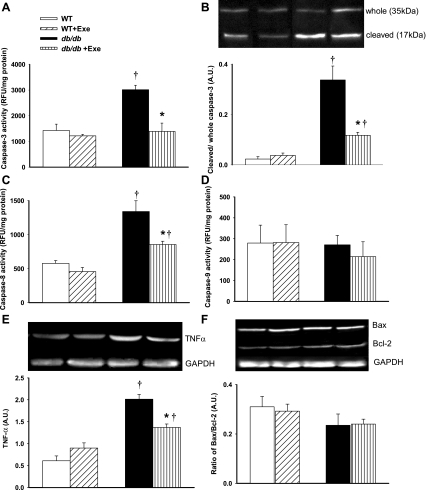
Renal apoptotic signaling in response to diabetes and exercise. A: chief effector caspase, caspase-3, activity is increased in diabetic kidneys and is reduced to WT levels with exercise. B: further evidence of renal caspase-3 activation as evidenced by enhanced caspase-3 processing (ratio of the “cleaved” 17-kDa fragment to 35-kDa whole caspase-3 expression) in diabetes. Exercise decreased caspase-3 activation in db/db kidneys. Representative Western blots are depicted in the inset. C: enhanced activity of caspase-8, the initiator caspase of the “extrinsic” pathway in diabetic kidneys. Exercise also decreases caspase-8 activity. D: caspase-9 activity, the initiator caspase of the mitochondrial “intrinsic” pathway, is unchanged by exercise in all groups. E: protein expression of TNF-α, a proinflammatory cytokine implicated in the activation of caspase-8, was increased in db/db kidneys and reduced by exercise. Representative Western blots are depicted in the inset. F: ratio between protein expression of Bax, a proapoptotic protein, and BCl-2, an anti-apoptotic protein, remained unchanged in all groups. Representative Western blots are depicted in the inset. AU, arbitrary units; RFU, relative fluorescence units. Results are means ± SE. *Significantly different from sedentary littermate. †Significantly different from corresponding WT group, P < 0.05.
Fig. 4.
Fig. 4.
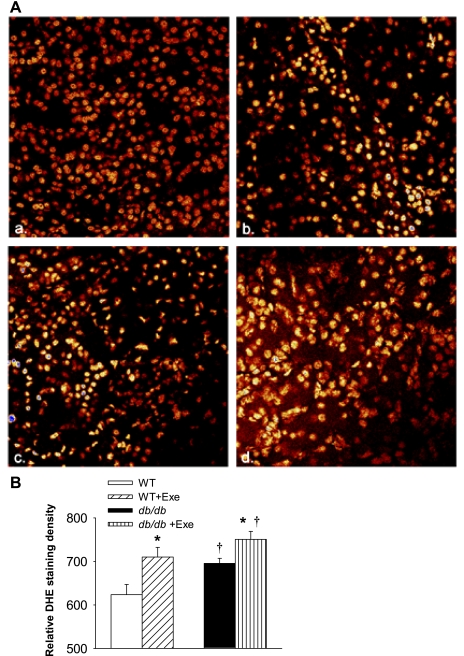
Exercise and diabetes induced changes in ex vivo superoxide generation. Renal superoxide generation as measured by dihydroethidium (DHE) staining of nuclei. A: representative micrographs from WT (a), WT + Exe (b), db/db (c), and db/db + Exe (d) are depicted. Cells with mild reactive oxygen species (ROS) have red-stained nuclei, whereas cells with intense ROS have yellow-stained nuclei. Sedentary WT mice (a) have minimal ROS production (mostly red nuclei), whereas exercise in WT mice (b) increases renal ROS generation (increased number of yellow nuclei). Sedentary db/db mice (c) also have higher renal ROS generation than sedentary WT, with exercise further increasing ROS generation in db/db mice (intense yellow nuclei in d). Images were taken on an inverted confocal microscope, equipped with a Ar/ArKr laser (Ex: 515 nm/Em: 605 nm). A total of 4 animals per group was analyzed, with 2 slides from each animal and 7 images per slide. After image intensity per image was calculated, the signal intensity was divided by the captured area and expressed (B) as DHE staining intensity. Results are means ± SE. *Significantly different from sedentary littermate. †Significantly different from corresponding WT group, P < 0.05.
Fig. 5.
Fig. 5.
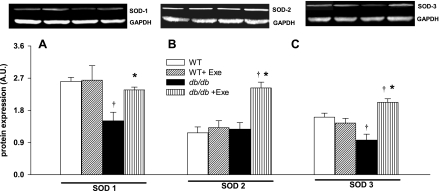
Differential regulation of superoxide dismutase (SOD) isoforms following diabetes and exercise. Representative Western blots are depicted in the inset. Cytosolic SOD 1 (A), mitochondrial SOD 2 (B), and extracellular SOD 3 (C) were evaluated. SOD 1 and 3 decreased in db/db kidneys. Exercise increased protein expression of all SODs in db/db kidneys. Results are means ± SE. *Significantly different from sedentary littermate. †Significantly different from corresponding WT group, P < 0.05.
Fig. 6.
Fig. 6.
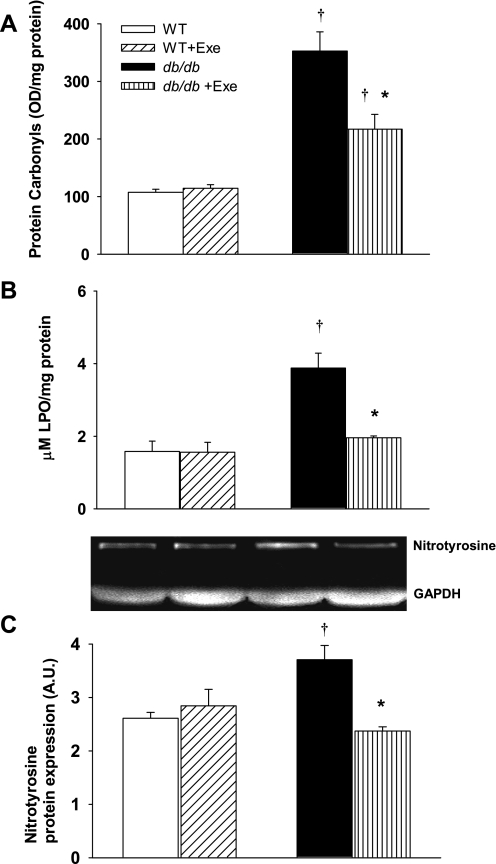
Exercise and diabetes-related changes on renal oxidative stress. A: protein carbonyl levels as a measure of nonspecific protein oxidation. B: lipid hydroperoxide levels as a measure for lipid peroxidation. C: peroxinitrite-induced protein nitration as measured by nitrotyrosine protein expression. Diabetes increased oxidative lipid, protein, and nitrotyrosine formation, all of which were reduced with exercise. Representative Western blots are depicted in the inset. LPO, lipid hydroperoxide. Results are means ± SE. *Significantly different from sedentary littermate. †Significantly different from corresponding WT group, P < 0.05.

References

    1. Al-Kateb H, Boright AP, Mirea L, Xie X, Sutradhar R, Mowjoodi A, Bharaj B, Liu M, Bucksa JM, Arends VL, Steffes MW, Cleary PA, Sun W, Lachin JM, Thorner PS, Ho M, McKnight AJ, Maxwell AP, Savage DA, Kidd KK, Kidd JR, Speed WC, Orchard TJ, Miller RG, Sun L, Bull SB, Paterson AD. Multiple superoxide dismutase 1/splicing factor serine alanine 15 variants are associated with the development and progression of diabetic nephropathy: the Diabetes Control and Complications Trial/Epidemiology of Diabetes Interventions and Complications Genetics study. Diabetes 57: 218–228, 2008. - PMC - PubMed
    1. Allen DA, Harwood S, Varagunam M, Raftery MJ, Yaqoob MM. High glucose-induced oxidative stress causes apoptosis in proximal tubular epithelial cells and is mediated by multiple caspases. FASEB J 17: 908–910, 2003. - PubMed
    1. Baba K, Minatoguchi S, Sano H, Kagawa T, Murata I, Takemura G, Hirano T, Ohashi H, Takemura M, Fujiwara T, Fujiwara H. Involvement of apoptosis in patients with diabetic nephropathy: a study on plasma soluble Fas levels and pathological findings. Nephrology (Carlton) 9: 94–99, 2004. - PubMed
    1. Baumgartner-Parzer SM, Wagner L, Pettermann M, Grillari J, Gessl A, Waldhausl W. High-glucose-triggered apoptosis in cultured endothelial cells. Diabetes 44: 1323–1327, 1995. - PubMed
    1. Behl Y, Krothapalli P, Desta T, DiPiazza A, Roy S, Graves DT. Diabetes-enhanced tumor necrosis factor-alpha production promotes apoptosis and the loss of retinal microvascular cells in type 1 and type 2 models of diabetic retinopathy. Am J Pathol 172: 1411–1418, 2008. - PMC - PubMed

Publication types

MeSH terms