. 2009 Mar;296(3):F505-11.
doi: 10.1152/ajprenal.90545.2008. Epub 2009 Jan 14.

The copper transporter Ctr1 contributes to cisplatin uptake by renal tubular cells during cisplatin nephrotoxicity

Affiliations

The copper transporter Ctr1 contributes to cisplatin uptake by renal tubular cells during cisplatin nephrotoxicity

Navjotsingh Pabla et al. Am J Physiol Renal Physiol. 2009 Mar.

Abstract

The usefulness and efficacy of cisplatin, a chemotherapeutic drug, are limited by its toxicity to normal tissues and organs, including the kidneys. The uptake of cisplatin in renal tubular cells is high, leading to cisplatin accumulation and tubular cell injury and death, culminating in acute renal failure. While extensive investigations have been focused on the signaling pathways of cisplatin nephrotoxicity, much less is known about the mechanism of cisplatin uptake by renal cells and tissues. In this regard, evidence has been shown for the involvement of organic cation transporters (OCT), specifically OCT2. The copper transporter Ctr1 is highly expressed in the renal tubular cells; however, its role in cisplatin nephrotoxicity is not known. In this study, we demonstrate that Ctr1 is mainly expressed in both proximal and distal tubular cells in mouse kidneys. We further show that Ctr1 is mainly localized on the basolateral side of these cells, a proposed site for cisplatin uptake. Importantly, downregulation of Ctr1 by small interfering RNA or copper pretreatment results in decreased cisplatin uptake. Consistently, downregulation of Ctr1 suppresses cisplatin toxicity, including cell death by both apoptosis and necrosis. Cimetidine, a pharmacological inhibitor of OCT2, can also partially attenuate cisplatin uptake. Notably, cimetidine can further reduce cisplatin uptake and cisplatin toxicity in Ctr1-downregulated cells. The results have demonstrated the first evidence for a role of Ctr1 in cisplatin uptake and nephrotoxicity.


Figures
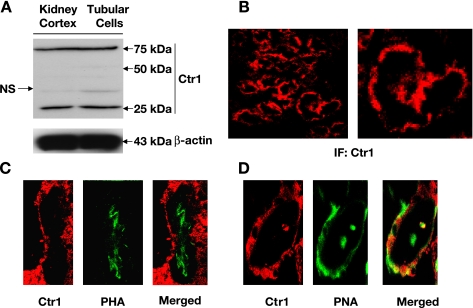
Fig. 1.
Fig. 1.
Basolateral expression of copper transporter Ctr1 in renal tubular cells. C57BL/6 mice were killed to collect renal cortical tissues. The tissues were homogenized in SDS buffer to collect tissue lysates for immunoblot analysis, dissected for digestion to isolate tubular cells for primary culture, or frozen to obtain cryosections for immunofluorescence staining. A: immunoblot analysis of Ctr1 in renal cortical homogenate and whole-cell lysate of primary tubular cell cultures. The 25-, 50-, and 75-kDa bands correspond to the monomeric, dimeric, and trimeric forms of Ctr1. B: immunofluorescence of Ctr1 in renal cortical tissue. Right: magnified image of a single tubule. C: cryosections of cortical tissues were costained with Ctr1 (red) and FITC-labeled Phaseolus vulgaris agglutinin (PHA; green), a lectin marker of proximal tubular cells. D: cryosections of cortical tissues were costained with Ctr1 (red) and FITC-labeled peanut agglutinin (PNA; green), a lectin marker of distal tubular cells. NS is a nonspecific band recognized by the Ctr1 antibody.
Fig. 2.
Fig. 2.
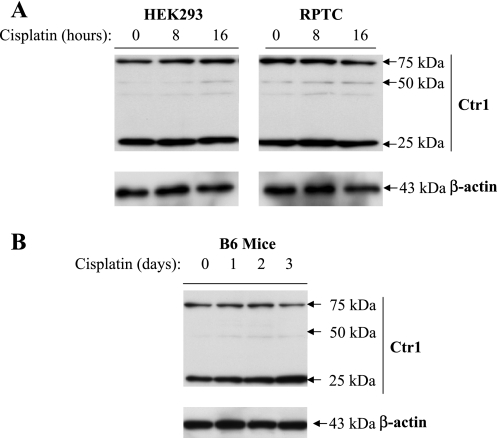
Ctr1 expression renal cells and tissues during cisplatin treatment. A: HEK293 and renal proximal tubule cells (RPTC) cells were treated with 20 and 40 μM cisplatin, respectively, for indicated time points, and whole-cell lysates were collected and used for immunoblot analysis of Ctr1. B: male C57BL/6 mice were treated with 30 mg/kg cisplatin, and kidney lysates were prepared on days 0, 1, 2, and 3 for immunoblot analysis of Ctr1.
Fig. 3.
Fig. 3.
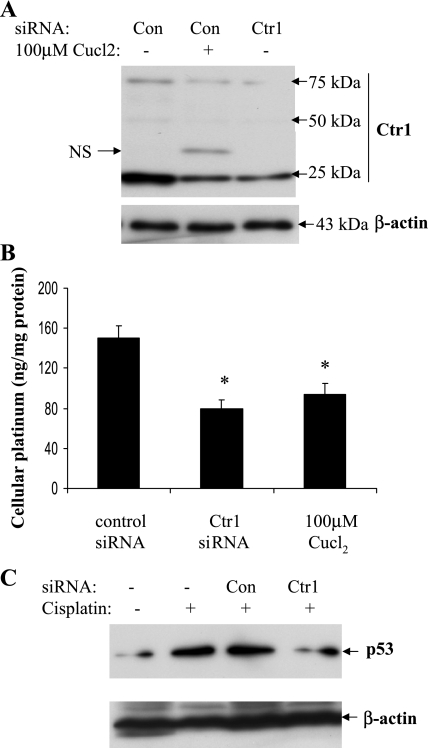
Effects of Ctr1 downregulation on cisplatin uptake in renal cells. HEK293 cells were transfected with control small interfering (si)RNA or Ctr1-specific siRNA. Control siRNA-transfected cells were then incubated for 3 h with or without 100 μM Ctr1. A: Ctr1 downregulation by siRNA and copper treatment. The cells were lysed in 1% SDS buffer for immunoblot analysis of Ctr1 and β-actin. B: effects of Ctr1 downregulation on cisplatin uptake. The cells were incubated with 40 μM cisplatin for 12 h to collect lysate for platinum measurement. Values are means ± SD; n = 3. *Statistically significant difference from the control siRNA-transfected group. C: p53 accumulation. The cells were treated with 40 μM cisplatin for 12 h to collect whole-cell lysate for immunoblot analysis of p53 and β-actin. NS is a nonspecific band recognized by the Ctr1 antibody.
Fig. 4.
Fig. 4.
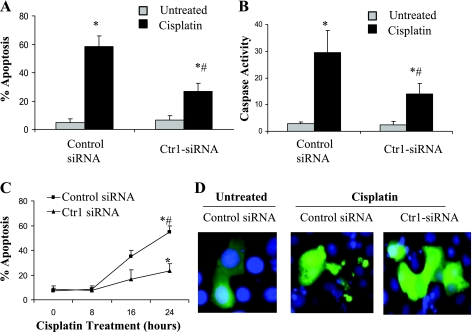
Suppression of cisplatin-induced apoptosis in Ctr1 knockdown cells. HEK293 cells transfected with control or Ctr1 siRNA were treated with 40 μM cisplatin for 20 h, and apoptosis was measured by morphological examination (A) and caspase assay (B). RPTC cells transfected with control or Ctr1 siRNA were treated with 20 μM cisplatin for 16 h, and apoptosis was estimated by morphological examination of green fluorescent protein (GFP)-positive cells (C). D: representative image of RPTC cells. Values are expressed as means ± SD; n = 3. *Statistically significant difference from the untreated group (P < 0.05). #Statistically significant difference from the treated control siRNA group (P < 0.05).
Fig. 5.
Fig. 5.
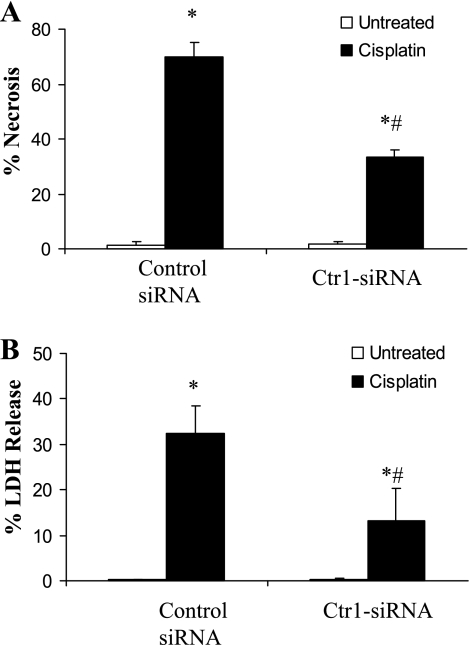
Suppression of cisplatin-induced necrosis in Ctr1 knockdown cells. HEK293 cells transfected with control or Ctr1 siRNA were treated with 150 μM cisplatin for 8 h, and necrosis was measured by propidium iodide (PI) staining (A) and LDH assay (B). Values are means ± SD; n = 3. *Statistically significant difference from the untreated group (P < 0.05). #Statistically significant difference from the control siRNA treated group (P < 0.05).
Fig. 6.
Fig. 6.
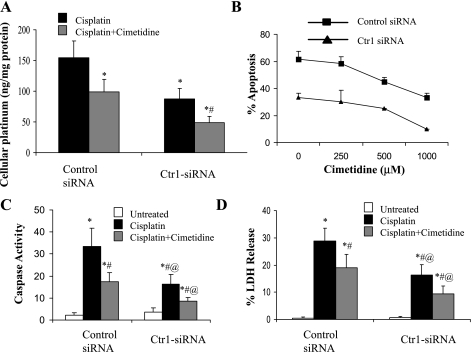
Additive effects of Ctr1 knockdown and cimetidine on cisplatin uptake and cell death in HEK293 cells. A: cisplatin uptake. Control and Ctr1 siRNA-transfected cells were treated with either 40 μM cisplatin alone or 1 mM cimetidine+40 μM cisplatin for 12 h to measure cisplatin uptake. B: apoptosis. Control and Ctr1 siRNA-transfected cells were treated with either 40 μM cisplatin alone or 40 μM cisplatin with different concentrations of cimetidine for 20 h. Apoptosis was determined by a morphological method. C: caspase activity. Control and Ctr1 siRNA-transfected cells were treated with either 40 μM cisplatin alone or 1 mM cimetidine+40 μM cisplatin for 20 h to measure caspase activity. D: necrosis. Control and Ctr1 siRNA-transfected cells were treated with either 150 μM cisplatin alone or 1 mM cimetidine+150 μM cisplatin for 8 h to determine LDH release to indicate plasma membrane breakdown or necrosis. Values are means ± SD; n = 3. *Statistically significant difference from the untreated group (P < 0.05). #Statistically significant difference from the cisplatin-treated group (P < 0.05). @Statistically significant difference compared with control siRNA-treated group (P < 0.05).

References

    1. Aller SG, Unger VM. Projection structure of the human copper transporter CTR1 at 6-A resolution reveals a compact trimer with a novel channel-like architecture. Proc Natl Acad Sci USA 103: 3627–3632, 2006. - PMC - PubMed
    1. Arany I, Safirstein RL. Cisplatin nephrotoxicity. Semin Nephrol 23: 460–464, 2003. - PubMed
    1. Bhatt K, Feng L, Pabla N, Liu K, Smith S, Dong Z. Effects of targeted Bcl-2 expression in mitochondria or endoplasmic reticulum on renal tubular cell apoptosis. Am J Physiol Renal Physiol 294: F499–F507, 2008. - PubMed
    1. Biermann J, Lang D, Gorboulev V, Koepsell H, Sindic A, Schroter R, Zvirbliene A, Pavenstadt H, Schlatter E, Ciarimboli G. Characterization of regulatory mechanisms and states of human organic cation transporter 2. Am J Physiol Cell Physiol 290: C1521–C1531, 2006. - PubMed
    1. Ciarimboli G, Ludwig T, Lang D, Pavenstadt H, Koepsell H, Piechota HJ, Haier J, Jaehde U, Zisowsky J, Schlatter E. Cisplatin nephrotoxicity is critically mediated via the human organic cation transporter 2. Am J Pathol 167: 1477–1484, 2005. - PMC - PubMed

Publication types

MeSH terms