Characterization of large mumps outbreak among vaccinated Palestinian refugees
- PMID: 19144793
- PMCID: PMC2650945
- DOI: 10.1128/JCM.01756-08
Characterization of large mumps outbreak among vaccinated Palestinian refugees
Abstract
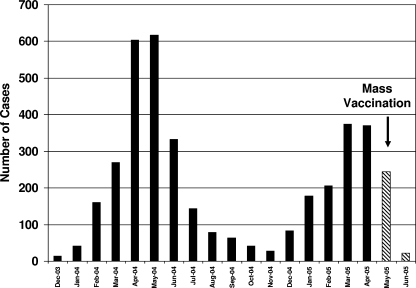
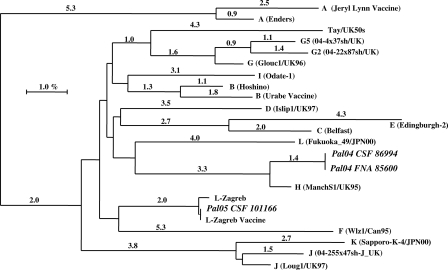
During a large mumps virus (MuV) outbreak which occurred in the Palestinian refugee camps of the West Bank, 68.1% (2,636/3,871) of the cases were vaccinated with one dose of trivalent measles, mumps, and rubella (MMR) vaccine. Attack rates by camp ranged from less than 1 case per 1,000 people in the population to 43/1,000 (overall, 11/1,000). The outbreak lasted from December 2003 to June 2005, with two peaks, one from April to May 2004 and the other from March to April 2005. To control the outbreak, a mass MMR vaccination campaign was conducted in May 2005. Evaluation of the immune status of cases (n=59) and healthy controls (n=51) revealed high levels of mumps immunoglobulin G (IgG) and a low MuV-specific IgM in clinical cases indicative of a booster immune response. This suggested a secondary rather than a primary infection due to the insufficient protection conferred by the single vaccine dose included in the vaccination program. This prediction was further confirmed by the low seroprevalence (68.6%) found in the healthy control group, which was below the threshold level required for MuV herd immunity. Mumps diagnosis was established mainly by reverse transcription-PCR in clinical samples obtained within 48 h from the onset of disease. Of the parotid fluids and nasopharyngeal aspirates analyzed, 92% were positive for MuV RNA, while only 33% of the urine samples were positive. Phylogenetic analysis of the MuV SH gene identified the outbreak strain as the H genotype, which has been in circulation worldwide at least since 1989.
Figures
References
-
- Afzal, M. A., J. Buchanan, J. A. Dias, M. Cordeiro, M. L. Bentley, C. A. Shorrock, and P. D. Minor. 1997. RT-PCR based diagnosis and molecular characterisation of mumps viruses derived from clinical specimens collected during the 1996 mumps outbreak in Portugal. J. Med. Virol. 52349-353. - PubMed
-
- Afzal, M. A., V. Dussupt, P. D. Minor, P. A. Pipkin, R. Fleck, D. J. Hockley, and G. N. Stacey. 2005. Assessment of mumps virus growth on various continuous cell lines by virological, immunological, molecular and morphological investigations. J. Virol. Methods 126149-156. - PubMed
-
- Boga, J. A., M. de Ona, A. Fernandez-Verdugo, D. Gonzalez, A. Morilla, M. Arias, L. Barreiro, F. Hidalgo, and S. Melon. 2008. Molecular identification of two genotypes of mumps virus causing two regional outbreaks in Asturias, Spain. J. Clin. Virol. 42425-428. - PubMed
-
- Bonnet, M. C., A. Dutta, C. Weinberger, and S. A. Plotkin. 2006. Mumps vaccine virus strains and aseptic meningitis. Vaccine 247037-7045. - PubMed
MeSH terms
Substances
Associated data
- Actions
- Actions
LinkOut - more resources
Full Text Sources
Medical
Miscellaneous