Targeting ornithine decarboxylase impairs development of MYCN-amplified neuroblastoma
- PMID: 19147568
- PMCID: PMC2749594
- DOI: 10.1158/0008-5472.CAN-08-2968
Targeting ornithine decarboxylase impairs development of MYCN-amplified neuroblastoma
Abstract
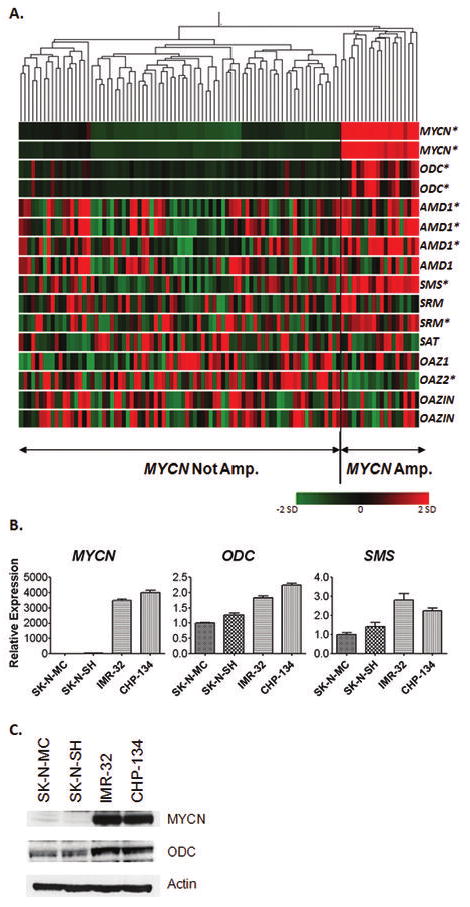
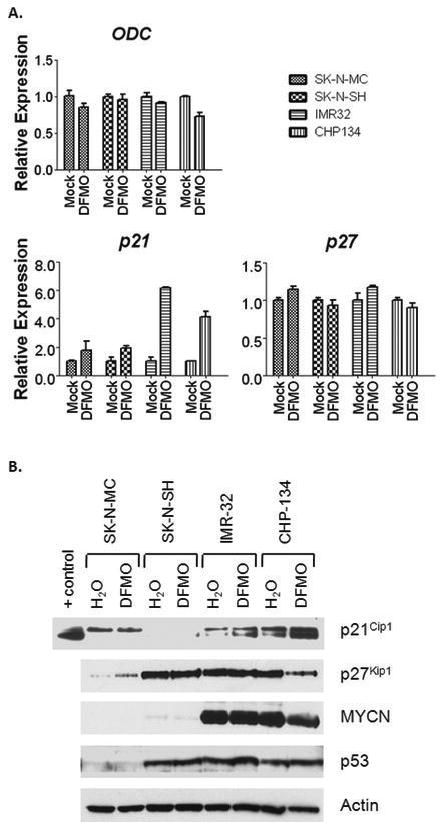
Neuroblastoma is a pediatric malignancy that arises from the neural crest, and patients with high-risk neuroblastoma, which typically harbor amplifications of MYCN, have an extremely poor prognosis. The tyrosine hydroxylase (TH) promoter-driven TH-MYCN transgenic mouse model faithfully recapitulates many hallmarks of human MYCN-amplified neuroblastoma. A key downstream target of Myc oncoproteins in tumorigenesis is ornithine decarboxylase (Odc), the rate-limiting enzyme of polyamine biosynthesis. Indeed, sustained treatment with the Odc suicide inhibitor alpha-difluoromethylornithine (DFMO) or Odc heterozygosity markedly impairs lymphoma development in Emicro-Myc transgenic mice, and these effects are linked to the induction of the cyclin-dependent kinase (Cdk) inhibitor p27(Kip1), which is normally repressed by Myc. Here, we report that DFMO treatment, but not Odc heterozygosity, impairs MYCN-induced neuroblastoma and that, in this malignancy, transient DFMO treatment is sufficient to confer protection. The selective anticancer effects of DFMO on mouse and human MYCN-amplified neuroblastoma also rely on its ability to disable the proliferative response of Myc, yet in this tumor context, DFMO targets the expression of the p21(Cip1) Cdk inhibitor, which is also suppressed by Myc oncoproteins. These findings suggest that agents, such as DFMO, that target the polyamine pathway may show efficacy in high-risk, MYCN-amplified neuroblastoma.
Figures



References
-
- Ries LAG, S M, Gurney JG, Linet M, Tamra T, Young JL, Bunin GR, editors. Cancer Incidence and Survival among Children and Adolescents: United States SEER Program, 1975-1995. National Cancer Institute, SEER Program; 1999.
-
- De Bernardi B, Nicolas B, Boni L, et al. Disseminated neuroblastoma in children older than one year at diagnosis: comparable results with three consecutive high-dose protocols adopted by the Italian Co-Operative Group for Neuroblastoma. J Clin Oncol. 2003;21:1592–601. - PubMed
-
- Seeger RC, Brodeur GM, Sather H, et al. Association of multiple copies of the N-myc oncogene with rapid progression of neuroblastomas. The N Engl J Med. 1985;313:1111–6. - PubMed
-
- Brodeur GM, Seeger RC, Schwab M, Varmus HE, Bishop JM. Amplification of N-myc in untreated human neuroblastomas correlates with advanced disease stage. Science. 1984;224:1121–4. - PubMed
-
- Lee LA, Dang CV. Myc target transcriptomes. Curr Top Microbiol Immunol. 2006;302:145–67. - PubMed
Publication types
MeSH terms
Substances
Grants and funding
LinkOut - more resources
Full Text Sources
Other Literature Sources
Medical
Molecular Biology Databases
Research Materials
Miscellaneous