Disseminated tumor cells in prostate cancer patients after radical prostatectomy and without evidence of disease predicts biochemical recurrence
- PMID: 19147774
- PMCID: PMC3162324
- DOI: 10.1158/1078-0432.CCR-08-1754
Disseminated tumor cells in prostate cancer patients after radical prostatectomy and without evidence of disease predicts biochemical recurrence
Abstract
Purpose: Men with apparently localized prostate cancer often relapse years after radical prostatectomy. We sought to determine if epithelial-like cells identified from bone marrow in patients after radical prostatectomy, commonly called disseminated tumor cells (DTC), were associated with biochemical recurrence.
Experimental design: We obtained bone marrow aspirates from 569 men prior to radical prostatectomy and from 34 healthy men with prostate-specific antigens <2.5 ng/mL to establish a comparison group. Additionally, an analytic cohort consisting of 98 patients with no evidence of disease (NED) after radical prostatectomy was established to evaluate the relationship between DTC and biochemical recurrence. Epithelial cells in the bone marrow were detected by magnetic bead enrichment with antibodies to CD45 and CD61 (negative selection) followed by antibodies to human epithelial antigen (positive selection) and confirmation with FITC-labeled anti-BerEP4 antibody.
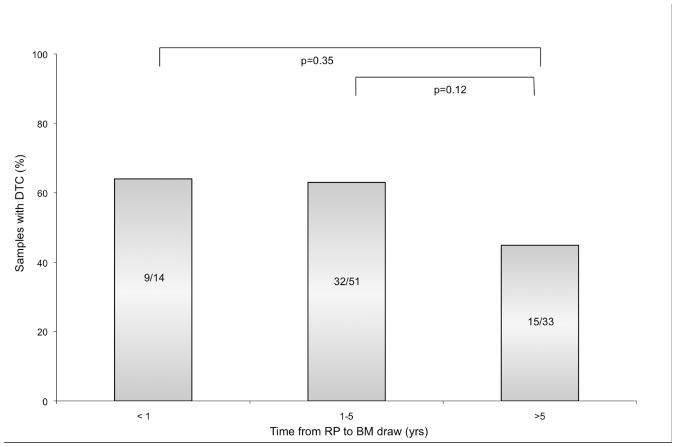
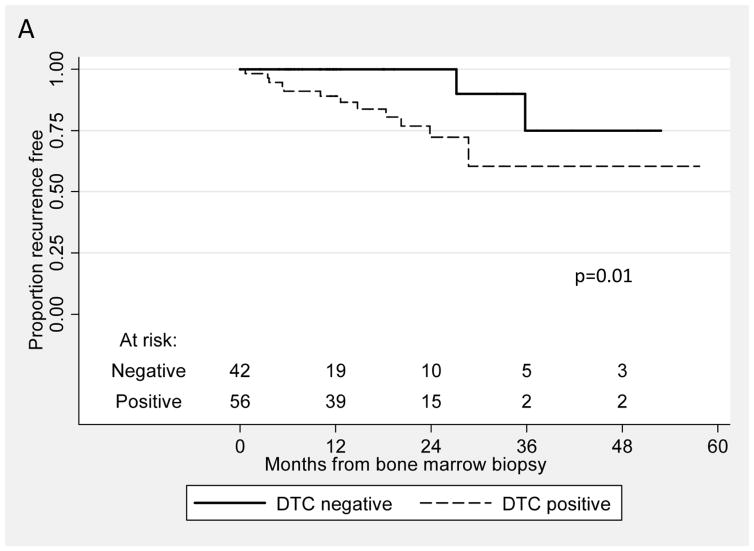
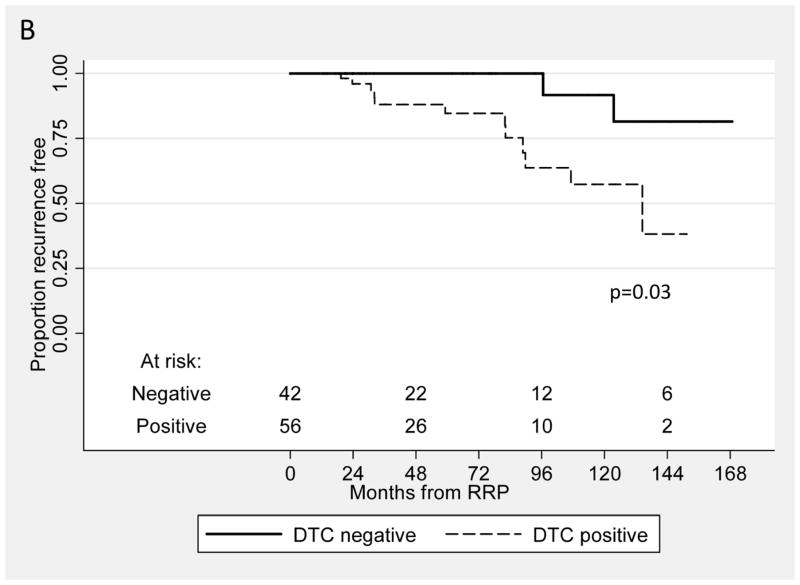
Results: DTC were present in 72% (408 of 569) of patients prior to radical prostatectomy. There was no correlation with pathologic stage, Gleason grade, or preoperative prostate-specific antigens. Three of 34 controls (8.8%) had DTC present. In patients with NED after radical prostatectomy, DTC were present in 56 of 98 (57%). DTC were detected in 12 of 14 (86%) NED patients after radical prostatectomy who subsequently suffered biochemical recurrence. The presence of DTC in NED patients was an independent predictor of recurrence (hazard ratio 6.9; 95% confidence interval, 1.03-45.9).
Conclusions: Approximately 70% of men undergoing radical prostatectomy had DTC detected in their bone marrow prior to surgery, suggesting that these cells escape early in the disease. Although preoperative DTC status does not correlate with pathologic risk factors, persistence of DTC after radical prostatectomy in NED patients was an independent predictor of recurrence.
Figures
References
-
- Pound CR, Partin AW, Eisenberger MA, Chan DW, Pearson JD, Walsh PC. Natural history of progression after PSA elevation following radical prostatectomy. JAMA. 1999;281:1591–7. - PubMed
-
- Amling CL, Blute ML, Bergstralh EJ, Seay TM, Slezak J, Zincke H. Long-term hazard of progression after radical prostatectomy for clinically localized prostate cancer: continued risk of biochemical failure after 5 years. J Urol. 2000;164:101–5. - PubMed
-
- Meng SD, Tripathy D, Frenkel EP, et al. Circulating tumor cells in patients with breast cancer dormancy. Clin Cancer Res. 2004;10:8152–62. - PubMed
-
- Klein CA, Blankenstein JF, Schmidt-Kittler O, et al. Genetic heterogeneity of single disseminated tumour cells in minimal residual cancer. Lancet. 2002;360:683–9. - PubMed
Publication types
MeSH terms
Substances
Grants and funding
LinkOut - more resources
Full Text Sources
Other Literature Sources
Medical
Research Materials
Miscellaneous