


Grade II whiplash injuries to the neck: what is the benefit for patients treated by different physical therapy modalities?
- PMID: 19149880
- PMCID: PMC2635353
- DOI: 10.1186/1754-9493-3-2
Grade II whiplash injuries to the neck: what is the benefit for patients treated by different physical therapy modalities?
Abstract
Background: In a majority of cases, whiplash injuries are a domain of conservative therapy. Nevertheless it remains unclear whether physical therapy is of medical or economic benefit in patients with whiplash injuries.
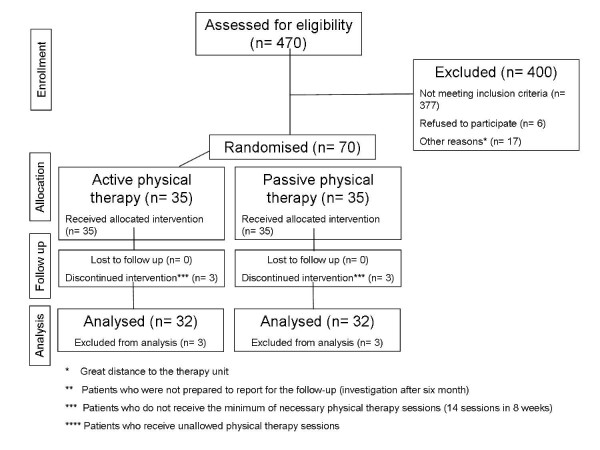
Methods: Seventy patients with acute Quebec Task Force (QTF) grade II whiplash injuries were randomized to two therapy groups and received either active (APT) or passive (PPT) physical therapy. Patients were compared with regard to pain and range of motion with data obtained in an earlier study from a group with grade II whiplash injuries in which the therapy recommendation had been "act as usual" (AAU; n = 20). The above-mentioned parameters were assessed at 24 hours and two months after the injury. Furthermore patients' period of disability was documented after two months.
Results: After two months, patients in both the APT and PPT groups showed significant improvement in the median period of disability (active: 14 days; passive: 14 days) compared to the AAU group (49 days). No group difference was observed with regard to median improvement in range of motion (active: 120 degrees ; passive: 108 degrees ; activity as usual: 70 degrees ). The median pain reduction was significantly greater in the APT group (50.5) than in the PPT (39.2) or AAU group (28.8).
Conclusion: Our data show that active physical therapy results in enhanced pain reduction and shortening of post-injury disability. Therefore, active physical therapy should be considered the treatment of choice in patients with QTF grade II whiplash injuries.
Trial registration: The study complied with applicable German law and with the principles of the Helsinki Declaration and was approved by the institutional ethics commission.
Figures
References
-
- Gay J, Abbott K. Common whiplash injuries of the neck. J Am Med Ass. 1953;152:1698–1704. - PubMed
-
- Nightingale RW, McElhaney JH, Richardson WJ, Best TM, Myers BS. Experimental impact injury to the cervical spine: relating motion of the head and the mechanism of injury. J Bone Joint Surg Am. 1996;78:412–421. - PubMed
LinkOut - more resources
Full Text Sources
