. 2009 Jan 16:3:9.
doi: 10.1186/1752-0509-3-9.

Information theoretical quantification of cooperativity in signalling complexes

Affiliations

Information theoretical quantification of cooperativity in signalling complexes

Tom Lenaerts et al. BMC Syst Biol. .

Abstract

Background: Intra-cellular information exchange, propelled by cascades of interacting signalling proteins, is essential for the proper functioning and survival of cells. Now that the interactome of several organisms is being mapped and several structural mechanisms of cooperativity at the molecular level in proteins have been elucidated, the formalization of this fundamental quantity, i.e. information, in these very diverse biological contexts becomes feasible.

Results: We show here that Shannon's mutual information quantifies information in biological system and more specifically the cooperativity inherent to the assembly of macromolecular complexes. We show how protein complexes can be considered as particular instances of noisy communication channels. Further we show, using a portion of the p27 regulatory pathway, how classical equilibrium thermodynamic quantities such as binding affinities and chemical potentials can be used to quantify information exchange but also to determine engineering properties such as channel noise and channel capacity. As such, this information measure identifies and quantifies those protein concentrations that render the biochemical system most effective in switching between the active and inactive state of the intracellular process.

Conclusion: The proposed framework provides a new and original approach to analyse the effects of cooperativity in the assembly of macromolecular complexes. It shows the conditions, provided by the protein concentrations, for which a particular system acts most effectively, i.e. exchanges the most information. As such this framework opens the possibility of grasping biological qualities such as system sensitivity, robustness or plasticity directly in terms of their effect on information exchange. Although these parameters might also be derived using classical thermodynamic parameters, a recasting of biological signalling in terms of information exchange offers an alternative framework for visualising network cooperativity that might in some cases be more intuitive.


Figures
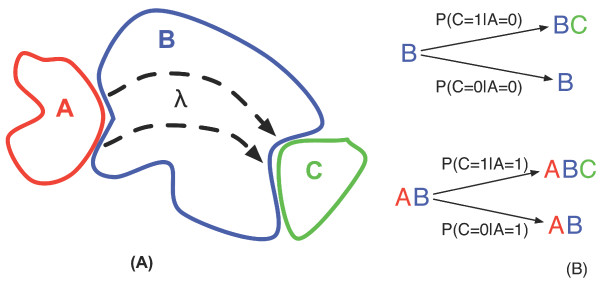
Figure 1
Figure 1
Abstract ternary protein complex. (A) The protein B in this abstract complex acts as a communication pathway between the two other proteins A and C. Binding protein A sends information over the pathway λ to the binding site of protein C, facilitating the binding of protein C. (B) Like a communication channel, the ternary complex can be described by a number of conditional probabilities. The conditional probabilities P(C = 0|A = 0) and P(C = 1|A = 1), describe the accuracy of the communication channel, i.e. the likelihood that a given output signal corresponds to the appropriate input signal. A second set of probabilities, P(C = 1|A = 0) and P(C = 0|A = 1), describes the intrinsic noise of the communication channel, i.e. the likelihood that a given input signal is not correctly conveyed.
Figure 2
Figure 2
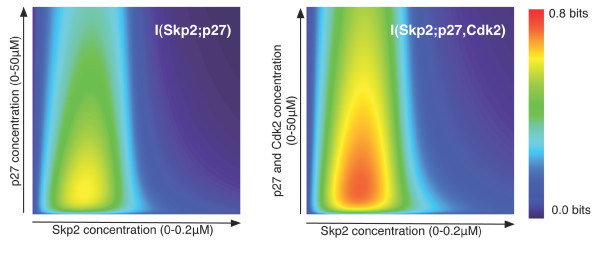
Phase-space of cooperativity for the Cks1 adaptor protein. Both contour diagrams show the mutual information for different concentrations of Cks1, Skp2 and phosphorylated p27 (left panel) and for different concentrations of Cks1, Skp2, Cdk2 and phosphorylated p27 (right panel). In both panels, the concentration of Cks1 is kept fixed (0.1 μM) and the concentration of Skp2 and p27 vary between 0.0–0.2 μM and 0.0–50 μM respectively. In the right panel, Cdk2 varies together with p27, meaning that we assumed [p27] = [Cdk2] for all combinations. As can be observed, the signal between Skp2 and phosphorylated p27 is clearly constrained by the input concentrations. Moreover, when adding Cdk2, as shown in the right plot, the signal is reinforced.
Figure 3
Figure 3
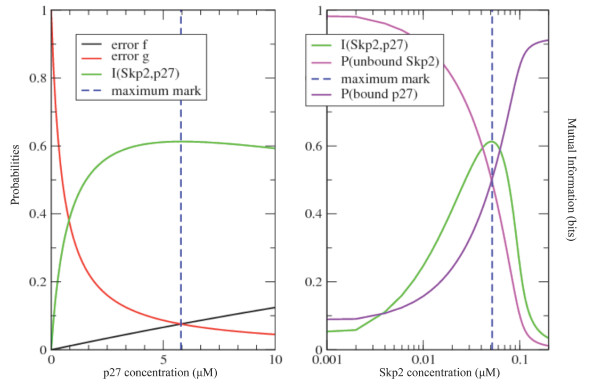
Analysis of information exchange at Cks1 capacity. In both plots, the mutual information (green line) is shown. In the left panel, it is visualized for optimal [Cks1]* and [Skp2]* and varying [p27]. In the right panel, the same information is shown for optimal [Cks1]* and [p27]* and varying [Skp2]. In both plots, the blue striped line marks the concentrations of p27 (left panel) and of Skp2 (right panel) where the channel's capacity is obtained. In the left panel, the error probabilities f and g are added and are shown to be equal when the optimal value of mutual information is achieved. Both error probabilities intersect around f = g = 0.075 for [p27] 5.79 μM. In the right panel, the probabilities that Skp2 is not bound to Cks1 and p27 is bound to Cks1 were added.
Figure 4
Figure 4
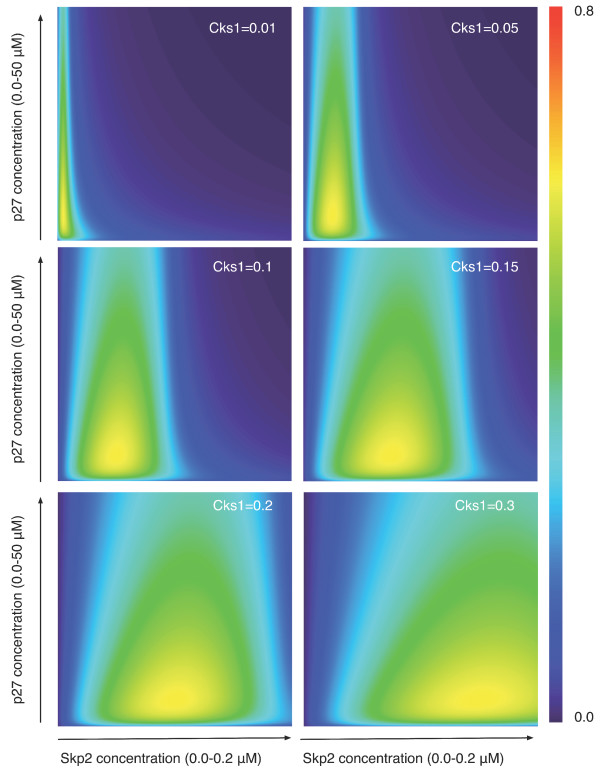
Cooperativity phase-space for other concentrations of Cks1. This figure extends the results shown in Figure 2, left panel. We show here that increasing the concentration of Cks1 (from 0.01 μM to 0.3 μM) results in an increase of cooperativity of the system, specifically for the concentrations of Skp2. Yet this increase has no effect on the maximum amount of information that is exchanged.
Figure 5
Figure 5
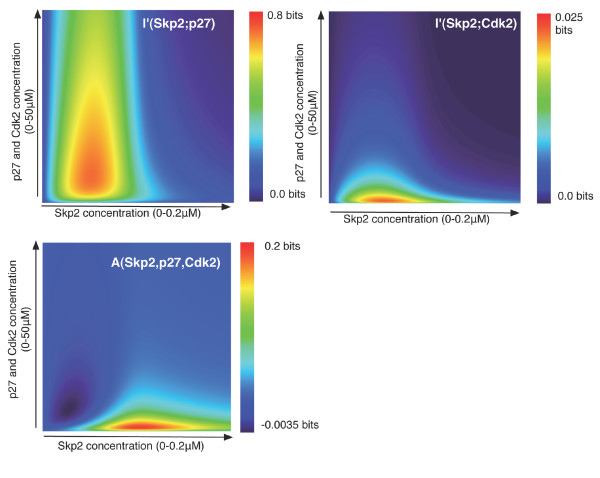
Deconstruction of the information exchange in the quaternary complex Cdk2-p27-Cks1-Skp2. This figure shows the mutual information between Skp2 and p27 (top left panel), Skp2 and Cdk2 (top right panel) and the effect of integrating both signals called mutual information (bottom left panel). The majority of the transmission occurs between the proteins Skp2 and p27. There is little interaction between Skp2 and Cdk2. Yet the stochiometric relation between p27 and Cdk2 modulates the signal in such a way that more information can be exchanged.
Figure 6
Figure 6
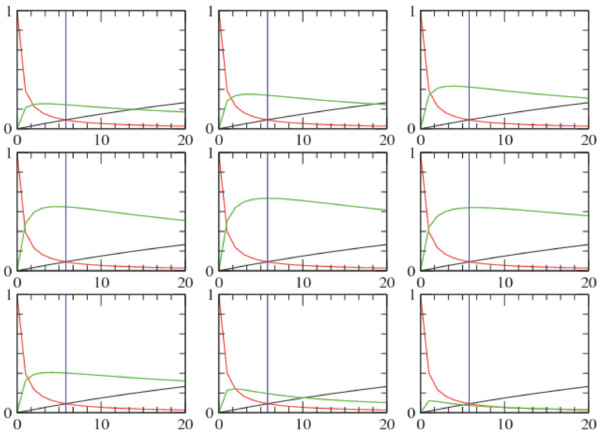
Skp2 regulates the mutual information and noise in the communication. We analysed the relationship between the mutual information for fixed concentrations Cks1. The concentration of Skp2 varies between plots from 0 μM and 0.2 μM. The concentration of p27 varies in each plot between 0 μM and 20 μM. Following the plots from top left to bottom right, the amount of Skp2 increases. As can be observed, the amount of mutual information (green line) also increases until some maximum is reached (centre plot). At this same point the error probabilities f and g intersect.

References

    1. Spirin V, Mirny LA. Protein complexes and functional modules in molecular networks. Proc Natl Acad Sci USA. 2003;100:12123–12128. - PMC - PubMed
    1. Rousseau F, Schymkowitz J. A systems biology perspective on protein structural dynamics and signal transduction. Curr Opin Struct Biol. 2005;15:23–30. - PubMed
    1. Senear DF, Ross JB, Laue TM. Analysis of protein and DNA-mediated contributions to cooperative assembly of protein-DNA complexes. Methods. 1998;16:3–20. - PubMed
    1. Luque I, Leavitt SA, Freire E. The linkage between protein folding and functional cooperativity: two sides of the same coin? Annu Rev Biophys Biomol Struct. 2002;31:235–256. - PubMed
    1. Goh CS, Milburn D, Gerstein M. Conformational changes associated with protein-protein interactions. Curr Opin Struct Biol. 2004;14:104–109. - PubMed

MeSH terms

Substances

LinkOut - more resources