. 2009 Apr;37(5):1638-49.
doi: 10.1093/nar/gkn1070. Epub 2009 Jan 19.

A self-cleaving DNA enzyme modified with amines, guanidines and imidazoles operates independently of divalent metal cations (M2+)

Affiliations

A self-cleaving DNA enzyme modified with amines, guanidines and imidazoles operates independently of divalent metal cations (M2+)

Marcel Hollenstein et al. Nucleic Acids Res. 2009 Apr.

Abstract

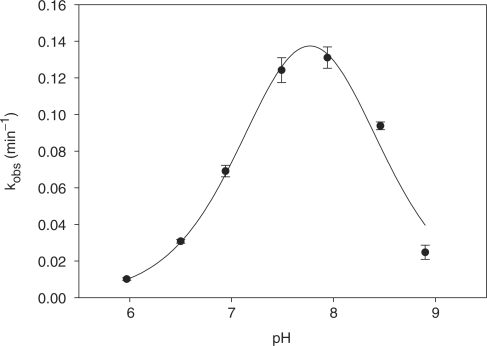
The selection of modified DNAzymes represents an important endeavor in expanding the chemical and catalytic properties of catalytic nucleic acids. Few examples of such exist and to date, there is no example where three different modified bases have been simultaneously incorporated for catalytic activity. Herein, dCTP, dATP and dUTP bearing, respectively, a cationic amine, an imidazole and a cationic guanidine, were enzymatically polymerized on a DNA template for the selection of a highly functionalized DNAzyme, called DNAzyme 9-86, that catalyzed (M(2+))-independent self-cleavage under physiological conditions at a single ribo(cytosine)phosphodiester linkage with a rate constant of (0.134 +/- 0.026) min(-1). A pH rate profile analysis revealed pK(a)'s of 7.4 and 8.1, consistent with both general acid and base catalysis. The presence of guanidinium cations permits cleavage at significantly higher temperatures than previously observed for DNAzymes with only amines and imidazoles. Qualitatively, DNAzyme 9-86 presents an unprecedented ensemble of synthetic functionalities while quantitatively it expresses one of the highest reported values for any self-cleaving nucleic acid when investigated under M(2+)-free conditions at 37 degrees C.


Figures
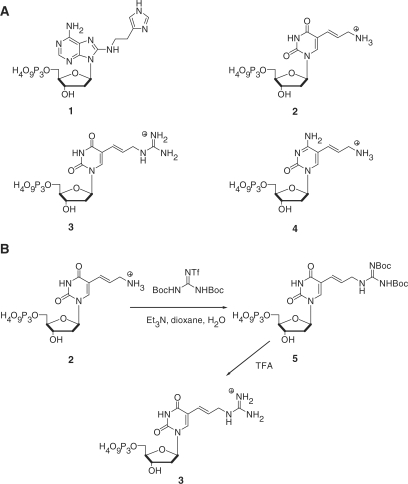
Figure 1.
Figure 1.
(A) Chemical structure of the modified triphosphates dAimTP 1, dUaaTP 2, dUgaTP 3 and dCaaTP 4. (B) Synthesis of the modified C5-guanidinium deoxyuridine analog.
Figure 2.
Figure 2.
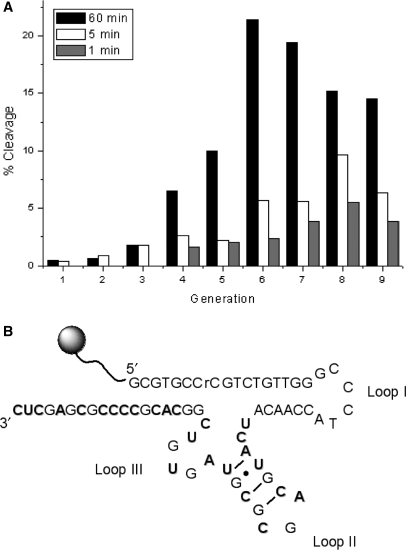
(A) Progress of the selection: the fraction is shown for each generation (round of selection). For the first four rounds a selection time of 60 min was used. In round 5, the selection time was reduced to 5 min. At round 7, the selection time was again decreased to 1 min and maintained until round 9. Starting at round 4, self-cleavage activity was measured at 1, 5 and 60 min. (B) Sequence and hypothetical 2D structure of the selected DNAzyme 9-86. (bold-face A, C and U indicate the position of the modified nucleosides 1, 2 and 3, respectively).
Figure 3.
Figure 3.
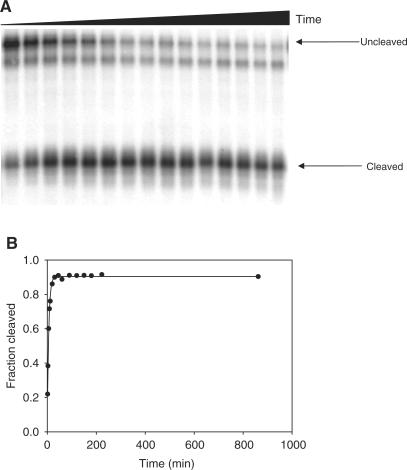
Kinetic analysis of self-cleavage. (A) Representative autoradiographic image of denaturing PAGE 7% showing the fraction cleaved over a period of 900 min. (B) Graphical analysis of this particular run: kobs = (0.167 ± 0.007) min−1 (R2 > 0.99); error is standard deviation from the exponential fit. Reaction conditions: 1 mM EDTA, 200 mM NaCl, 50 mM cacodylate pH 7.4, 24°C. A slightly truncated species is observed and remains relatively constant throughout the time course suggesting the enzymatic production of minor, catalytically inactive species. Rate constants were calculated using equation (1) based on the relative autoradiographic densities in both the uncleaved and cleaved bands. Time points were 1, 3, 6, 9, 12, 20, 30, 45, 60, 90, 120, 150, 180, 240 and 900 min.
Figure 4.
Figure 4.
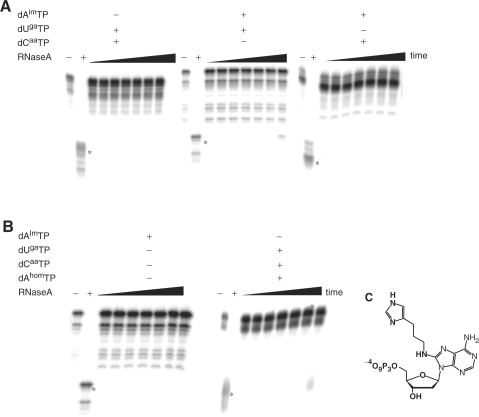
Gel images (PAGE 7%) demonstrating the importance of the three modifications. (A) Modified DNAs with dAimTP, dCaaTP and dUgaTP single knockouts. (B) Modified DNAs synthesized with dAimTP as sole modification and with dAhomTP instead of dAimTP. As a control, the elongated strands were also cleaved with RNase A to identify anticipated cleavage products that are denoted with asterisks. (C) Structure of dAhomTP, which when added as a triphosphate in lieu the histaminyl dATP is incorporated into strands that manifest <10% activity after 1260 min. Time points were 3, 5, 10, 20, 30, 60 and 1260 min.
Figure 5.
Figure 5.
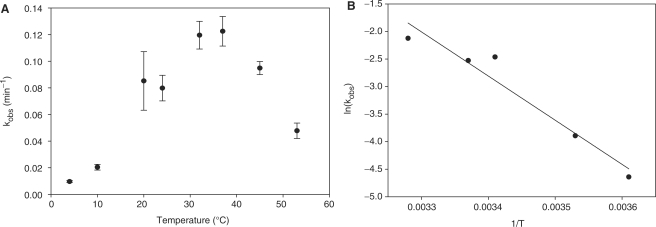
(A) Temperature dependence of the intramolecular RNA cleavage, measured in 200 mM NaCl, 50 mM cacodylate pH 7.4, and 1 mM EDTA over a range of 4–53°C. Cacodylate was chosen for a relatively constant pH at variable temperature (ΔpH/ΔT = −0.0015 pH U/°C), and error bars indicate standard error on triplicate runs. (B) Arrhenius plot of the temperature dependence of DNAzyme 9-86 in the interval 4–32°C. Fitting the data to a linear regression gave Ea = 15.9 ± 2.3 kcal mol−1 (R2 = 0.94).
Figure 6.
Figure 6.
Cleavage rate dependence on pH, measured in (50 mM buffer, 200 mM NaCl, 1 mM EDTA) at room temperature, error bars indicate standard error on triplicate runs. Values for pKa were calculated using equation (4) (See Materials and methods section) to be 7.4 ± 0.1, 8.1 ± 0.1 and kmax = 0.29 ± 0.06 min−1 (R2 = 0.96).

References

    1. Ellington AD, Szostak JW. In vitro selection of RNA molecules that bind specific ligands. Nature. 1990;346:818–822. - PubMed
    1. Tuerk C, Gold L. Systematic evolution of ligands by exponential enrichment - RNA ligands to bacteriophage -T4 DNA-polymerase. Science. 1990;249:505–510. - PubMed
    1. Breaker RR, Joyce GF. A DNA enzyme that cleaves RNA. Chem. Biol. 1994;1:223–229. - PubMed
    1. Cuenoud B, Szostak JW. A DNA metalloenzyme with DNA-ligase activity. Nature. 1995;375:611–614. - PubMed
    1. Li YF, Liu Y, Breaker RR. Capping DNA with DNA. Biochemistry. 2000;39:3106–3114. - PubMed

Publication types

MeSH terms