. 2009 Jan 20:10:6.
doi: 10.1186/1471-2202-10-6.

Restorative effect of endurance exercise on behavioral deficits in the chronic mouse model of Parkinson's disease with severe neurodegeneration

Affiliations

Restorative effect of endurance exercise on behavioral deficits in the chronic mouse model of Parkinson's disease with severe neurodegeneration

Konstantinos Pothakos et al. BMC Neurosci. .

Abstract

Background: Animal models of Parkinson's disease have been widely used for investigating the mechanisms of neurodegenerative process and for discovering alternative strategies for treating the disease. Following 10 injections with 1-methyl-4-phenyl-1,2,3,6-tetrahydropyridine (MPTP, 25 mg/kg) and probenecid (250 mg/kg) over 5 weeks in mice, we have established and characterized a chronic mouse model of Parkinson's disease (MPD), which displays severe long-term neurological and pathological defects resembling that of the human Parkinson's disease in the advanced stage. The behavioral manifestations in this chronic mouse model of Parkinson's syndrome remain uninvestigated. The health benefit of exercise in aging and in neurodegenerative disorders including the Parkinson's disease has been implicated; however, clinical and laboratory studies in this area are limited. In this research with the chronic MPD, we first conducted a series of behavioral tests and then investigated the impact of endurance exercise on the identified Parkinsonian behavioral deficits.

Results: We report here that the severe chronic MPD mice showed significant deficits in their gait pattern consistency and in learning the cued version of the Morris water maze. Their performances on the challenging beam and walking grid were considerably attenuated suggesting the lack of balance and motor coordination. Furthermore, their spontaneous and amphetamine-stimulated locomotor activities in the open field were significantly suppressed. The behavioral deficits in the chronic MPD lasted for at least 8 weeks after MPTP/probenecid treatment. When the chronic MPD mice were exercise-trained on a motorized treadmill 1 week before, 5 weeks during, and 8-12 weeks after MPTP/probenecid treatment, the behavioral deficits in gait pattern, spontaneous ambulatory movement, and balance performance were reversed; whereas neuronal loss and impairment in cognitive skill, motor coordination, and amphetamine-stimulated locomotor activity were not altered when compared to the sedentary chronic MPD animals.

Conclusion: This study indicates that in spite of the drastic loss of dopaminergic neurons and depletion of dopamine in the severe chronic MPD, endurance exercise training effectively reverses the Parkinson's like behavioral deficits related to regular movement, balance and gait performance.


Figures
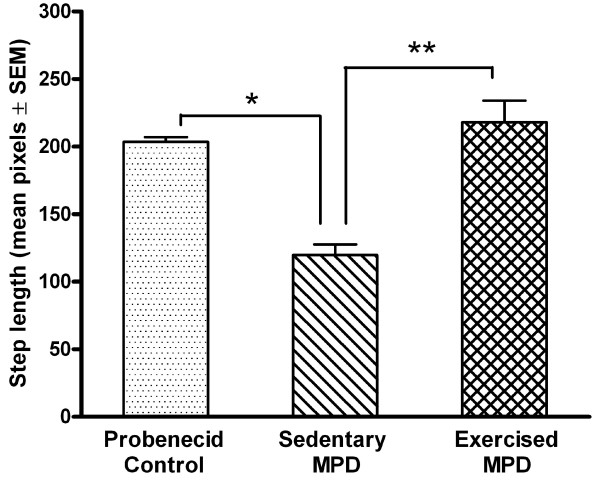
Figure 1
Figure 1
Effect of exercise on the step length in the chronic MPD. The mean step length in the sedentary chronic MPD mice 12 weeks after MPTP/probenecid treatment was significantly shorter than the probenecid-treated controls (*P = 0.0001). Continuous exercise for 12 weeks after MPTP/probenecid treatment in the chronic MPD completely reversed the step length deficit as detected in the sedentary chronic MPD group (**P = 0.0001). The mean step length in the control group and exercised chronic MPD group were not statistically different.
Figure 2
Figure 2
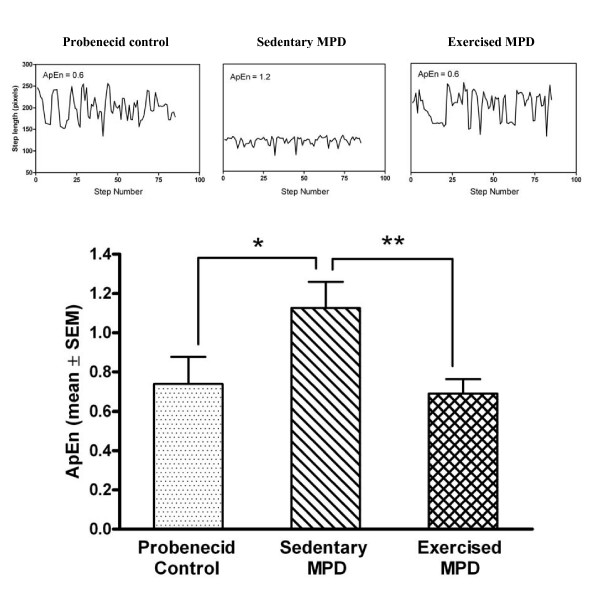
Effect of exercise on the gait pattern in the chronic MPD. The representative pattern of step length time series from a probenecid control mouse, a sedentary chronic MPD mouse, and an exercised chronic MPD mouse 12 weeks after MPTP/probenecid treatment were shown at top. The calculated gait pattern certainties in terms of approximate entropy (ApEn) for the three groups of animals were respectively shown in the bar graph below. A larger ApEn value denotes a more variable movement pattern, which was significantly demonstrated by the sedentary chronic MPD when compared with the control group of animals (*P = 0.0001). The ApEn value for the exercised chronic MPD was significantly lower suggesting a more consistent gait pattern than that of the sedentary chronic MPD (**P = 0.007). The gait pattern consistency (ApEn value) in the control group and exercised chronic MPD group were not statistically different.
Figure 3
Figure 3
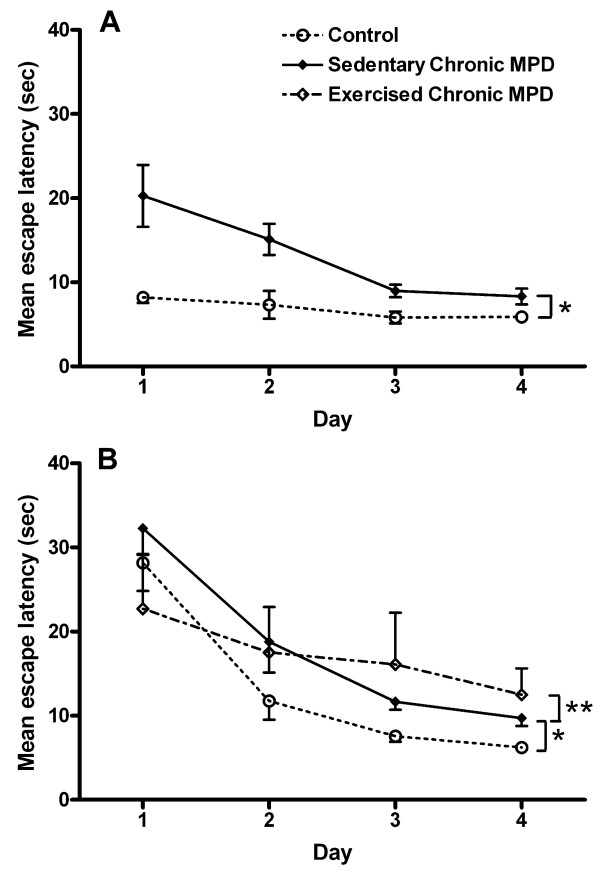
Exercise effect on learning of the cued version of the Morris water maze (MWM) in the chronic MPD. (A) One day and (B) 10 weeks after MPTP/probenecid treatment, the chronic MPD group of mice showed significant impairment in learning the cued version of the MWM when compared with the controls (A, *P = 0.01 and B, *P = 0.012, respectively). (B) Continuous exercise for 10 weeks after MPTP/probenecid treatment did not alter the learning deficit for the cued version of the MWM in the chronic MPD (**P = 0.557, when compared to the sedentary chronic MPD).
Figure 4
Figure 4
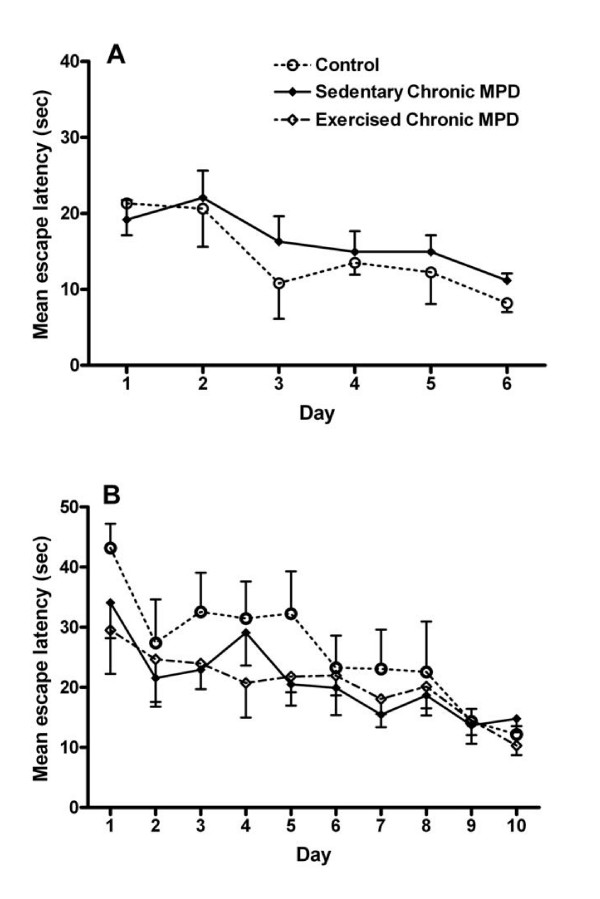
Exercise effect on learning of the spatial reference version of the MWM in the chronic MPD. (A) One week and (B) 8 weeks after MPTP/probenecid treatment, the chronic MPD group of mice showed no impairment in learning the spatial reference version of the MWM when compared to the controls. (B) Continuous exercise for 8 weeks after MPTP/probenecid treatment did not alter the learning for the spatial reference version of the MWM in the chronic MPD.
Figure 5
Figure 5
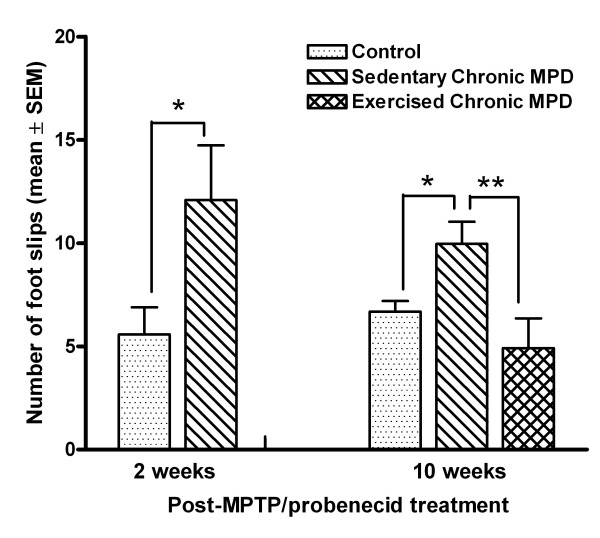
Exercise effect on balance performance on a challenging beam in the chronic MPD. Two and 10 weeks after MPTP/probenecid treatment, the chronic MPD group of mice had significantly more limb slips than the controls while traversing the challenging beam (*P = 0.041 and *P = 0.013, respectively). The chronic MPD, when continuously exercised for 10 weeks after MPTP/probenecid treatment, had significantly less foot slips on the challenging beam than the sedentary chronic MPD (**P = 0.01).
Figure 6
Figure 6
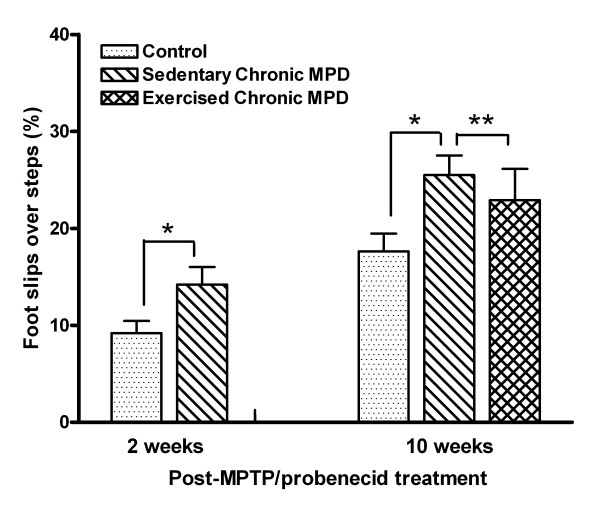
Exercise effect on motor coordination on a walking grid in the chronic MPD. Two and 10 weeks after MPTP/probenecid treatment, the chronic MPD group of mice had significantly higher percentage of limb slips over steps than the controls while walking on a perforated grid (*P = 0.037 and *P = 0.01, respectively). Continuous exercise for 10 weeks after MPTP/probenecid treatment did not significantly improve the grid walk performance in the chronic MPD (**P = 0.485).
Figure 7
Figure 7
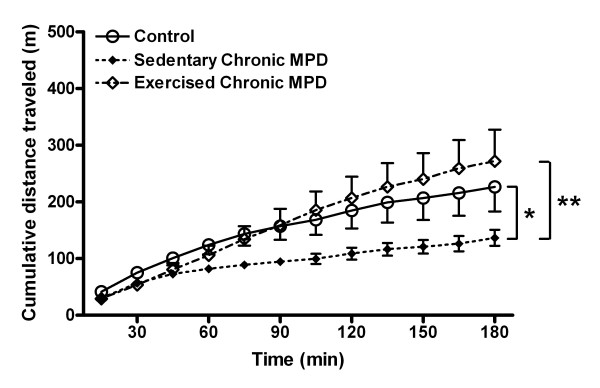
Exercise effect on the spontaneous locomotor activity in the chronic MPD. The horizontal movement expressed as cumulative distance traveled by each animal was recorded over 180 min. The spontaneous locomotor activity in the chronic MPD mice 11 weeks after MPTP/probenecid treatment was significantly lower than that of the chronic probenecid-treated control mice (*P = 0.03). Continuous exercise for 11 weeks after MPTP/probenecid treatment in the chronic MPD completely reversed the spontaneous movement deficit as detected in the sedentary chronic MPD group (**P = 0.02).
Figure 8
Figure 8
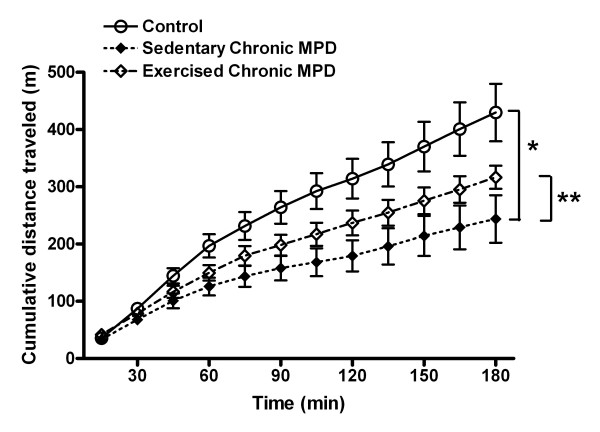
Exercise effect on the amphetamine-induced locomotor activity in the chronic MPD. The amphetamine (3 mg/kg, i.p.)-induced locomotor activity in the chronic MPD mice 11 weeks after MPTP/probenecid treatment was significantly lower than that of the chronic probenecid-treated control mice (*P = 0.009). Following 11 weeks of exercise training, no statistically significant recovery of the amphetamine-stimulated movement was observed when comparing to the sedentary chronic MPD (**P = 0.186).

References

    1. Miyai I, Fujimoto Y, Ueda Y, Yamamoto H, Nozaki S, Saito T, Kang J. Treadmill training with body weight support: its effect on Parkinson's disease. Arch Phys Med Rehabil. 2000;81:849–852. doi: 10.1053/apmr.2000.4439. - DOI - PubMed
    1. Bergen JL, Toole T, Elliott RG, 3rd, Wallace B, Robinson K, Maitland CG. Aerobic exercise intervention improves aerobic capacity and movement initiation in Parkinson's disease patients. NeuroRehabilitation. 2002;17:161–168. - PubMed
    1. Hirsch MA, Toole T, Maitland CG, Rider RA. The effects of balance training and high-intensity resistance training on persons with idiopathic Parkinson's disease. Arch Phys Med Rehabil. 2003;84:1109–1117. doi: 10.1016/S0003-9993(03)00046-7. - DOI - PubMed
    1. Langston JW, Ballard P, Tetrud JW, Irwin I. Chronic Parkinsonism in humans due to a product of meperidine-analog synthesis. Science. 1983;219:979–980. doi: 10.1126/science.6823561. - DOI - PubMed
    1. Tetrud JW, Langston JW, Redmond DE, Roth RH, Sladek JR, Angel RW. MPTP-induced tremor in human and non-human primates. Neurology. 1986;36:308.

Publication types

MeSH terms

LinkOut - more resources