. 2009 Jan;21(1):54-71.
doi: 10.1105/tpc.108.061309. Epub 2009 Jan 20.

Repression of seed maturation genes by a trihelix transcriptional repressor in Arabidopsis seedlings

Affiliations

Repression of seed maturation genes by a trihelix transcriptional repressor in Arabidopsis seedlings

Ming-Jun Gao et al. Plant Cell. 2009 Jan.

Abstract

The seed maturation program is repressed during germination and seedling development so that embryonic genes are not expressed in vegetative organs. Here, we describe a regulator that represses the expression of embryonic seed maturation genes in vegetative tissues. ASIL1 (for Arabidopsis 6b-interacting protein 1-like 1) was isolated by its interaction with the Arabidopsis thaliana 2S3 promoter. ASIL1 possesses domains conserved in the plant-specific trihelix family of DNA binding proteins and belongs to a subfamily of 6b-interacting protein 1-like factors. The seedlings of asil1 mutants exhibited a global shift in gene expression to a profile resembling late embryogenesis. LEAFY COTYLEDON1 and 2 were markedly derepressed during early germination, as was a large subset of seed maturation genes, such as those encoding seed storage proteins and oleosins, in seedlings of asil1 mutants. Consistent with this, asil1 seedlings accumulated 2S albumin and oil with a fatty acid composition similar to that of seed-derived lipid. Moreover, ASIL1 specifically recognized a GT element that overlaps the G-box and is in close proximity to the RY repeats of the 2S promoters. We suggest that ASIL1 targets GT-box-containing embryonic genes by competing with the binding of transcriptional activators to this promoter region.


Figures
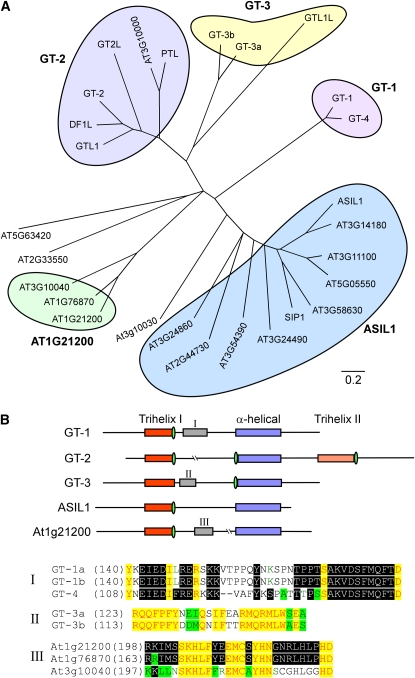
Figure 1.
Figure 1.
Comparative Analysis of Trihelix Proteins in Arabidopsis. (A) A phylogenetic tree of ASIL proteins, GT factors, and other trihelix proteins in Arabidopsis. The tree was generated using the neighbor-joining method after sequence alignment with ClustalW. Five major subfamilies are grouped: ASIL1, GT-1, GT-2, GT-3, and At1g21200. (B) Structure and subfamily-specific motifs of trihelix protein family. The conserved trihelix and α-helical domains are in different colors as indicated. The putative nuclear localization signals are represented in green ovals. Subfamily-specific motifs, which are shown as roman numerals I, II, and III, are aligned and indicated on the bottom of the figure.
Figure 2.
Figure 2.
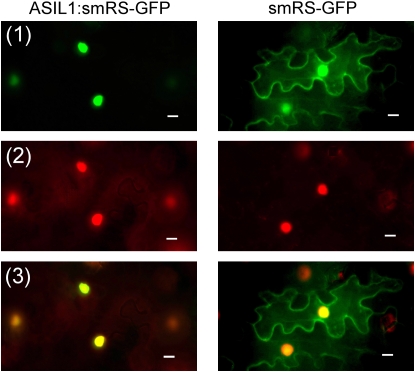
Nuclear localization of ASIL1 Fused to smRS-GFP in Tobacco Epidermal Cells. Plasmids that carried either construct p35S∷ASIL1:smRS-GFP or negative control p35S∷smRS-GFP were introduced into tobacco leaf cells by infiltration. All leaf tissues were stained with 4',6-diamidino-2-phenylindole (DAPI) and viewed using fluorescence microscopy with blue excitation to detect GFP fluorescence and UV excitation to detect DAPI. GFP is shown in green (1) and DAPI is shown in red (2). Merged images are shown at the bottom (3). Bars = 10 μm.
Figure 3.
Figure 3.
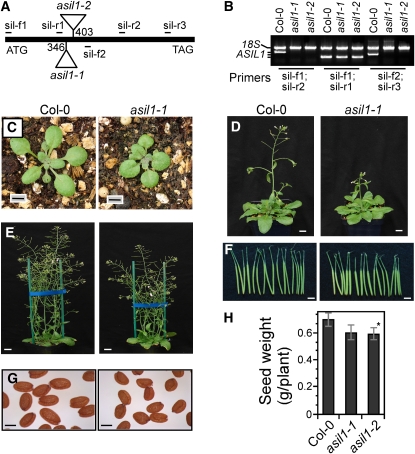
Phenotypes of Arabidopsis asil1 Mutant Plants. (A) Schematic representation of the T-DNA insertion alleles of asil1-1 and asil1-2 in Arabidopsis. The ASIL1 gene has no intron. Numbers indicate positions of T-DNA insertions with respect to A of the translational start codon. The positions of PCR primers for genotyping (sil-f1 and sil-r3) and RT-PCR analysis are also indicated. (B) RT-PCR analysis of total RNA from leaves of wild type (Col-0) and homozygous asil1-1 and asil1-2 plants with several primer pairs. 18S rRNA was used as an internal control. (C) Phenotypes of 18-d-old wild-type and asil1-1 plantlets grown in soil. Bars = 0.5 cm. (D) Wild-type and homozygous asil1-1 plants at 31 d of growth in soil under long days. Bars = 1 cm. (E) Wild-type and asil1-1 adult plants at 41 d of growth in soil. Bars = 1.5 cm. (F) Siliques of wild-type and asil1-1 mutant plants corresponding to, from right to left, 6 to 12 DPA. Bars = 0.5 cm. (G) Mature seeds from wild-type and asil1-1 plants. Bars = 250 μm. (H) Seed yield per plant from wild-type and homozygous asil1-1 and asil1-2 plants (n = 16). The error bars indicate ± sd of the means. Similar results were obtained from three independent experiments. Asterisk indicates a statistically significant difference between the wild type and asil1-2 mutant based on a Student's t test (P < 0.05).
Figure 4.
Figure 4.
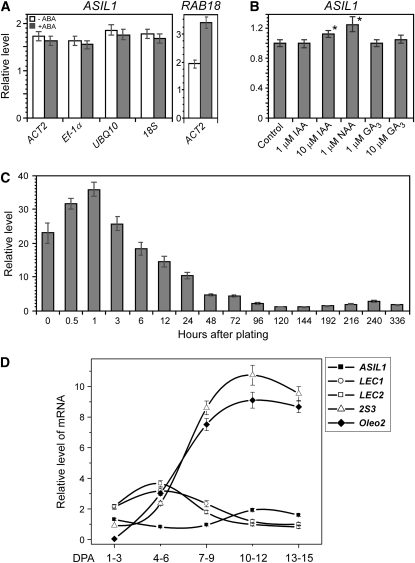
ASIL1 Expression in Response to Hormones and Temporal Regulation during Germination and Seed Development. Real time qRT-PCR analysis was used to analyze ASIL1 transcript levels in seeds, seedlings, and siliques. The expression values of ASIL1 were normalized using the expression level of ACT2 unless otherwise indicated; housekeeping genes were considered as internal references. Results of expression represent the average of data, and sd values were calculated from the results of three independent experiments. (A) ASIL1 expression in leaves in response to ABA. Total RNA was prepared from 2-week-old seedlings that were grown on plates of medium and incubated with 0 or 50 μM ABA for up to 24 h before harvest. ACT2, Ef-1α, UBQ10, and 18S were used as internal reference genes. Expression of RAB18, a known ABA responsive gene, was used to validate the ABA treatment. (B) Regulation of ASIL1 expression in leaves by auxin and GA. Total RNA was isolated from 2-week-old seedlings that were grown on plates of medium then treated in liquid medium with IAA, NAA, and GA3 for 1 h at concentrations as indicated. Asterisk indicates a statistically significant difference between auxin treatment and control based on a Student's t test (P < 0.05). ASIL1 RNA levels in the untreated control were designated as onefold. (C) Temporal expression of ASIL1 in seedlings. Total RNA was isolated from desiccated seeds or seeds that had been imbibed for up to 336 h (14 d) on plates of half-strength MS medium with 1% sucrose. Germination was completed by ∼70 h as scored by emergence of radicle from the seed coat. The lowest ASIL1 transcript level was at day 144 after imbibition and designated as onefold. (D) Temporal expression of ASIL1 in developing siliques compared with embryonic genes LEC1, LEC2, 2S3, and Oleo2. Total RNA was isolated from siliques corresponding to five developmental stages as indicated.
Figure 5.
Figure 5.
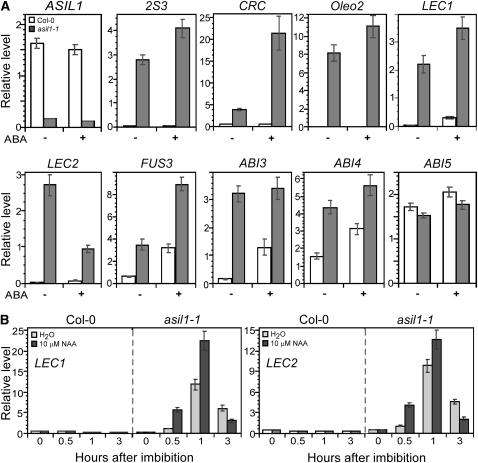
Effect of ASIL1 and Its Interaction with ABA and Auxin on Expression of Seed Maturation Genes in Arabidopsis Seedlings. Expression of seed maturation genes was analyzed using RNA isolated from either 2-week-old wild-type Col-0 and asil1-1 mutant seedlings that were grown on medium and incubated with 0 (−) or 50 μM (+) ABA for 2 d (A) or wild-type and asil1-1 seeds that had been imbibed for up to 3 h in the presence or absence of 10 μM NAA (B). The mean and sd from qRT-PCR analysis were determined from three biological replicates. (A) Expression of seed maturation genes in wild-type and asil1-1 seedlings. Total RNA was isolated from 2-week-old plants after exposure to ABA. The levels of various gene transcripts were determined by qRT-PCR using ACT2 mRNA as an internal reference. (B) Expression of LEC1 and LEC2 in germinating wild-type and asil1-1 seeds. Total RNA was isolated from desiccated seeds or seeds that had been imbibed with the presence of NAA. Real-time RT-PCR was used to examine the levels of LEC1 and LEC2 transcripts with Ef-1α as a reference gene.
Figure 6.
Figure 6.
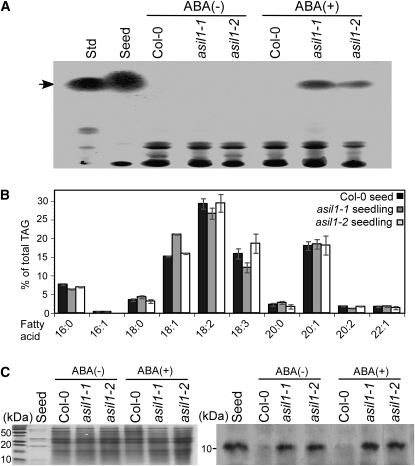
Accumulation of Seed Storage Reserves in asil1 Seedlings. (A) TAG in wild-type (Col-0) and asil1-1 and asil1-2 mutant seedlings. Total lipids were extracted from 3-week-old seedlings grown in soil and treated with 0 (−) or 50 μM (+) ABA for 24 h before harvest. An equivalent amount of extracts from wild-type and asil1 seedlings were separated by TLC and stained with sulphuric acid. Lipid extracts from wild-type seeds were used as a control, and glyceryl trilinoleate (10 μg) was used as a standard (Std). The position of the seed-specific TAG is indicated by an arrow. (B) Fatty acid composition of TAG fraction from wild-type seeds and asil1 seedlings treated with ABA. TAG fraction was separated by TLC, and the fatty acid composition was analyzed on a gas chromatograph and expressed as a percentage of the total TAG fraction. Results represent the average and sd from three biological replicates. (C) Accumulation of 2S albumin in asil1 seedlings. Protein extracts (20 μg) from 3-week-old wild-type and asil1-1 and asil1-2 mutant seedlings grown in soil and treated with 0 (−) or 50 μM (+) ABA for 24 h were resolved by SDS-PAGE and analyzed by either Coomassie blue staining (left) or immunoblotting with polyclonal antibody raised against 2S albumin (right). Protein extracts (0.5 μg) from wild-type seeds were used as a control. A portion of the membrane blot is shown (right).
Figure 7.
Figure 7.
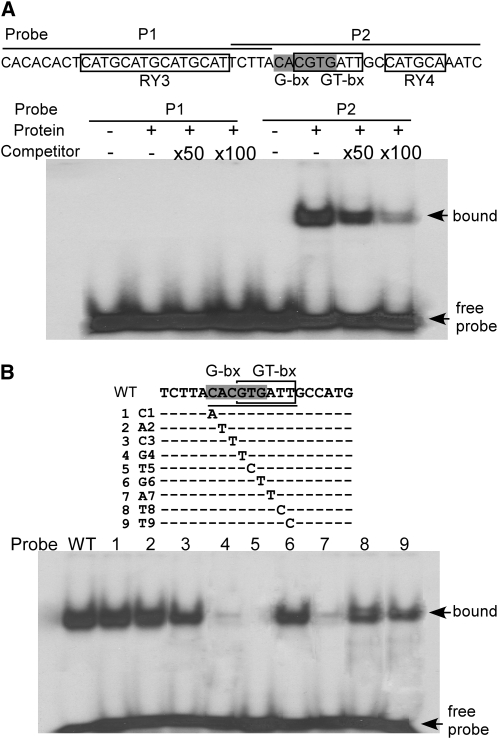
ASIL1 Binding Specificity to the GT-Box of the 2S3 Promoter. ASIL1 protein was produced using a coupled in vitro transcription/translation reaction and incubated with [α-32P]dATP-labeled probes (50,000 cpm/reaction) in an EMSA. (A) Interaction of ASIL1 with sequence motifs in the 49-bp promoter region. The nucleotide sequences of probes (P1 and P2) used in the EMSA analysis are indicated on top of the figure (lines) with cis-elements indicated (boxed regions or shaded for G-box). Binding of ASIL1 to probes P1 and P2 was assayed with no (−) or 50- or 100-fold excess of unlabeled competitor DNA. (B) DNA binding preference of ASIL1 protein to the GT-box. Binding of ASIL1 to either the G-box or GT-box was evaluated by systematically mutating the binding motifs as indicated (top panel) and assaying binding affinity by EMSA (bottom panel). The overlapping G-/GT-box motif is underlined with the G-box (shaded) and GT-box (boxed) indicated. Each of the nucleotides in the underlined motif was systematically substituted with A (1C1), T (2A2-4G4, 6G6, and 7A7) or C (5T5, 8T8, and 9T9).
Figure 8.
Figure 8.
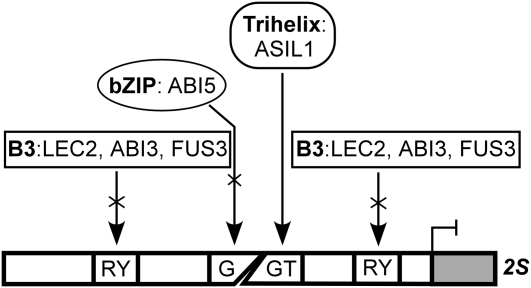
A Model for Negative Regulation of 2S Genes Mediated by the GT-Box. ASIL1 specifically recognizes the GT-box, the bZIP proteins preferentially bind to the G-box, and the B3 regulators interact with the RY repeats. The GT-box overlaps the ACGT/G-box and is in close proximity to the RY repeats. ASIL1 represses 2S transcription by interfering with the binding of ABA-inducible bZIP and B3 proteins to the G-box and RY repeats, respectively.

References

    1. Acevedo-Hernández, G.J., León, P., and Herrera-Estrella, L.R. (2005). Sugar and ABA responsiveness of a minimal RBCS light-responsive unit is mediated by direct binding of ABI4. Plant J. 43 506–519. - PubMed
    1. Altschul, S.F., Madden, T.L., Schaffer, A.A., Zhang, J., Zhang, Z., Miller, W., and Lipman, D.J. (1997). Gapped BLAST and PSI-BLAST: A new generation of protein database search programs. Nucleic Acids Res. 25 3389–3402. - PMC - PubMed
    1. Ayadi, M., Delaporte, V., Li, Y.F., and Zhou, D.X. (2004). Analysis of GT-3a identifies a distinct subgroup of trihelix DNA-binding transcription factors in Arabidopsis. FEBS Lett. 562 147–154. - PubMed
    1. Baud, S., Mendoza, M.S., To, A., Harscoët, E., Lepiniec, L., and Dubreucq, B. (2007). WRINKLED1 specifies the regulatory action of LEAFY COTYLEDON2 towards fatty acid metabolism during seed maturation in Arabidopsis. Plant J. 50 825–838. - PubMed
    1. Bensmihen, S., Rippa, S., Lambert, G., Jublot, D., Pautot, V., Granier, F., Giraudat, J., and Parcy, F. (2002). The homologous ABI5 and EEL transcription factors function antagonistically to fine-tune gene expression during late embryogenesis. Plant Cell 14 1391–1403. - PMC - PubMed

MeSH terms

Associated data