


SSRIs act as selective brain steroidogenic stimulants (SBSSs) at low doses that are inactive on 5-HT reuptake
- PMID: 19157982
- PMCID: PMC2670606
- DOI: 10.1016/j.coph.2008.12.006
SSRIs act as selective brain steroidogenic stimulants (SBSSs) at low doses that are inactive on 5-HT reuptake
Abstract
Brain principal glutamatergic neurons synthesize 3alpha-hydroxy-5alpha-pregnan-20-one (Allo), a neurosteroid that potently, positively, and allosterically modulates GABA action at GABA(A) receptors. Cerebrospinal fluid (CSF) Allo levels are decreased in patients with posttraumatic stress disorder (PTSD) and major depression. This decrease is corrected by fluoxetine in doses that improve depressive symptoms. Emotional-like behavioral dysfunctions (aggression, fear, and anxiety) associated with a decrease of cortico-limbic Allo content can be induced in mice by social isolation. In socially isolated mice, fluoxetine and analogs stereospecifically normalize the decrease of Allo biosynthesis and improve behavioral dysfunctions by a mechanism independent from 5-HT reuptake inhibition. Thus, fluoxetine and related congeners facilitate GABA(A) receptor neurotransmission and effectively ameliorate emotional and anxiety disorders and depression by acting as selective brain steroidogenic stimulants (SBSSs).
Figures
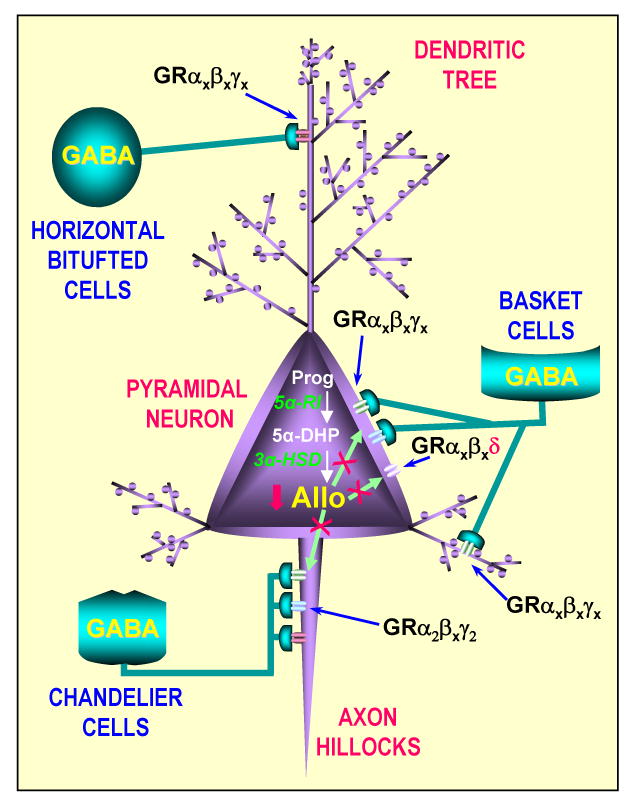
 ) to cell membranes and facilitates the action of GABA at synaptic and extrasynaptic GABAA receptors.
  , denotes Allo biosynthesis downregulation in pyramidal neurons of socially isolated mice.
  , denotes a decrease of Allo levels reaching synaptic or extrasynaptic GABAA receptors located on pyramidal neurons in socially isolated mice. GRαxβx
 , extrasynaptic GABAA receptors that express δ subunits.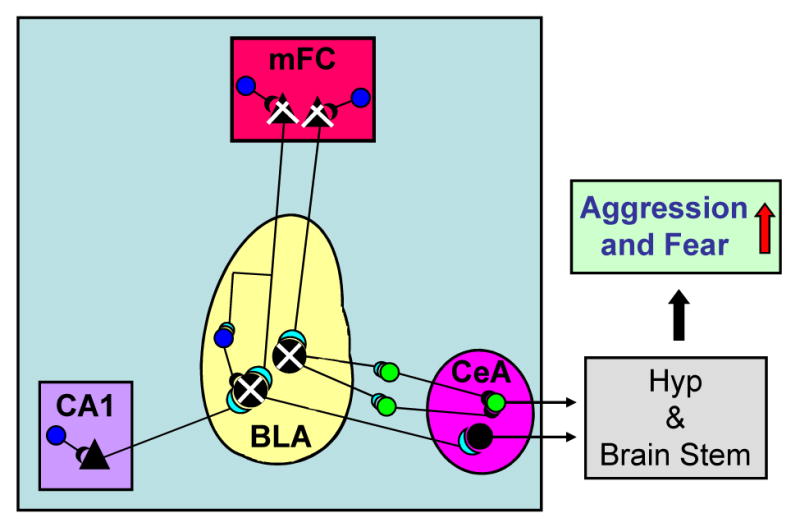
 ) downregulates the inhibitory potency of GABAergic interneurons (indicated by
  ) impinging on these pyramidal neurons. This Allo content decrease results in an increased excitatory output from BLA to the intercalated (ITC) neurons or to neurons of the CeA nucleus, which project to the hypothalamus (Hyp) and brain stem, enhancing fear and aggression (indicated by
  ).
).  Pyramidal-like glutamatergic neurons expressing Allo
  Pyramidal glutamatergic neurons expressing Allo Inhibitory GABAergic interneurons
  Intercalated (ITC) GABAergic neuron Decreased Allo biosynthesis in mFC pyramidal and BLA pyramidal-like glutamatergic neurons Modified from Sah and Westbrook [45].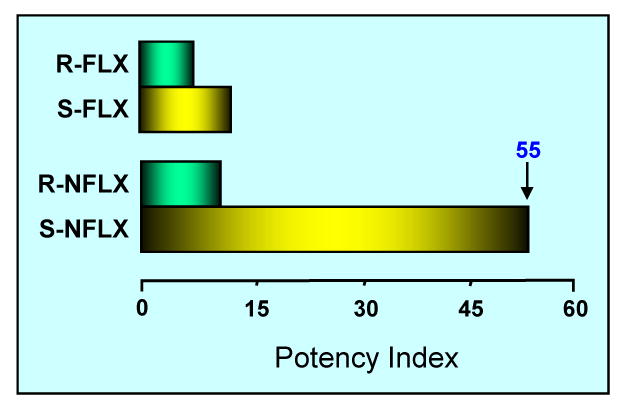
References
-
- Diagnostic Statistical Manual of Mental Disorders. American Psychiatric Press; Washington DC: 2000.
-
- Berton O, Nestler IJ. New approaches to antidepressant drug discovery: beyond monoamines. Nat Rev Neurosci. 2006;7:137–151. - PubMed
-
- Charney DS. Psychobiological mechanisms of resilience and vulnerability: implications for successful adaptation to extreme stress. Am J Psychiatry. 2004;161:195–216. - PubMed
-
- Wong ML, Licinio J. From monoamines to genomic targets: a paradigm shift for drug discovery in depression. Nat Rev Drug Discov. 2004;3:136–151. - PubMed
-
- Morilak D, Frazer A. Antidepressants and brain monoaminergic systems: a dimensional approach to understanding their behavioural effects in depression and anxiety disorders. Int J Neuropsychopharmacol. 2004;7:193–218. - PubMed
Publication types
MeSH terms
Substances
Grants and funding
LinkOut - more resources
Full Text Sources
Other Literature Sources
Medical
