Review
. 2009 Jun 6;6 Suppl 3(Suppl 3):S361-9.
doi: 10.1098/rsif.2008.0427.focus. Epub 2009 Jan 20.

An overview of biofunctionalization of metals in Japan

Affiliations
Review

An overview of biofunctionalization of metals in Japan

Takao Hanawa. J R Soc Interface. .

Abstract

Surface modification is an important and predominant technique for obtaining biofunction and biocompatibility in metals for biomedical use. The surface modification technique is a process that changes the surface composition, structure and morphology of a material, leaving the bulk mechanical properties intact. A tremendous number of surface modification techniques using dry and wet processes to improve the hard tissue compatibility of titanium have been developed. Some are now commercially available. Most of these processes have been developed by Japanese institutions since the 1990 s. A second approach is the immobilization of biofunctional molecules to the metal surface to control the adsorption of proteins and adhesion of cells, platelets and bacteria. The immobilization of poly(ethylene glycol) to a metal surface with electrodeposition and its effect on biofunction are reviewed. The creation of a metal-polymer composite is another way to obtain metal-based biofunctional materials. The relationship between the shear bonding strength and the chemical structure at the bonding interface of a Ti-segmentated polyurethane composite through a silane coupling agent is explained.


Figures

Figure 1
Figure 1
Categorization of surface treatment techniques of metals for medical devices according to the process and purpose. Dry (using ion beams) and wet (performed in aqueous solutions) processes are predominant surface modification techniques. In biomaterials, the chief purpose of surface modification is to improve the corrosion resistance, wear resistance, antibacterial property and tissue compatibility.
Figure 2
Figure 2
History of the surface treatment technique to improve hard tissue compatibility. Approaches to improving hard tissue compatibility are categorized based on the resultant surface layer: calcium phosphate layer formation with thickness measured in micrometres and surface-modified layer formation with thickness measured in nanometres. (HAP, hydroxyapatite.)
Figure 3
Figure 3
Scanning electron micrographs of (a) thin Ti texture and (b) calcium phosphate precipitated on it with a low-voltage alternating current.
Figure 4
Figure 4
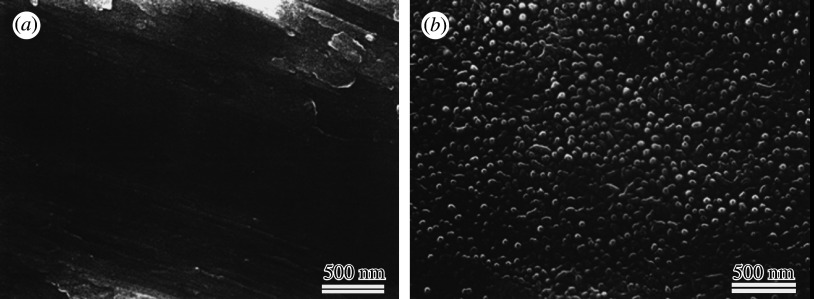
Scanning electron micrographs of surfaces of (a) Ti and (b) calcium-ion-implanted Ti after scraping off osteogenic cells in which these specimens were incubated for 14 days. The original surfaces of both Ti and calcium-ion-implanted Ti are the same as those shown in (a).
Figure 5
Figure 5
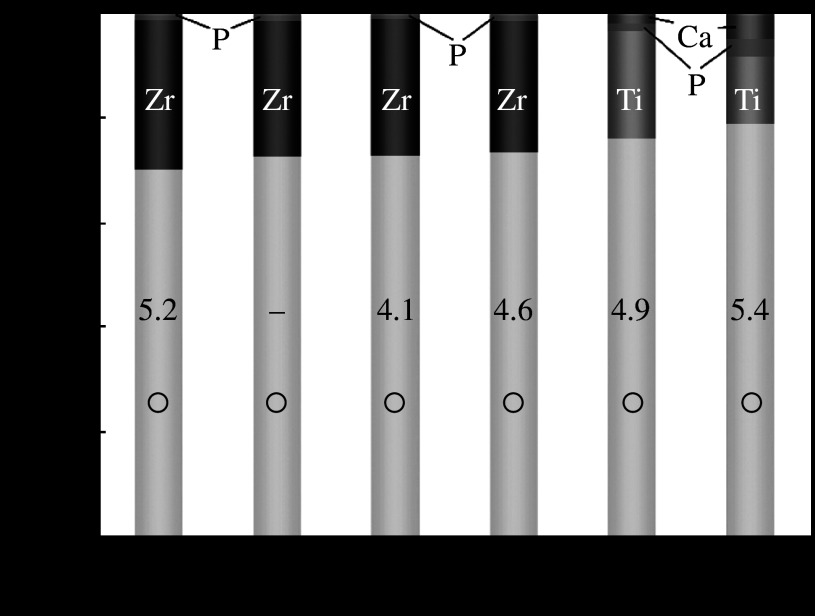
Relative concentration of elements detected from zirconium-coated Ti (Zr/Ti), zirconium (Zr) and Ti. Phosphorus was detected from all specimens, while calcium was not detected from Zr-coated Ti and Zr. Numbers in bars represent the thickness (in nm) of the surface oxide film containing calcium phosphate or zirconium phosphate on specimens.
Figure 6
Figure 6
Chemical structures of the (a) original PEG molecule. (b) PEG with one terminal terminated with amine and (c) PEG with both terminals terminated with amine. The amine bases dissociated and were positively charged in aqueous solution. (d) They were electrically attracted to the Ti surface with a cathodic charge. The PEG molecules were eventually immobilized.
Figure 7
Figure 7
Thickness of PEG layers deposited on Ti by electrodeposition and immersion as determined by ellipsometry.
Figure 8
Figure 8
Schematic model of PEG immobilized to a Ti surface with immersion and electrodeposition. More terminated amines combined with Ti oxide as ionic NH–O by electrodeposition, while more amines randomly existed as NH3+ in the PEG molecule by immersion. The difference in amine termination led to different bonding manners: U-shaped in B-PEG and brush-shaped in O-PEG.
Figure 9
Figure 9
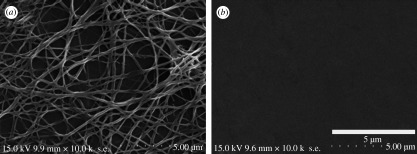
(a) Platelets adhered to the untreated Ti surface, and a fibrin network was formed on it. (b) Platelet adhesion was inhibited on the PEG-electrodeposited Ti surface. Human blood from a healthy volunteer was drawn into a syringe with 1 ml of 3.8% sodium citrate solution used as an anticoagulant at a ratio of nine parts blood to one part citrate. From freshly citrated blood was obtained 1×10⁵ platelets μl−1 plate-rich plasma (PRP). A 0.25 mol l−1 CaCl2 solution was added to the PRP. The untreated Ti and electrodeposited Ti, incubated at 310 K in advance, were immersed in PRP at 310 K for 5 min. Thereafter, they were rinsed with phosphate buffered saline, fixed with 2% glutaraldehyde, dehydrated and observed through a scanning electron microscope.
Figure 10
Figure 10
Bacteria (Streptococcus mutans MT8148) adhered to (a) an untreated Ti surface, while bacterial adhesion was inhibited on (b) a PEG-electrodeposited Ti surface.
Figure 11
Figure 11
Schematic model of the fractured region before and after the shear-bonding test in the case of (a) a thin γ-MPS layer and (b) a thick γ-MPS layer.
Figure 12
Figure 12
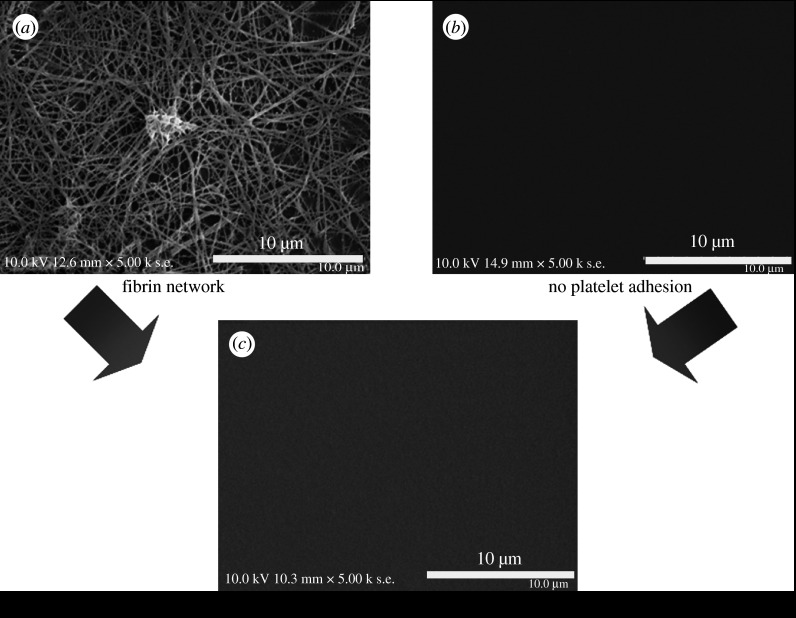
Platelets adhered to (a) the untreated Ti surface, and a fibrin network was formed on it. Platelet adhesion was inhibited on (b) SPU and (c) SPU-coated Ti surfaces. The platelet adhesion to Ti was inhibited by the coating of SPU.

References

    1. Ban S., Maruno S. Morphology and microstructure of electrochemically deposited calcium phosphates in a modified simulated body fluid. Biomaterials. 1998;19:1245–1253. doi: 10.1016/S0142-9612(98)00032-5. - DOI - PubMed
    1. Ban S., Maruno S., Arimoto N., Harada A., Hasegawa J. Effect of electrochemically deposited apatite coating on bonding of bone to the HA–G–Ti composite and Ti. J. Biomed. Mater. Res. 1997;36:9–15. doi: 10.1002/(SICI)1097-4636(199707)36:1<9::AID-JBM2>3.0.CO;2-P. - DOI - PubMed
    1. Hamada K., Kon M., Hanawa T., Yokoyama K., Miyamoto Y., Asaoka K. Hydrothermal modification of Ti surface in calcium solutions. Biomaterials. 2002;23:2265–2272. doi: 10.1016/S0142-9612(01)00361-1. - DOI - PubMed
    1. Hanawa T., Ota M. Calcium phosphate naturally formed on Ti in electrolyte solution. Biomaterials. 1991;12:767–774. doi: 10.1016/0142-9612(91)90028-9. - DOI - PubMed
    1. Hanawa T., Okuno O., Hamanaka H. Compositional change in surface of Ti–Zr alloys in artificial bioliquid. J. Jpn Inst. Met. 1992;56:1168–1173.