Extreme longevity is associated with increased serum thyrotropin
- PMID: 19158193
- PMCID: PMC2682478
- DOI: 10.1210/jc.2008-2325
Extreme longevity is associated with increased serum thyrotropin
Abstract
Context: The distribution of serum TSH shifts progressively to higher concentrations with age.
Objective: The aim of the study was to determine whether the population shift in TSH distribution to higher concentrations with aging extends to people of exceptional longevity, namely centenarians, and to assess the relationship between concentrations of TSH and free T(4) (FT4).
Design/setting/patients: We analyzed TSH, FT4, and TSH frequency distribution curves in thyroid disease-free Ashkenazi Jews with exceptional longevity (centenarians; median age, 98 yr), in younger Ashkenazi controls (median age, 72 yr), and in a population of thyroid disease-free individuals (median age, 68 yr) from the U.S. National Health and Nutrition Examination Survey 1998-2002 (NHANES controls).
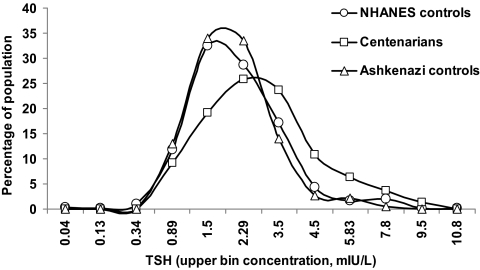
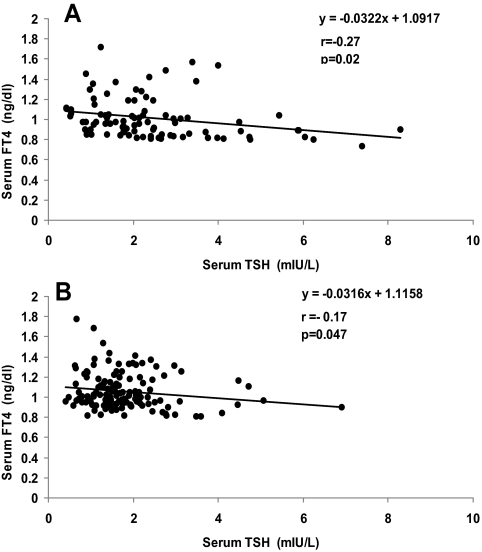
Results: Serum TSH was significantly higher in centenarians [1.97 (0.42-7.15) mIU/liter] than in Ashkenazi controls [1.55 (0.46-4.55) mIU/liter] and NHANES controls [1.61 (0.39-6.29) mIU/liter] (median, 2.5 and 97.5 centiles) (P < 0.001). The TSH frequency distribution curve of centenarians was relatively similar in shape to controls but shifted significantly to higher TSH, including TSH concentration at peak frequency. The TSH distribution curve of the NHANES control group was superimposable to and not significantly different from the Ashkenazi controls. FT4 was similar in centenarians and Ashkenazi controls, and there was a significant inverse correlation between FT4 and TSH in both groups.
Conclusions: The TSH population shifts to higher concentrations with age appear to be a continuum that extends even to people with exceptional longevity. The inverse correlation between TSH and FT4 in our populations suggests that changes in negative feedback may contribute to exceptional longevity.
Figures
References
-
- Hollowell JG, Staehling NW, Flanders WD, Hannon WH, Gunter EW, Spencer CA, Braverman LE 2002 Serum TSH, T(4), and thyroid antibodies in the United States population (1988 to 1994): National Health and Nutrition Examination Survey (NHANES III). J Clin Endocrinol Metab 87:489–499 - PubMed
-
- Gharib H, Tuttle RM, Baskin HJ, Fish LH, Singer PA, McDermott MT 2005 Consensus statement 1: subclinical thyroid dysfunction: a joint statement on management from the American Association of Clinical Endocrinologists, the American Thyroid Association, and The Endocrine Society. Thyroid 15:24–28; response, 32–33 - PubMed
-
- Surks MI, Ortiz E, Daniels GH, Sawin CT, Col NF, Cobin RH, Franklyn JA, Hershman JM, Burman KD, Denke MA, Gorman C, Cooper RS, Weissman NJ 2004 Subclinical thyroid disease: scientific review and guidelines for diagnosis and management. JAMA 291:228–238 - PubMed
-
- Biondi B, Cooper DS 2008 The clinical significance of subclinical thyroid dysfunction. Endocr Rev 29:76–131 - PubMed
Publication types
MeSH terms
Substances
Grants and funding
LinkOut - more resources
Full Text Sources
Molecular Biology Databases