


Depletion of Ly6G/Gr-1 leukocytes after spinal cord injury in mice alters wound healing and worsens neurological outcome
- PMID: 19158301
- PMCID: PMC6665178
- DOI: 10.1523/JNEUROSCI.4918-08.2009
Depletion of Ly6G/Gr-1 leukocytes after spinal cord injury in mice alters wound healing and worsens neurological outcome
Abstract
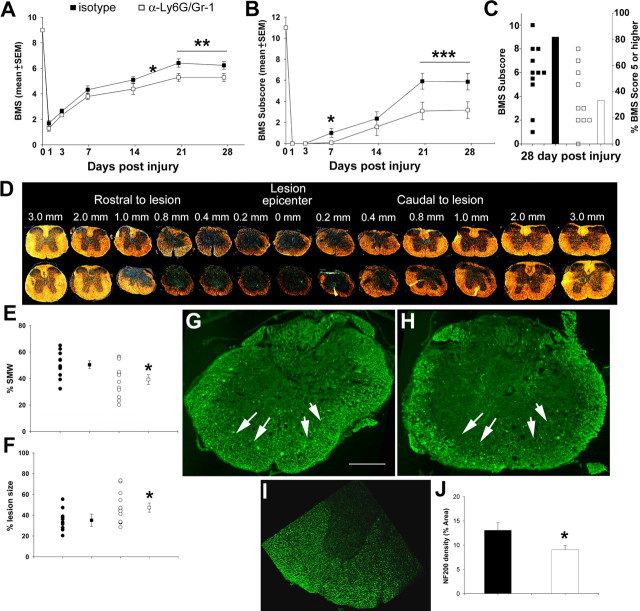
Spinal cord injury (SCI) induces a robust inflammatory response and the extravasation of leukocytes into the injured tissue. To further knowledge of the functions of neuroinflammation in SCI in mice, we depleted the early arriving neutrophils using an anti-Ly6G/Gr-1 antibody. Complete blood counts revealed that neutrophils increased approximately 3-fold over uninjured controls and peaked at 6-12 h after injury, and that anti-Ly6G/Gr-1 treatment reduced circulating neutrophils by >90% at these time points. Intravital and spinning disk confocal microscopy of the exposed posterior vein and postcapillary venules showed a significant reduction in rolling and adhering neutrophils in vivo after anti-Ly6G/Gr-1 treatment; this was accompanied by a parallel reduction in neutrophil numbers within the injured spinal cord at 24 and 48 h as determined by flow cytometry. The evolution of astrocyte reactivity, a wound healing response, was reduced in anti-Ly6G/Gr-1-treated mice, which also had less spared white matter and axonal preservation compared with isotype controls. These histological outcomes may be caused by alterations of growth factors and chemokines important in promoting wound healing. Importantly, anti-Ly6G/Gr-1 treatment worsened behavioral outcome as determined using the Basso Mouse Scale and subscores. Although the spectrum of cells affected by anti-Ly6G/Gr-1 antibody treatment cannot be fully ascertained at this point, the correspondence of neutrophil depletion and worsened recovery suggests that neutrophils promote recovery after SCI through wound healing and protective events that limit lesion propagation.
Figures


References
-
- Bao F, Chen Y, Dekaban GA, Weaver LC. Early anti-inflammatory treatment reduces lipid peroxidation and protein nitration after spinal cord injury in rats. J Neurochem. 2004;88:1335–1344. - PubMed
-
- Bartholdi D, Schwab ME. Methylprednisolone inhibits early inflammatory processes but not ischemic cell death after experimental spinal cord lesion in the rat. Brain Res. 1995;672:177–186. - PubMed
-
- Bartholdi D, Schwab ME. Expression of pro-inflammatory cytokine and chemokine mRNA upon experimental spinal cord injury in mouse: an in situ hybridization study. Eur J Neurosci. 1997;9:1422–1438. - PubMed
-
- Basso DM, Fisher LC, Anderson AJ, Jakeman LB, McTigue DM, Popovich PG. Basso Mouse Scale for locomotion detects differences in recovery after spinal cord injury in five common mouse strains. J Neurotrauma. 2006;23:635–659. - PubMed
-
- Carlson SL, Parrish ME, Springer JE, Doty K, Dossett L. Acute inflammatory response in spinal cord following impact injury. Exp Neurol. 1998;151:77–88. - PubMed
Publication types
MeSH terms
Substances
LinkOut - more resources
Full Text Sources
Other Literature Sources
Medical
