. 2009 Feb 17;48(6):1284-92.
doi: 10.1021/bi801766g.

Subunit structure of benzylsuccinate synthase

Affiliations

Subunit structure of benzylsuccinate synthase

Lei Li et al. Biochemistry. .

Abstract

Benzylsuccinate synthase is a member of the glycyl radical family of enzymes. It catalyzes the addition of toluene to fumarate to form benzylsuccinate as the first step in the anaerobic pathway of toluene fermentation. The enzyme comprises three subunits, alpha, beta, and gamma, that in Thauera aromatica strain T1 are encoded by the tutD, tutG, and tutF genes, respectively. The large alpha-subunit contains the essential glycine and cysteine residues that are conserved in all glycyl radical enzymes. However, the function of the small beta- and gamma-subunits has remained unclear. We have overexpressed all three subunits of benzylsuccinate synthase in Escherichia coli, both individually and in combination. Coexpression of the gamma-subunit (but not the beta-subunit) is essential for efficient expression of the alpha-subunit. The benzylsuccinate synthase complex lacking the glycyl radical could be purified as an alpha(2)beta(2)gamma(2) hexamer by nickel affinity chromatography through a "His(6)" affinity tag engineered onto the C-terminus of the alpha-subunit. Unexpectedly, BSS was found to contain two iron-sulfur clusters, one associated with the beta-subunit and the other with the gamma-subunit that appear to be necessary for the structural integrity of the complex. The spectroscopic properties of these clusters suggest that they are most likely [4Fe-4S] clusters. Removal of iron with chelating agents results in dissociation of the complex; similarly, a mutant gamma-subunit lacking the [4Fe-4S] cluster is unable to stabilize the alpha-subunit when the proteins are coexpressed.


Figures
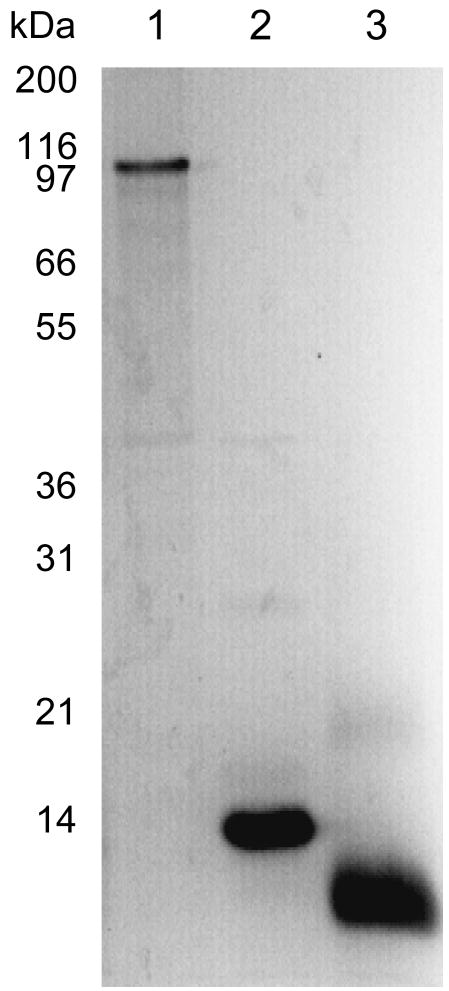
Figure 1
Figure 1
Over-expression and purification of individual BSS subunits. Lane 1: BSS-α, purified from inclusion bodies and refolded; lane 2: BSS-β, purified as soluble protein by Ni-NTA chromatography; lane 3: BSS-γ, purified as soluble protein by Ni-NTA chromatography.
Figure 2
Figure 2
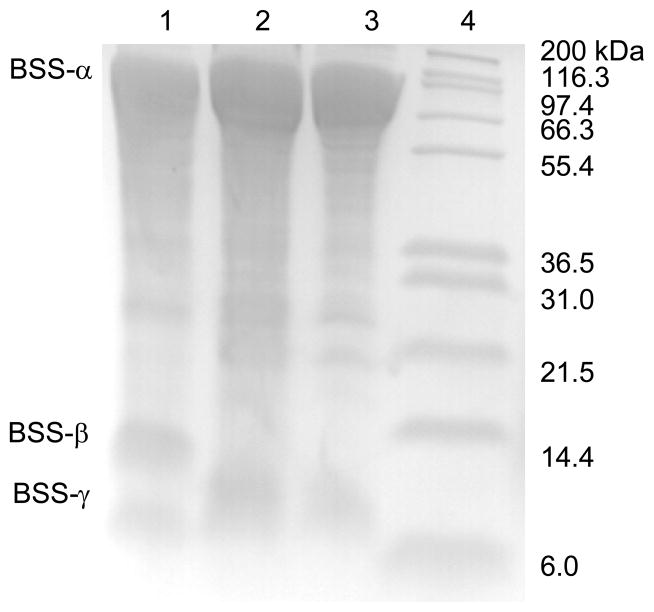
Over-expression and purification of BSS-αβγ and BSS-αγ complexes. Lane 1: BSS-α2β2γ2 complex, purified by Ni-NTA chromatography; lane 2: BSS-α2γ2, complex purified by Ni-NTA chromatography; lane 3: BSS-α2γ2, complex after gel filtration; lane 4: molecular weight standards. Note: the lanes have been heavily over-loaded so that the weakly staining β and γ subunits can be seen.
Figure 3
Figure 3
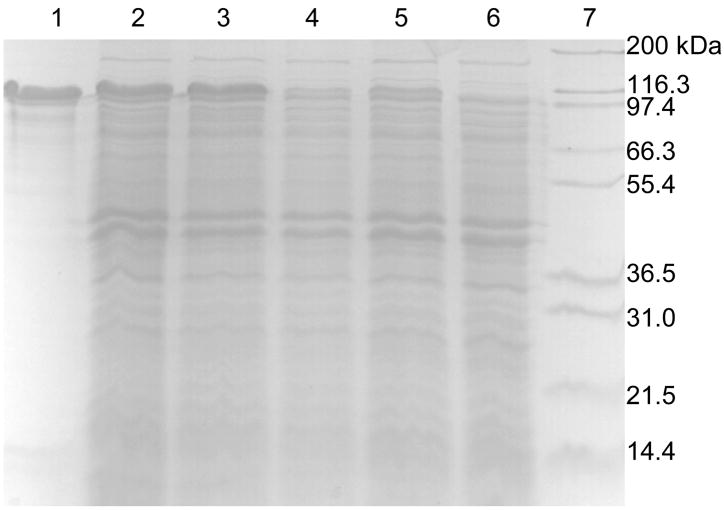
Effect of the BSS-β and BSS-γ proteins on the expression of BSS-α in E. coli. Lane 1: BSS-α standard; lane 2: co-expression of tutD, tutF and tutG genes (BSS-α strongly expressed); lane 3: co-expression of tutD and tutF genes (BSS-α strongly expressed); lane 4: co-expression of tutD and tutG genes (BSS-α weakly expressed); lane 5: expression of only tutD gene (BSS-α weakly expressed); lane 6: expression of only tutF gene (negative control for BSS-α expression); lane 7: molecular weight standards.
Figure 4
Figure 4
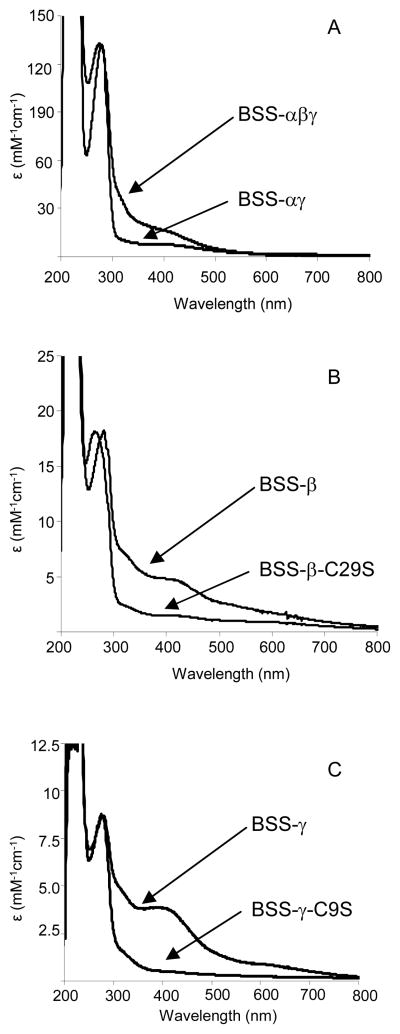
U.V.-visible spectra of BSS proteins. A: Spectra of the BSS-αβγ complex and the BSS-αγ complex as isolated from E. coli; B: Spectra of BSS-β protein and the BSS-β-C29S mutant after reconstitution of iron-sulfur clusters; C: Spectra of BSS-γ protein and the BSS-γ-C9S mutant after reconstitution of iron-sulfur clusters.
Figure 5
Figure 5
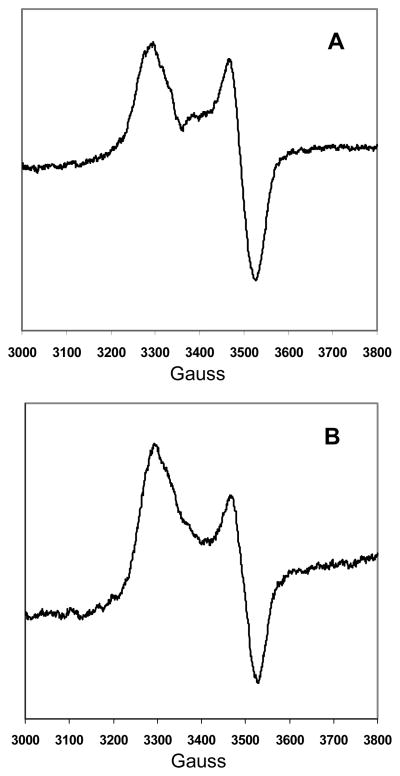
EPR spectra of sodium dithionite reduced BSS complexes as isolated from E. coli. A: Spectrum of the BSS-αβγ complex; B: Spectrum of the BSS-αγ complex
Figure 6
Figure 6
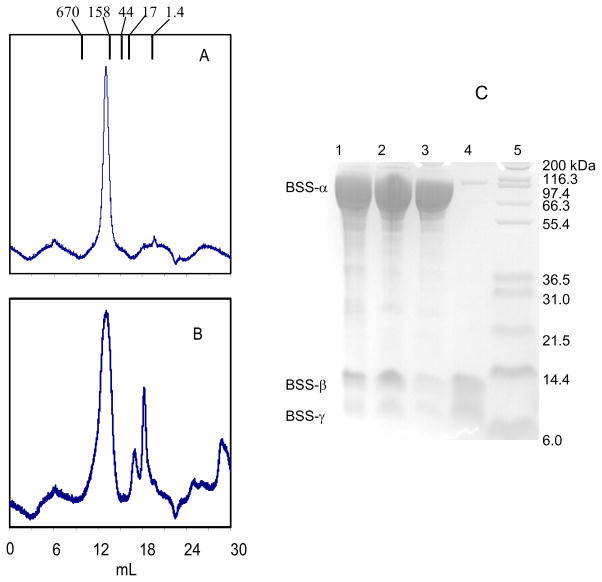
Dissociation of BSS upon treatment with iron chelators. A: Chromatography of BSS on Superose-6 gel filtration column. The intact BSS complex elutes with apparent Mr = 230000 (elution volumes of molecular weight standards are indicated above chromatogram). B: elution profile of BSS after treatment with iron chelator. The first peak contains primarily BSS- α; the second BSS-β and BSS-γ; the third peak contains no proteins and is probably chelating agent. C: analysis of column fractions by SDS-PAGE; lane 1: BSS purified by chromatography on Ni-NTA column; lane 2: BSS after gel filtration chromatography - material from peak in chromatograph A; lane 3: BSS after treatment with iron chelator and gel filtration chromatography - material from first peak (BSS-α) in chromatograph B; lane 4: BSS after treatment with iron chelator and gel filtration chromatography - material from second peak (BSS-β and γ) in chromatograph B. lane 5: molecular weight standards.
Figure 7
Figure 7
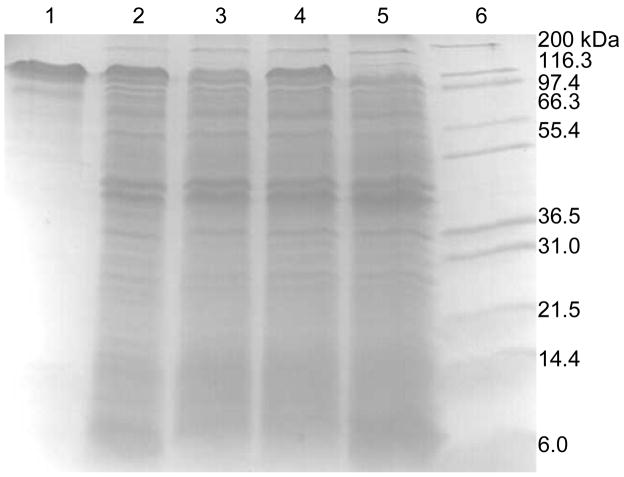
Effect of mutations that remove the iron-sulfur clusters in BSS-β and BSS-γ on expression of BSS-α in E. coli. Lane 1: BSS-α standard; lane 2: co-expression of tutD, tutF and tutG genes (BSS-α strongly expressed); lane 3: co-expression of tutD, tutG and tutF-C9S genes (BSS-α weakly expressed); lane 4: co-expression of tutD, tutF and tutG-C29S genes (BSS-α strongly expressed); lane 5: expression of only tutF gene (negative control for BSS-α expression); lane 6: molecular weight standards.
Figure 8
Figure 8
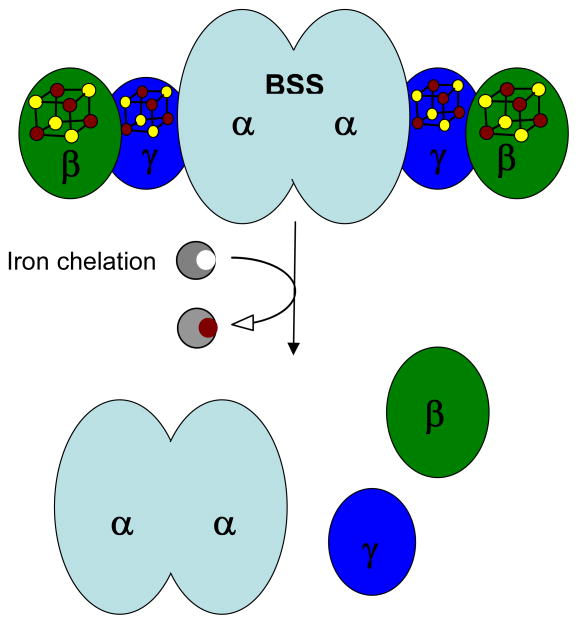
Structural model for BSS, illustrating the location of the [4Fe-4S] clusters and the proposed quaternary structure of the enzyme. Chelation of iron by OBP results in dissociation to the dimeric α subunit and monomeric β and γ subunits.
Scheme 1
Scheme 1
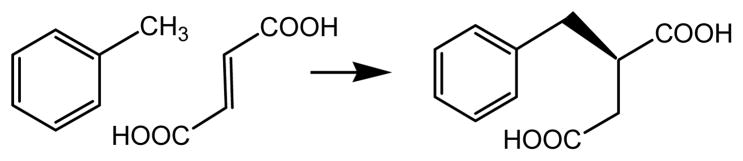
Reaction catalyzed by benzylsuccinate synthase

References

    1. Biegert T, Fuchs G, Heider F. Evidence that anaerobic oxidation of toluene in the denitrifying bacterium Thauera aromatica is initiated by formation of benzylsuccinate from toluene and fumarate. Eur J Biochem. 1996;238:661–668. - PubMed
    1. Rabus R, Heider J. Initial reactions of anaerobic metabolism of alkylbenzenes in denitrifying and sulfate reducing bacteria. Arch Microbiol. 1998;170:377–384.
    1. Spormann AM, Widdel F. Metabolism of alkylbenzenes, alkanes, and other hydrocarbons in anaerobic bacteria. Biodegradation. 2000;11:85–105. - PubMed
    1. Heider J, Spormann AM, Beller HR, Widdel F. Anaerobic bacterial metabolism of hydrocarbons. FEMS Microbiol Rev. 1998;22:459–473.
    1. Leuthner B, Heider J. A two-component system involved in regulation of anaerobic toluene metabolism in Thauera aromatica. FEMS Microbiol Lett. 1998;166:35–41. - PubMed

Publication types

MeSH terms

LinkOut - more resources