Review
. 2009 Mar;75(3):209-19.
doi: 10.1111/j.1399-0004.2008.01134.x. Epub 2009 Jan 20.

Noncoding RNAs in mental retardation

Affiliations
Review

Noncoding RNAs in mental retardation

K E Szulwach et al. Clin Genet. 2009 Mar.

Abstract

Recent genome-wide interrogations of transcribed RNA have yielded compelling evidence for pervasive and complex transcription throughout a large majority of the human genome. Tens of thousands of noncoding RNA transcripts have been identified, most of which have yet to be functionally characterized. Along with the revelation that noncoding RNAs in the human genome are surprisingly abundant, there has been a surge in molecular and genetic data showing important and diverse regulatory roles for noncoding RNA. In this report, we summarize the potential roles that noncoding RNAs may play in the molecular pathogenesis of different mental retardation disorders. We suspect that these findings are just the tip of the iceberg, with noncoding RNAs possibly being involved in disease pathogenesis at different levels and through multiple distinct mechanisms.


Figures
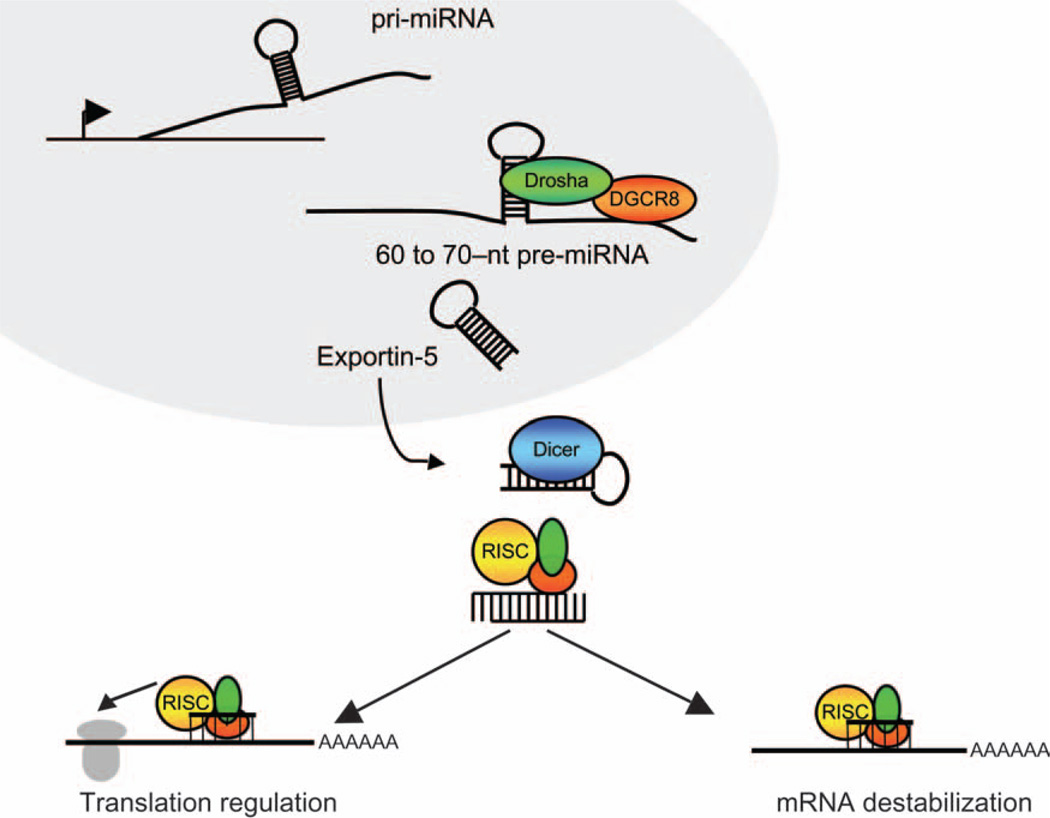
Fig. 1
Fig. 1
The miRNA pathway. Within the nucleus, pri-miRNA transcripts are generated by either Pol II or Pol III. The stem-loop structure of the pri-miRNA is recognized and cleaved by the microprocessor complex, including Drosha and its partner, DGCR8. The 60- to 70-nt pre-miRNA is then exported from the nucleus in a Ran-GTP-dependent manner and processed a second time in the cytosol by Dicer. Processing by Dicer is immediately followed by loading of a single-stranded 18- to 24-nt mature miRNA into RISC. The mature miRNA loaded into RISC is referred to as the guide strand as it is what will guide the RISC to a target mRNA in a sequence-specific manner. Once directed to a target mRNA, RISC can mediate translation by inhibiting the initiation or elongation step or through destabilization of the target mRNA. Alternatively, miRNAs may also upregulate translation of target mRNAs in quiescent cells through an AGO2/FXR1-related mechanism, as described in the text. mRNA, messenger RNA; miRNA, microRNA; pri-miRNA, primary miRNA transcripts; RISC, RNA-induced silencing complex.
Fig. 2
Fig. 2
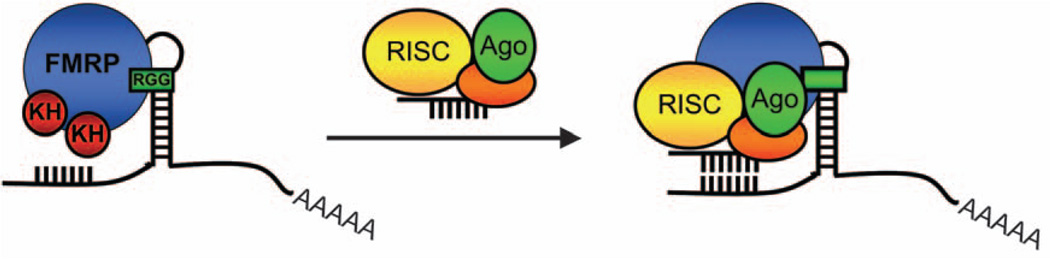
Translational regulation by fragile X mental retardation protein (FMRP) mediated through the miRNA pathway. FMRP binds target mRNAs through its two KH domains and single RGG box. RISC proteins, including Argonaute (Ago), may then interact with FMRP and use a loaded guide miRNA to interact with target sequences within the 3′-UTR of RNA bound to FMRP and suppress its translation. In this manner, the KH domains and RGG box of FMRP may help to initially bind target mRNAs, ensure proper targeting of guide miRNA-RISC within 3′-UTRs, and proper translational suppression. 3′-UTR, 3′ untranslated region; KH, K homology; mRNA, messenger RNA; miRNA, microRNA; RISC, RNA-induced silencing complex.
Fig. 3
Fig. 3
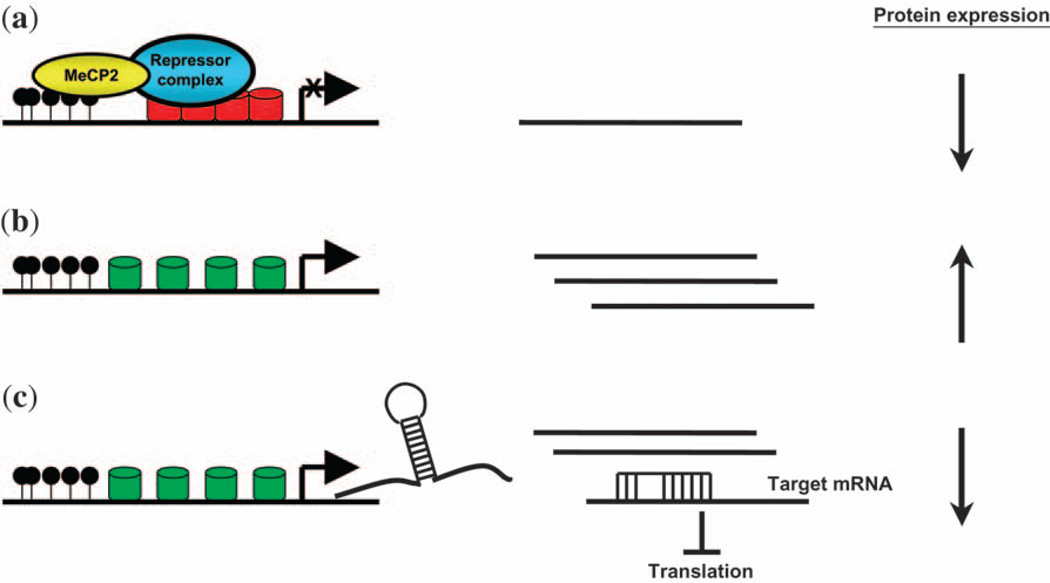
The differential effects of MeCP2-mediated transcriptional regulation of mRNA or miRNA on protein expression. (a) In this study, the example of MeCP2-mediated transcriptional repression is shown. Through interactions with methyl-CpG dinucleotides and repressor complexes, MeCP2 is able to associate with an open chromatin context. This ultimately results in the decreased protein expression due to reduced mRNA transcript level. (b) In the absence of functional MeCP2, as is the case in RTT patients, the chromatin to which MeCP2 is normally bound becomes more amenable to transcription, and the mRNA expression may be increased compared with the situation presented in (a). Ultimately, the end result is increased protein expression. (c) Nonetheless, if the target of MeCP2-mediated regulation is a miRNA, then downstream protein expression may be altered in the opposite direction. The absence of MeCP2 proximal to a miRNA results in increased expression of that miRNA. In the example shown, there is an increased translational suppression of mRNAs targeted by the miRNA that is overexpressed, causing a decrease in protein expression. Alternatively, in quiescent cells, such MeCP2-mediated epigenetic regulation of a miRNA may ultimately result in increased translation of the miRNA-targeted mRNA. mRNA, messenger RNA; miRNA, microRNA; RTT, Rett syndrome.
Fig. 4
Fig. 4
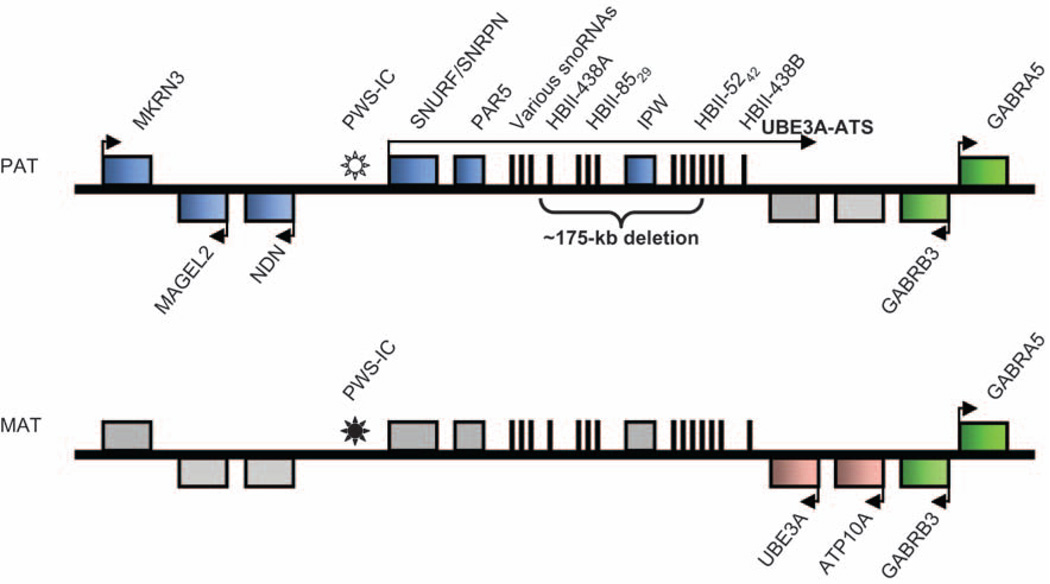
Genomic map of the human 15q11-q13 Prader–Willi syndrome/Angelman syndrome genomic region highlighting the allele-specific gene expression found in the brain. The paternally expressed genes (blue boxes) that encode proteins are MKRN3 (makorin, ring finger protein 3), MAGEL2 (MAGE-like protein 2), NDN (Necdin), and SNURF/SNRPN (bicistronic SNURF/small ribonucleoprotein N). Gray boxes indicate silenced alleles. Biallelically expressed genes (green boxes) that encode proteins are GABRB3 (γ-aminobutyric acid receptor β3) and GABRA5 (α5). UBE3A-antisense (UBE3A-ATS) is a noncoding paternally expressed transcript (>460 kb) that initiates within the SNURF/SNRPN gene. UBE3A-ATS is alternatively spliced to generate noncoding transcripts PAR5, IPW, various C/D small nucleolar RNAs (snoRNAs; HBII-13, HBII-436 and HBII-437), HBII-438A, HBII-85, HBII-52, and HBII-438B. There are 29 and 42 tandemly repeated copies of HBII-85 and HBII-52, respectively. The Prader–Willi imprinting center (PWS-IC) is unmethylated on the paternal allele (open sun) and methylated on the maternal allele (closed sun). The maternally expressed genes (pink boxes) are UBE3A (ubiquitin protein ligase E3A) and ATP10A (P-type adenosine triphosphatase). Arrows indicate the transcriptional direction. Each chromosome is depicted by a thick black line; genes shown on top of the line are transcribed from the opposite DNA strand from genes shown on the bottom of the line. The bracket indicates the approximate location of the recently identified ~175-kb deletion.

References

    1. Birney E, Stamatoyannopoulos JA, Dutta A, et al. Identification and analysis of functional elements in 1% of the human genome by the ENCODE pilot project. Nature. 2007;447:799–816. - PMC - PubMed
    1. Kapranov P, Cheng J, Dike S, et al. RNA maps reveal new RNA classes and a possible function for pervasive transcription. Science. 2007;316:1484–1488. - PubMed
    1. Crawford DC, Acuna JM, Sherman SL. FMR1 and the fragile X syndrome: human genome epidemiology review. Genet Med. 2001;3:359–371. - PMC - PubMed
    1. Siomi MC, Zhang Y, Siomi H, et al. Specific sequences in the fragile X syndrome protein FMR1 and the FXR proteins mediate their binding to 60S ribosomal subunits and the interactions among them. Mol Cell Biol. 1996;16:3825–3832. - PMC - PubMed
    1. Zhang Y, O’Connor JP, Siomi MC, et al. The fragile X mental retardation syndrome protein interacts with novel homologs FXR1 and FXR2. Embo J. 1995;14:5358–5366. - PMC - PubMed

Publication types

MeSH terms